Of the three Detroit manufacturers, only Ford has been a major player in the hybrid car game for several years now. The Ford Fusion Hybrid and Escape Hybrid were the two main-stay offerings from Ford until the company completely revamped its lineup in 2012 for the 2013 model year with all-new  hybrid offerings.

Ford dropped the Escape Hybrid when it introduced a completely redesigned model for the 2013 model year. More fuel efficient gas engines in the new Escape are able to achieve nearly the same level of economy as the outgoing hybrid model.

To replace the Escape Hybrid, Ford introduced the 2013 C-Max which is available only as a hybrid or plug-in hybrid known as the C-Max Energi. The C-Max, based on the outstanding Focus platform, has been sold in Europe in various forms for years – just not as a hybrid.

2013 Ford C-Max Hybrid SEL

2013 Ford C-Max Hybrid SEL

Ford reconfigured the C-Max for US sales by getting rid of its rear sliding doors in favor of conventional 4-doors. Ford marketing believed that sliding doors would automatically brand the C-Max with the Scarlet M (for minivan) and, in the States, the M-word is the kiss of death.

The compact interior of the 2013 C-Max will seat five - but that's two adults and three small children.

The compact interior of the 2013 C-Max will seat five – but that’s two adults and three small children.

The C-Max is as close as we are going to get to a Focus wagon and it’s the only direct competitor to the Toyota Prius V. It’s tall, like the Mazda5 compact minivan and you sit a bit higher and more upright than a normal car. The rear liftgate is large and the floor height is marginally higher than a comparable passenger car for easy loading. Lots of glass surrounds you so visibility is excellent and the large side mirrors are tipped with concave mirrors that provide an analog solution to blind spots.

2013 Ford C-Max Hybrid - Rear

2013 Ford C-Max Hybrid – Rear

My 6′ 1” frame fit into the driver’s seat, but there wasn’t much extra room. The standard manual tilt/telescoping helped make things comfortable. Rear seats are best for children or small adults as the cushions are short, with no thigh support and there’s a paucity of larger adult legroom. It should be fairly easy to strap in child seats as the tall doors and the C-Max’s diminutive size put belts and buckles in easy reach for weary parents.

The rear seats of the C-Max split 60/40 and fold flat. Not much leg room for adults, but it's pretty easy to reach in to grab the kids.

The rear seats of the C-Max split 60/40 and fold flat. Not much leg room for adults, but it’s pretty easy to reach in to grab the kids.

The flat-folding rear seats split 60/40 to open up 52.6 square feet of cargo space. Perfect for a Costco run or a couple large dogs. It would be nice if the rear windows rolled all the way down, but I’m not sure the rear occupants would care.
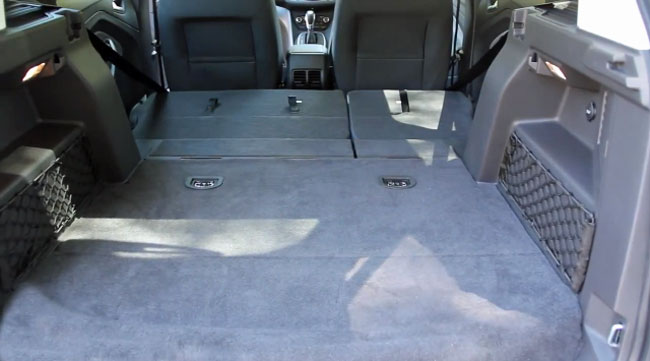
Plenty of cargo space in the back of the Ford C-Max with the rear seats folded down.

Plenty of cargo space in the back of the Ford C-Max with the rear seats folded down.

MyFord Touch is Ford’s much maligned infotainment system that is the number one cause of customers’ dissatisfaction with Ford vehicles in recent in JD Power & Associates surveys. Consumer Reports slammed Ford both before and after a major software update to the system. I’m a fairly tech-savvy guy, so I have mixed feelings about it.

The 8 inch color display on the C-Max is set high – too high, in my opinion – in the center stack. It’s deeply inset (as opposed to flush) in the dash and there is a table ledge of hard button controls in front of the screen.
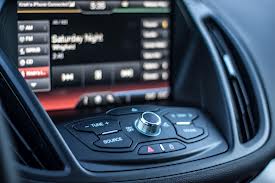
The 8 inch touch screen of MyFord Touch is deeply inset into the dash. Note the hard shortcut buttons and volume control in front of the screen.

The 8 inch touch screen of MyFord Touch is deeply inset into the dash. Note the hard shortcut buttons and volume control in front of the screen.

I think that you’d get used to it with some time; but the on-screen fonts are too small and delicate and each of the four major function – telephone, information (including navigation), radio and climate are brought up only by touching a slim bar that is either in the top or bottom of each assigned quadrant.

Because of the placement of the screen, when your hand reaches for one of those functions, your hand partially blocks your view of the screen, so you’re mostly poking around blind. It’s also hard to see the hard-button controls that are on the ledge in front of the screen. There are some redundant “hard” controls for things like volume or climate control; but selecting a preset radio station can be difficult with bumpy streets and the slim on-screen touch controls. At least the touch response is fast.
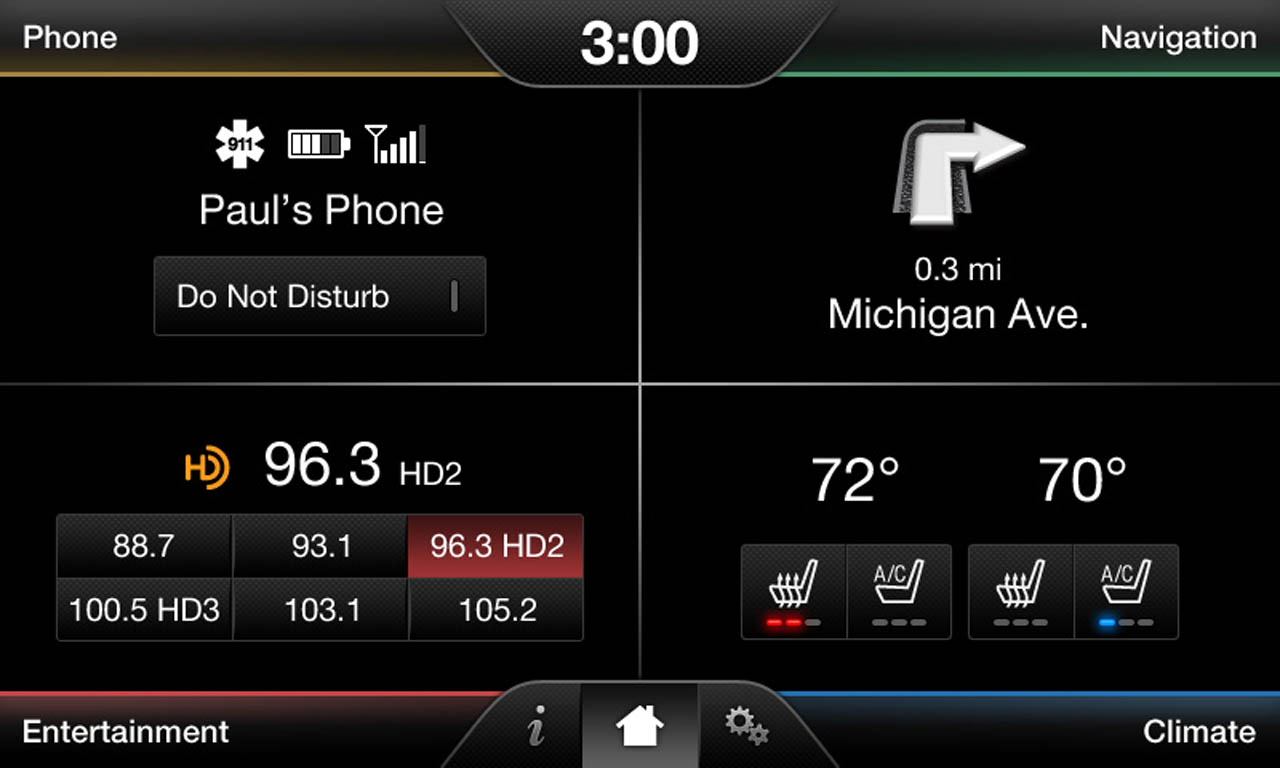
The four quadrants of MyFord Touch. To bring any area up to full screen, you tap on the slim area at the top or bottom corners.

The four quadrants of MyFord Touch. To bring any area up to full screen, you tap on the slim area at the top or bottom corners.

Power for the C-Max comes from a 2.0L Atkinson-cycle I-4 hybrid engine channeled through an electronically controlled Continuously Variable Transmission (CVT). The gas engine is good for 141 hp and 129 lb-ft of torque. Together with the permanent magnet AC synchronous electric motor, the system is good for 188 hp with a top speed (not that you’ll ever get there in this car) of 115 mpg. Ford says the C-Max can go up to 62 mph in electric-only mode, but it’s nearly impossible to do without being on a closed track with nearly zero gravity on your left foot. The statistic is useless in normal driving.

The C-Max’s electric motor is powered by a compact 1.4 kWh lithium-ion battery and, like the Prius, regenerative brakes feed the battery when you brake and the gas engine runs a generator to keep the battery charged. The battery doesn’t suck up any cargo space. Nifty graphics in the instrument panel show you how “green” you’re driving and which direction the electrons are flowing.
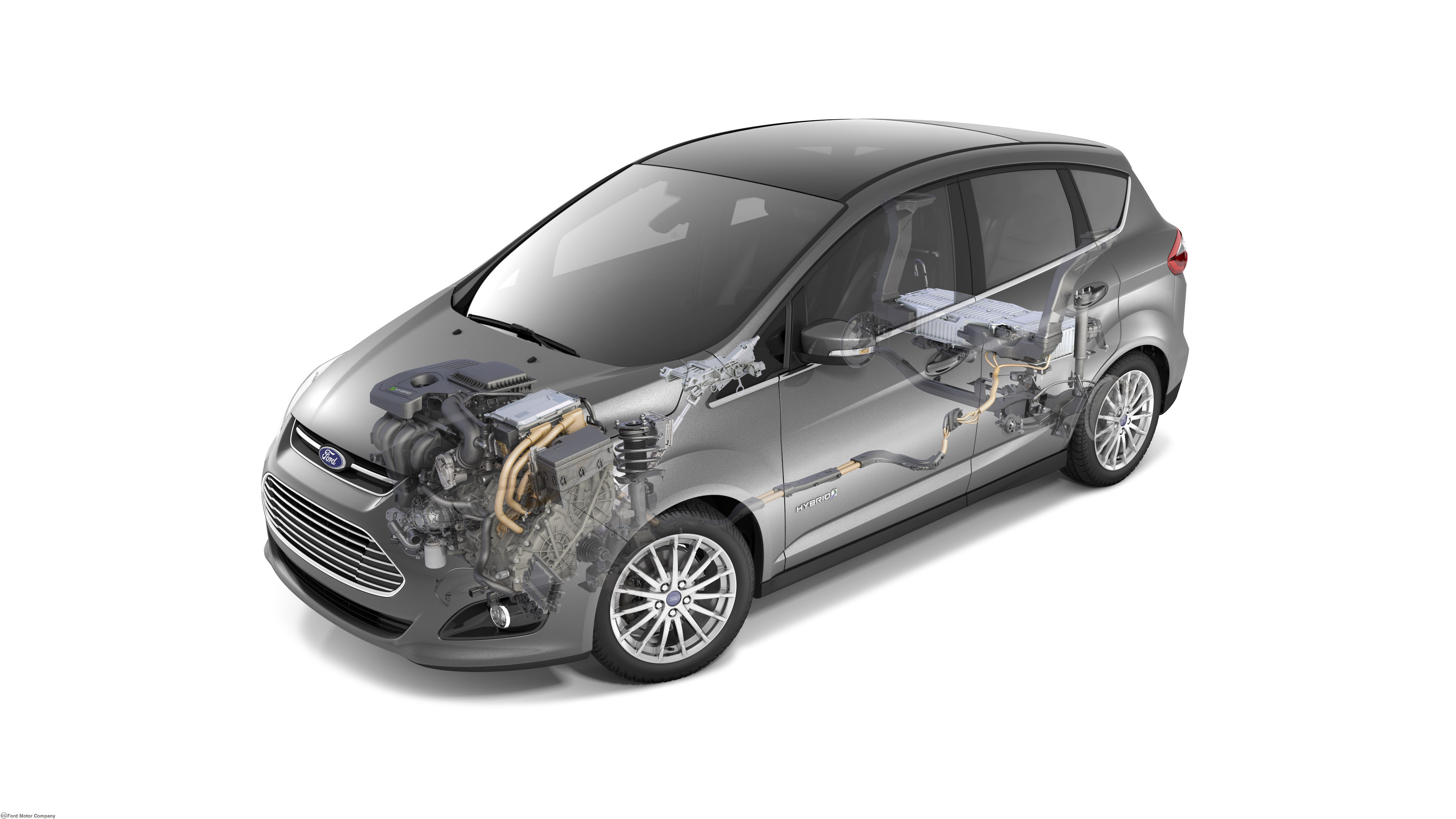
A cutaway of the 2013 Ford C-Max Hybrid.

A cutaway of the 2013 Ford C-Max Hybrid.

Speaking of the Prius, I think Ford engineers have jumped over Toyota’s flagship hybrid when it comes to smoothness of operation. Most of the time, it’s hard to notice when the gas engine goes on and off. You don’t feel the shakes and vibrations associated with the Prius. Even Ford’s CVT lacks a distinctive whine unless it’s pushed hard. The regenerative brakes don’t have that touchy-grabby hybrid feel either. In short, the driving experience is utterly normal except for the odd silence when the car is started and when it’s drifting in EV mode.

The cockpit of the 2013 Ford C-Max Hybrid. It bears more than a passing resemblance to the Ford Focus, which serves as the basis for the C-Max.

The cockpit of the 2013 Ford C-Max Hybrid. It bears more than a passing resemblance to the Ford Focus, which serves as the basis for the C-Max.

I like the compact size, ease of operation and visibility of the C-Max for daily city driving. The electric power steering had decent feedback – shocking, really, when compared to the electric rubber band attached to the Prius. While the C-Max will never be a NASCAR pace car, it scoots up to city speeds easily and without fuss, never feeling underpowered. I think it would need a bit more time to come to highway speed. Its turning radius was good and parking was easy. The C-Max was also relatively quiet for a small car.

Ergonomics are very good and the plastics and switchgear is on par with the excellent Focus. I’m not sure how much I’d like it on highway trips where road noise and the short wheelbase might make for a noisy and choppy ride.

While the C-Max may not be the sexiest car in the parking lot, it is fresh and modern.

While the C-Max may not be the sexiest car in the parking lot, it is fresh and modern.

The C-Max’s stated EPA fuel economy is impressive – 47 mpg city, highway and combined , besting the Prius V’s 42 mpg combined. However, several media sources, including Consumer Reports, has called out Ford, challenging those figures for the 2013 C-Max.

The C-Max I drove showed an average 28 mpg – but you expect lower figures in a tester. CR states that the C-Max achieved overall fuel economy of 37 mpg during its tests. By comparison, the Prius V achieved 41 mpg in CR’s test cycle – just 1 mpg shy of its EPA rating. So while the C-Max bests the Prius V in the EPA number game, in the real world, the Prius V bests the C-Max by 4 mpg. If you buy a C-Max, I recommend lowered expectations when it comes to fuel economy.

The 2013 C-Max Hybrid SE starts at $25,995 and a fully-loaded SEL can easily grow to $33,500 with niceties like leather-trimmed seats, navigation, an upgraded infotainment system and MyFord Touch, hands-free park assist, hands-free liftgate, rearview camera, parking sensors and a panoramic fixed glass roof. The Prius V can get pricey too, starting at $27,445 and rising all the way to $37,535.

While the C-Max Hybrid wouldn’t fit my driving needs, I believe it is a sweet little tall wagon that drives well (like its cousin, the Ford Focus) and offers lots of grown up features for a reasonable price. I wouldn’t call it stylish, but it is a fresh face in the hybrid market – particularly in Prius-happy L.A. The C-Max will appeal both to Eco-conscious buyers as well as people just looking for good fuel economy in a tidy, versatile package.Ford C-Max badge


Car sales are always a good barometer of the economy, and if that’s true, the outlook or at least the anticipated outlook for 2013 is good. According to the California New Car Dealers Association (CNCDA), new vehicle sales for 2012 were up 25.3% over 2011, exceeding a whopping 1.6 million units (including fleet sales).  Compare that to a nationwide increase of 13.4%.  Go California!

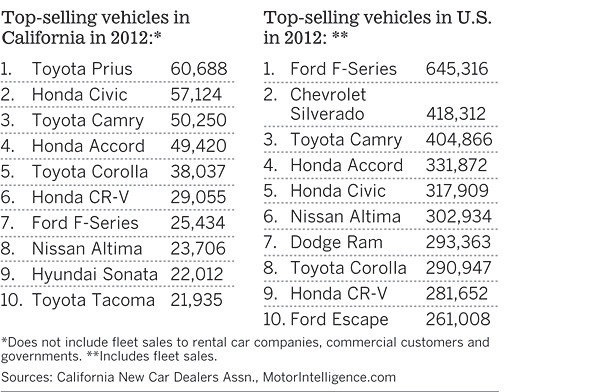
A couple weeks ago, headlines around the country trumpeted (or jeered, depending on your perspective), that the Toyota Prius was the number one selling vehicle in California in 2012.  How many? An impressive 60,688 – more than the entire population of Cheyenne, Wyoming.  You could practically feel the derision and scorn aimed at California from “real Americans” who only buy big pickup trucks and SUVs. Those damn socialist, communist, tree huggers, over-zealous environmentalists and car-haters in California.  How dare you choose a Japanese-made hybrid over an American pickup truck!

2013 Toyota Prius in the top trim level - Five.

2013 Toyota Prius in the top trim level – Five.

I think the Prius’ crown makes sense and here’s why: Gas is expensive in California – more than most of the rest of the country – and the Prius delivers the best fuel economy for the dollar.  For the vast majority of buyers, whether they admit it or not, it’s a pocketbook issue. Aside from economics, you can pretend to (or actually) care about the environment and brag about how little you spend on gas.  It’s also a class-less car.  You will see people of all socioeconomic levels driving a Prius — from a wealthy Hollywood star to one of the below-the-line staffers on a television show.

The 2013 Toyota Prius v ("v" for versatility) has more cargo capacity and a wagon-like tailgate.

The 2013 Toyota Prius v (“v” for versatility) has more cargo capacity and a wagon-like tailgate.

The whole Prius ethos is wrapped up into a simple, right-sized, easy to drive transportation appliance that people love. We have one in our family and it functions exactly as advertised. It is very reliable and requires almost no driving skill to glide through daily activities and gets a relatively consistent 40 mpg (never the 50 mpg claimed).

Top-Selling Vehicles in California versus Top-Selling Vehicles in the U.S. for 2012 (source:CNCDA)

However, for us in Los Angeles and the other large metropolitan areas that dot the beautiful coast of California, this isn’t surprising. You can’t throw a stone in any direction without hitting one.  And in 2012, the Prius family grew to three models: The standard Prius hatchback, the compact, Yaris-based Prius-C and the larger Prius-V wagon.  We are used to the creepy “silence” a Prius makes as it rolls along before the gas engine kicks:  There is that vague electric hum (like you hear from a transformer) and the subdued road noise from the low-rolling resistance tires as if someone was pushing a stalled car.

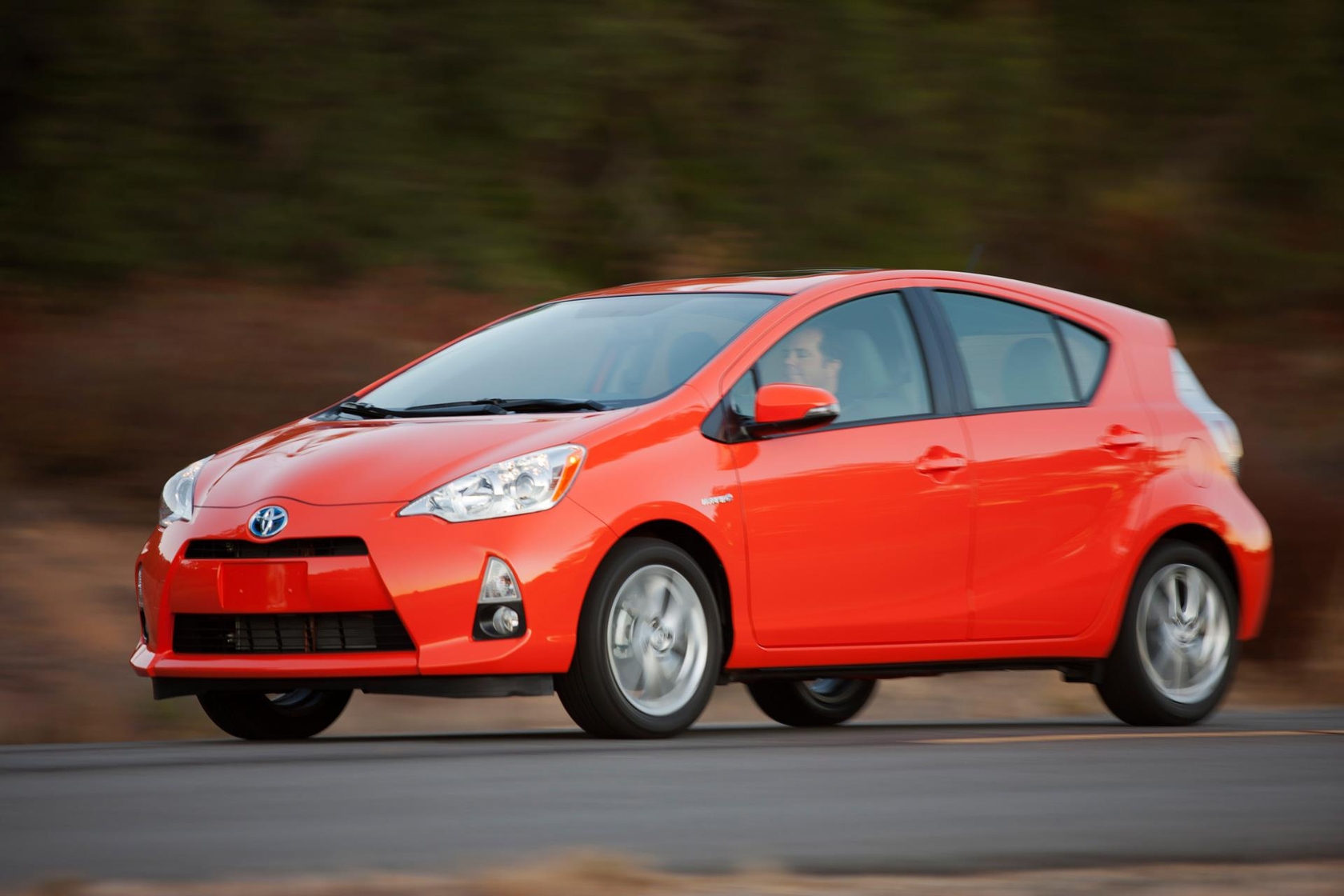
The Prius c ("c" for compact) was introduced in the first quarter of 2012 and was an instant hit from the beginning, despite tepid reviews. It's based on the humble Yaris.

The Prius c (“c” for compact) was introduced in the first quarter of 2012 and was an instant hit from the beginning, despite tepid reviews. It’s based on the humble Yaris.

This isn’t to say that our former favorite car, the Honda Civic, didn’t do very well, despite being dropped from Consumer Report’s “Recommend List” for the first time in memory and receiving near-universal scorn from the automotive press. When I drove the 2012 Honda Civic in 2011, I piled on the poor Civic calling it a second-rate, noisy econobox.  But as you can see by the graphic above, Honda Loyalists didn’t abandon their favorite car and still bought 57,124 units.

Honda execs, horrified by the merciless criticism, rushed a heavily-revised 2013 Civic to market in 18 months. I predict it will be a close race between the Prius and Civic in 2013.

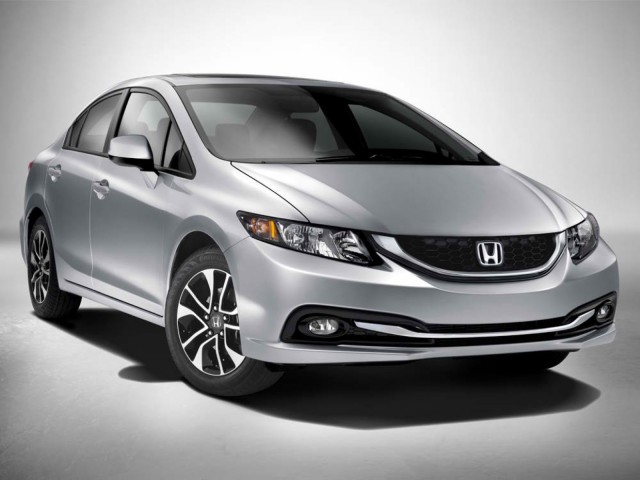
The heavily revised 2013 Honda Civic is sure to outsell the 2012 in 2013.

The heavily revised 2013 Honda Civic is sure to outsell the 2012 in 2013.

Apparently we also like cars better than trucks. In California, in 2012,  passenger cars accounted for 62.9% of sales; SUVs 24.3% and pickups and vans, 12.7%.  Compared to the entire country where passenger cars accounted for only 51.6% of total sales.

In 2012, hybrid registrations were 98,154 (a 7.4% of the market) and 2996 electric cars were registered (0.2% of the market) mostly Nissan Leafs, with a few Teslas thrown in.  The Tesla Model S is growing in popularity.  Just yesterday, on my short drive home from the gym, two of them passed me.  And last week in Venice, I saw a brand new Model S parked on (appropriately) Abbot Kinney.

The very sexy and very fast 2013 Tesla Model S

The very sexy and very fast 2013 Tesla Model S

Toyota and Honda still dominate our market. Below is how the various manufacturers divvy up the highly-lucrative California market:

  • Toyota (including Scion and Lexus) grabbed the lion’s share at 21.1%
  • Honda (including Acura) 12.5%
  • Ford (including Lincoln), 11.3%
  • GM (Chevrolet, GMC, Buick and Cadillac), 11.2%
  • Nissan (including Infiniti), 8.3%
  • Hyundai/Kia 8.3%
  • Chrysler (Chrysler, Dodge, Jeep, Ram, SRT and Fiat) 5.5%
  • VW (Volkswagen, Audi, Porsche. Bentley, Lamborghini and Bugatti) 5.5%
  • BMW (Including MINI and Rolls-Royce) 4.5%
  • Mercedes-Benz (including smart and Sprinter light trucks) 4.1%
  • Other 6.7%

The rising star in California is Hyundai’s twin, Kia, with sales up a whopping 53.3% in 2012.  And a  little car company whose sales are part of the “other” rounding category, Subaru, had a stellar year with sales up 44.2%.  Volkswagen, in its march to conquer the world, saw its California sales increase 37.9%.

Broken down by region, in 2012, L.A. and Orange Counties accounted for 522,256 (approximately 40%) of the total 1,310,720 (retail, excluding fleet) new car registrations.  Southern California (including Riverside, Ventura, Santa Barbara and San Diego counties) accounted for 67% or two thirds of all registrations. That makes sense given the vast freeway systems, long distances and lack of good public transportation.

California top-selling vehicles, by segment were:

Entry Level: Nissan Versa, Kia Soul, Honda Fit, Fiat 500, Ford Fiesta

Subcompact: Toyota Prius, Honda Civic, Toyota Corolla/Matrix, VW Jetta, Hyundai Elantra

Sporty Compact: Chevrolet Camaro, Ford Mustang, Dodge Challenger, Scion tC, Hyundai Veloster

I don't quite think of the 2013 Chevrolet Camaro (in ZL1 Convertible trim in this picture) as a "compact" sports car... But that's how it's categorized.

I don’t quite think of the 2013 Chevrolet Camaro (in ZL1 Convertible trim in this picture) as a “compact” sports car… But that’s how it’s categorized.

Standard Mid Size: Toyota Camry, Honda Accord, Nissan Altima, Hyundai Sonata, Kia Optima

Large Mid Size: Dodge Charger, Chrysler 300, Nissan Maxima, Buick LaCrosse, Toyota Avalon

Near Luxury: BMW 3-Series, Mercedes C-Class, Infiniti G, Lexus ES, Lexus IS

Luxury: Mercedes E-Class, BMW 5-series, Lexus GS, Audi A5, Audi A6California Auto Outlook Q4 2012 2014 Mercedes Benz E-class sedan

Sports Car: Porsche 911, Nissan 370Z, Chevrolet Corvette, Mazda MX-5 Miata, BMW Z4

Compact Pickup: Toyota Tacoma, Nissan Frontier, Ford Ranger, Chevrolet Colorado, Honda Ridgeline

Full Size Pickup: Ford F-Series, Chevrolet Silverado, Ram, Toyota Tundra, GMC Sierra

The Ford F-150 pickup truck and all its derivatives has been the best-selling vehicle in the US for more than 20 years.  This model is the SVT Raptor, an expensive performance upgrade to the standard F-150.

The Ford F-150 pickup truck and all its derivatives have been the best-selling vehicle in the US for more than 20 years. This model is the SVT Raptor, an expensive performance upgrade to the standard F-150.

Minivan: Toyota Sienna, Honda Odyssey, Dodge Caravan, Nissan Quest, Mazda5

Full Size Van: Ford E-Series, Ford Transit Connect, Chevrolet Express, Sprinter, Nissan NV

Compact SUV: Honda CR-V, Toyota RAV4, Ford Escape, Nissan Rouge, Jeep Wrangler

Always a big seller and favorite in both California and in the whole US, the Honda CR-V seems to hit the sweet spot of the compact SUV market.

Always a big seller and favorite in both California and in the whole US, the Honda CR-V seems to hit the sweet spot of the compact SUV market.

Mid Size SUV: Toyota Highlander, Honda Pilot, Ford Edge, Jeep Grand Cherokee, Kia Sorento

Full Size SUV: Ford Explorer, GMC Acadia, Ford Flex, Chevrolet Tahoe, Chevrolet Traverse

Luxury SUV: Lexus RX, BMW X5, Mercedes M-Class, Acura MDX, Mercedes GLK

The Lexus RX350 is forever popular in Los Angeles. This one is the F-Sport model with some subtle changes to the grille and body cladding.

The Lexus RX350 is forever popular in Los Angeles. This one is the F-Sport model with some subtle changes to the grille and body cladding.

You can download the full California Auto Outlook, Fourth Quarter publication here.