If you’re like me, you’ve been following the rapid ascent of the Tesla Model S in the Los Angeles market. On my daily commutes and errands, I’m sure to see at least one, and sometimes several Teslas slinking through traffic with those sexy reverse-angled signature LED daytime running lights.
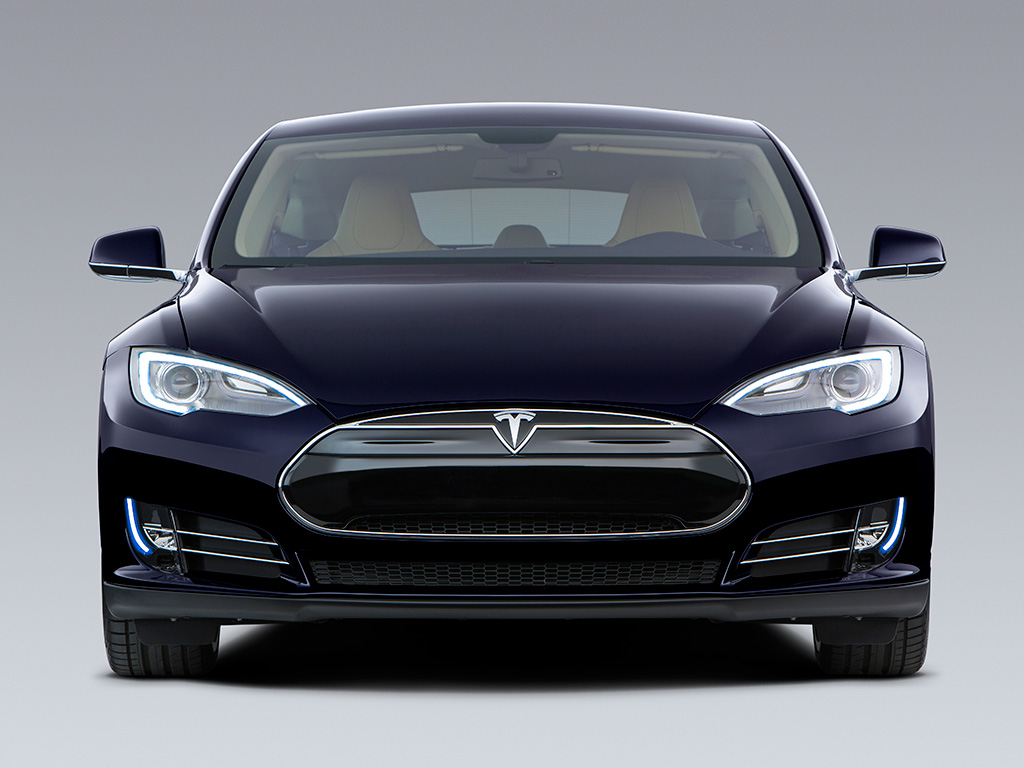
The 2013 Tesla Model S in Blue. Tesla likes to keep the color names simple: Black, White, Silver, Green, Blue, Grey and Brown.
More than any other alternative fuel vehicle, the Tesla is the first all-electric car that has real-world appeal to me. I drive to Palm Springs most weekends and I need cargo space for our family which includes two demanding dachshunds who travel in luxury crates.

The rear of the Model S is beautifully-balanced, understated and elegant.
The Tesla Model S, with its large battery pack sandwiched under the floor of the car, achieves a real-world 200+ mile driving range. The base 60 kWh battery pack carries a 208 mile EPA Certified Driving Range while the more popular 85 kWh pack option has a Certified Range of 265 miles.
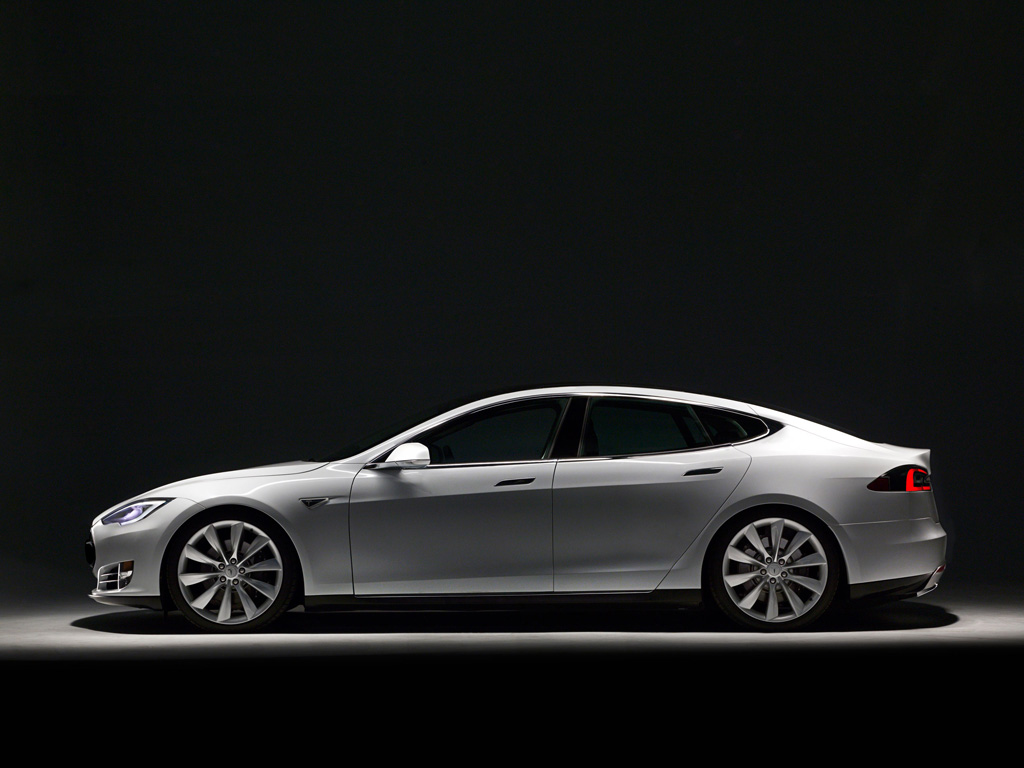
The 4-door coupe styling is familiar from rivals like the Mercedes CLS and Audi A7. I like the frameless windows.
With electrons to burn, you can zip to San Diego, Santa Barbara, Lake Arrowhead, Big Bear or Palm Springs without any range anxiety. Sure, go ahead, burn extra electrons with the AC blasting, Google Maps navigating and wireless devices charging. As long as you can plug the Model S in somewhere at your destination, you should have no trouble driving around for the weekend and returning home in complete zero-emission bliss.
Here’s a rundown of the other pure electric vehicles on the market and their EPA certified driving range.
- Chevrolet Spark EV – 82 miles
- Honda Fit EV – 82 miles
- Fiat 500e – 87 miles
- Ford Focus Electric – 76 miles
- Nissan Leaf – 75 miles
- Mitsubishi i-MiEV – 62 miles
- Toyota RAV4 EV – 103 miles
None of them could make a 120 mile trip to Palm Springs (or any other So Cal destination city) and, with the exception of the $50,000 Toyota RAV4, they are all too small for my needs.
Charging a Tesla is much faster than you’d think. Using a 240 volt charger, the battery replenishes at the rate of 31 miles per hour. Opt for the Tesla Twin Charger (installed in the car itself) and using the same 240 volt hookup, the battery absorbs enough electrons for 62 mile in one hour. Essentially, a nearly depleted 85 kWh battery can be fully charged in only 4 hours. That’s damn fast for such a large, powerful battery.

The rear doors are slim and attractive. The windows are frameless. Although it was a bit of a squeeze to get in due to the heavily-raked roof line, there was plenty of room due to the flat floors and lack of a transmission tunnel.
Around town, there are very few people who drive more than 200 miles a day. For most people, a 200+ mile range on one charge would be sufficient for 3-5 days of ordinary commuting. And if you can afford a Model S, it’s highly likely that you have a home and/or parking accommodations convenient enough for your own home charging station.
What cars compete with the Tesla Model S? It’s a stylish, luxury, 4-door sports “coupe” design, similar in size to and highly competitive with the Audi A7/S7, the BMW 6-series Gran Coupé, Mercedes-Benz CLS and the Porsche Panamera.
| Tesla Model S | $69,900 -$94,900 (before federal tax credit of $7,500 and any state credits) |
| Audi A7/S7 | $60,100 – $78,800 |
| BMW 6-series Gran Coupé | $77,600 – $91,400 |
| Mercedes-Benz CLS-Class | $72,100 – $107,425 |
| Porsche Panamera | $78,600 – $161,100 |
Why would I want to be a pioneer, an early adopter of this new breed of electric vehicle? Why would I give up on my life-long love affair with the internal combustion engine (ICE)?

The Model S in Red. The daytime running lights are very distinctive. Of course, LED DRLs are nearly mandatory on any new luxury vehicle, thanks to manufacturers like Audi and Mercedes-Benz.
I’ll try to answer the question with another one. I used to own a BlackBerry “smartphone” with a physical keyboard. When Apple introduced the first generation iPhone, I said that “no one would choose that horrible touchscreen over this great physical keyboard,” despite the BlackBerry being such a comparably clunky design.

The instrument panel is a large, horizontal thin film transistor (TFT) full-color display. Lovely stuff. The gear shift and steering wheel control stalks, as well as the switchgear come from Tesla investor Mercedes-Benz. One thing you won’t find in the Model S is a “start” button. The car knows the key is present and it’s ready to go as soon as you sit down in the driver’s seat.
Today, the answer to that question is self-evident. Touchscreens are far and above the preferred keyboard. But at the time of the iPhone’s introduction, touchscreens were small and not responsive and people weren’t used to them. That is why a hybrid phone made sense until touchscreen technology became so good that a physical keyboard was useless dead weight. The exception at the time, of course, was the iPhone, which worked well as a pure touchscreen.

The interior of the Model S is a study in simplicity. The instrument panel is a large TFT video display and the gargantuan 17 inch center console tablet controls almost all the functions without physical knobs. Usually I like physical knobs, but in the Tesla, it’s iPad-like touchscreen interface proves it can be done and done well.
The Tesla Model S is like the iPhone of the car world. While it’s not perfect in its initial offering — the original iPhone had trouble with email and was too slow to be a useful computing device; likewise, the Model S is inferior to ICE cars for long trips.

Nice details: The door handles are nestle flush into the body for better aerodynamics. When the driver approaches the door, the car senses the key and the handles extend automatically. Slick touch and it worked perfectly for me.
The iPhone committed so completely to touchscreen tech that it was able to make something functionally superior to old phone designs, thus proving the future of phone design has arrived. Similarly, the Model S committed so completely to EV tech that it was able to make what Motor Trend, Automobile Magazine, Consumer Reports, and many others have declared is the best car ever made — despite its current limitations on long road trips.
Here are some concrete examples of how Tesla’s commitment to a pure EV allows it to make a car better than anything else on the road:
Design
A lack of ICE components allows a clean slate and every opportunity to take advantage of a singularly electric car. Many find the Model S to be beautiful; the designers were freed from the constraints of the need for air intakes, radiator, exhaust and other “complications” associated with ICE and/or hybrid technology.
Safety
Not having an engine, transmission, gas tank, exhaust system, and countless other drivetrain components allowed Tesla to put crumple zones and reinforcement bars in ideal places, often where an engine component would have been. The result is that the Tesla is one of the safest car on the road, at one point a testing machine was broken by the car!
Interior
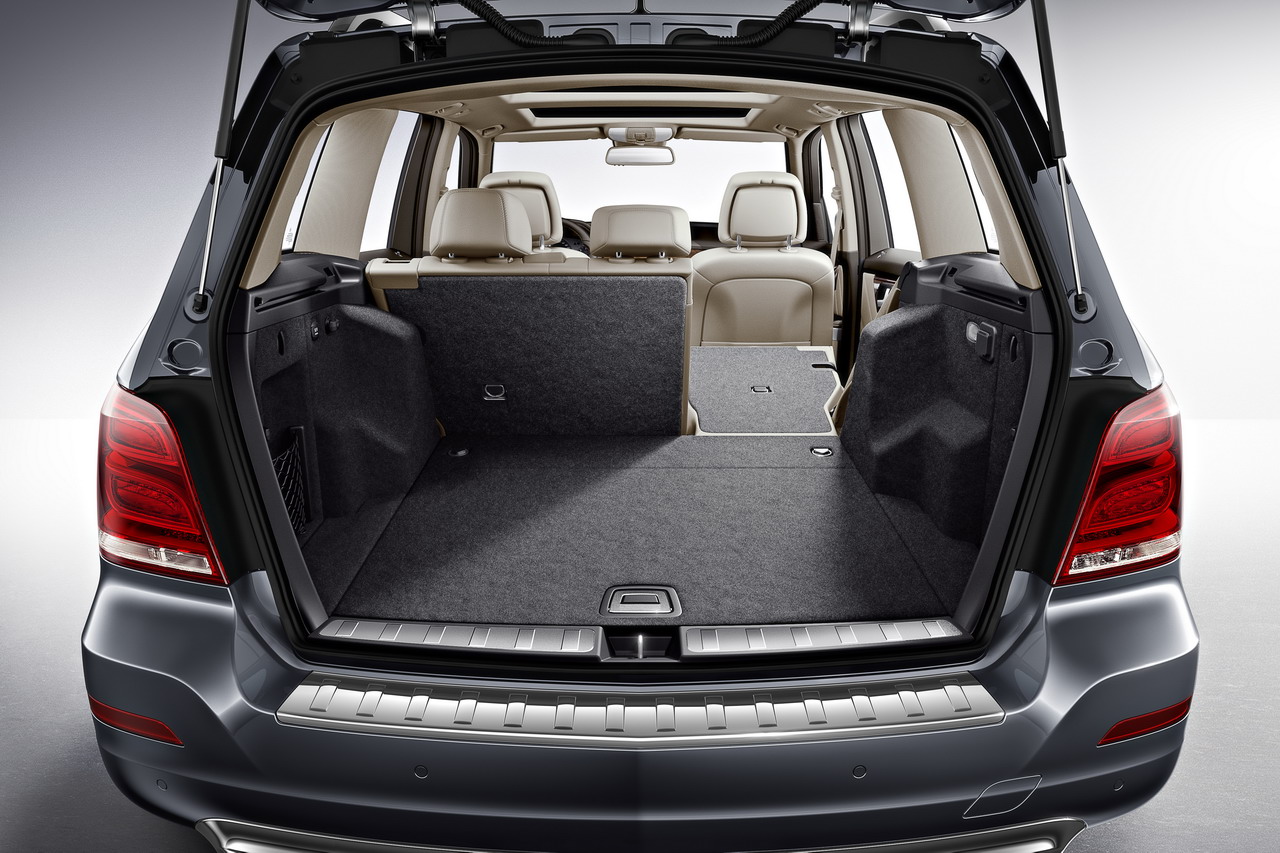
Lack of an ICE drivetrain allows the Model S to fit up to 7 people and have more cargo space (58.1 cubic feet, with the rear seats folded) than many SUVs. No plug-in hybrid comes close to that.
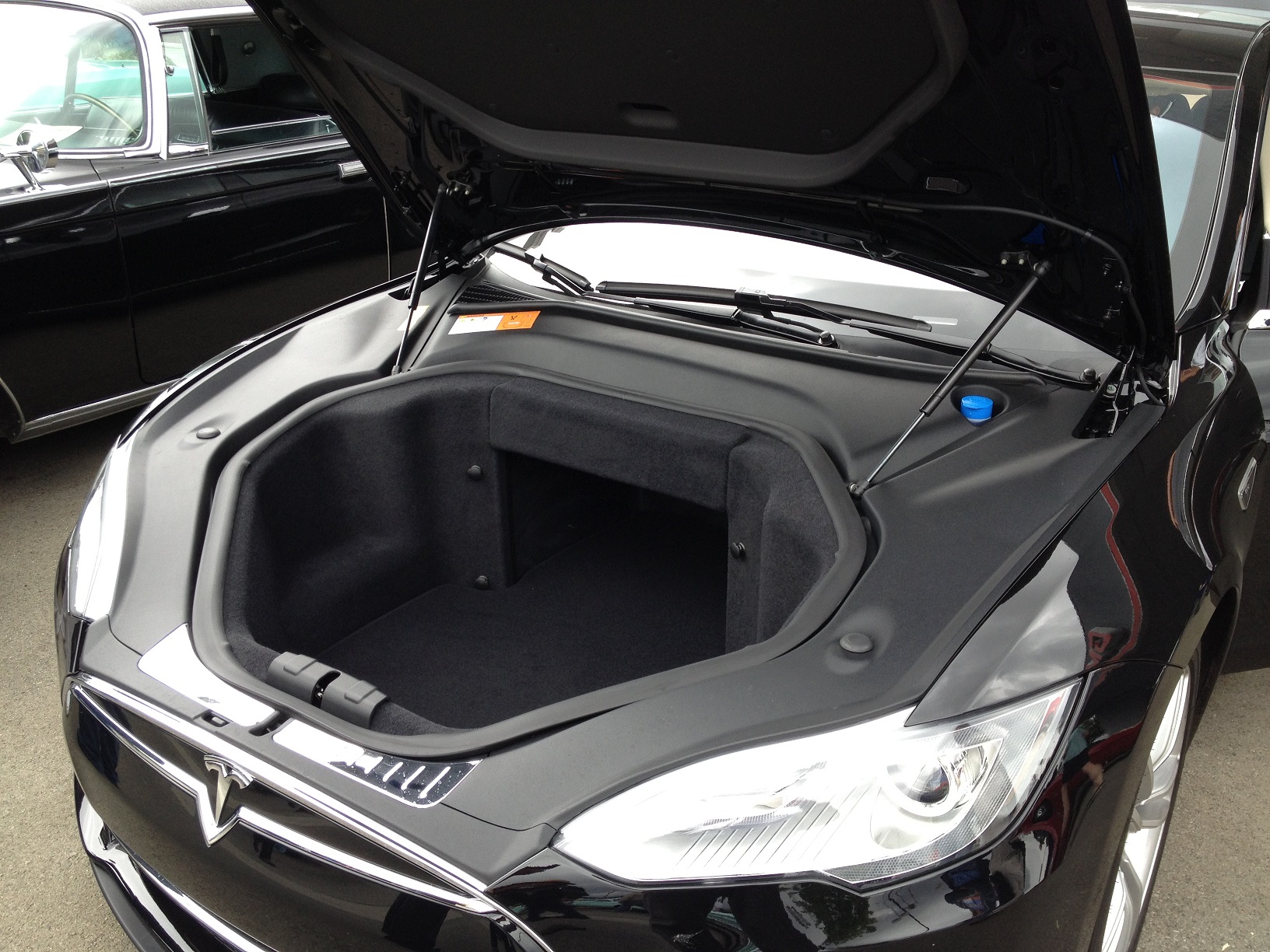
Lift the “hood” of the Model S and you will find a large cargo space, like a much larger version of what you’d find on a mid-engine Porsche Boxster.

Like the Porsche Panamera and Audi A7, the Model S is a 4-door hatchback design. However, unlike its competitors, the lack of mechanical and exhaust systems permit a cavernous space. Optional rear-facing seating for two small people increases the Model S’s passenger capacity from 5 to 7.
Reliability
Lack of moving components allows unprecedented reliability. Several Model S vehicles have gone over 500,000 miles and counting on the original batteries with no issues and less than 20% battery degradation. I’m not aware of a single drivetrain (battery or motor) breakdown in any of the 10,000 plus Model S vehicles on the road.
Service
Much of the Model S is controlled by software. Having a problem with the HD radio? Tesla can fix it through the car’s standard wireless internet connection. The car’s giant center console 17 inch touchscreen is essentially a sophisticated tablet computer. Like your smartphone, it can be updated by remote technicians using on-board diagnostics and downloading software updates and fixes. The Tesla Model S is essentially the first car that can be serviced online.
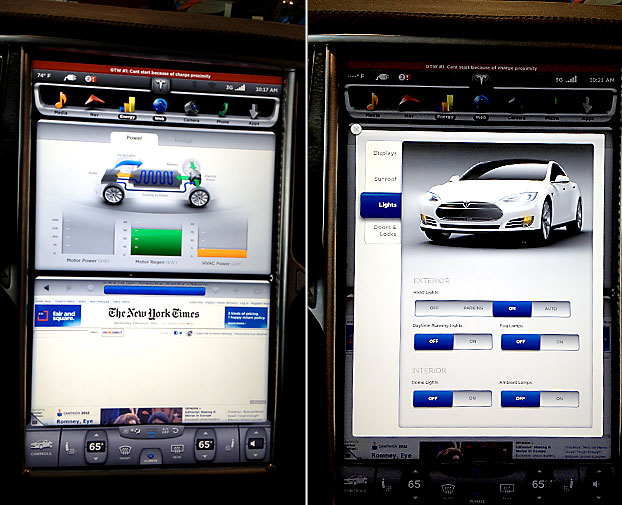
The brilliant, high-definition Tesla 17 inch touch screen is just amazing in person. Like a tablet computer, it’s internet-connected and technical service can be rendered online. Updates are downloaded and installed overnight while you sleep!
Cost
Although the Tesla is expensive, it is very comparably priced with other ICE cars in its class (see chart above). Meanwhile every plug-in hybrid is at least $8,000 more than comparable cars in their class. Instead of making two compromised drivetrains, like with hybrid plug-ins, the Tesla just has a single, uncompromised one.
Performance
The lack of ICE components allows for a clean undercarriage and minimal air induction. This translates into a drag coefficient of .24 — currently the lowest on the road! Incredible for a car this size. A MINI Cooper, by comparison, is .35 despite being less than half the size! A Ferrari 458 Italia has a drag coefficient of .33. The fastest production car in the world, a Bugatti Veyron Supersport, has a drag coefficient of .41.
The Model S, like any proper sports sedan, is rear wheel drive. It’s three-phase, four pole AC induction motor is mounted directly between the rear wheels. It uses a single-speed fixed gear transmission.
EV components can be mounted much lower to the ground than ICE components, allowing a sports car like low center of gravity, and therefore sports car like handling, despite being a big, heavy (4,647 lb), full-sized sedan. Motor Trend clocked the Model S 0-60 mph in 3.9 seconds. The instant torque of a pure EV is compromised by the ICE engine weight and integration of a plug-in hybrid
Tesla Supercharger Stations
Tesla isn’t waiting for governments or third-parties to build a nationwide EV charging network. It has begun building its own Tesla Superchargers to allow Model S (and future Teslas) to drive all over California and even coast-to-coast. It’s even more exciting because use of the Superchargers is free forever to every Tesla Models S owner. Non-Tesla owners can use the stations, but they must pay.

A rendering of a Tesla Supercharger station.
The 120 kw Supercharger can charge a Model S equipped with the on-board supercharger by 50% in 20 minutes. According to Tesla, it’s 20x faster and delivers 16x more electricity than other public charging stations.
The Supercharge module is standard on both Model Ses with the 85 kWh battery pack and it’s a $2,000 option on the 60 kWh base models.
According to Tesla’s website, here is the current information on the status of its Supercharger network:
- Today – 8 stations
- Summer 2013 – 27 stations
- Winter 2013 – Coast-to-coast travel
- 2014 – 80% of the US and Canada
- 2015 – 98% of the US and Canada
Many owners may still prefer the Tesla on long trips because the fuel is free, the ride is fun, and taking a 45 minute break every 200 hundred miles or so is something they would do anyway.
The Best Car in the World
It may sound like hyperbole, but the Models S has been met with near universal acclaim from the men and women who live and breathe ICE for a living. It’s a stunning accomplishment given Tesla’s status as a startup company and that the Model S is its freshman entry into a very cutthroat worldwide automotive marketplace. And as a California native, I can’t help but be proud that Tesla is a Silicon Valley-based company and the Model S is made in an old GM-Toyota joint venture factory in Freemont, CA.
Consumer Reports – never the go-to source for automotive enthusiasts – proclaimed the Model S to be the best car they have EVER tested. It scored an eye-popping rating of 99 out of 100.
If enthusiasts can agree with Consumer Reports about the Tesla Model S, it really must be the Best Car in the World and I want to drive the Best Car in the World. Who wouldn’t?





 Todd Bianco's ACarIsNotARefrigerator.com Blog