Archive for the ‘Lexus’ Category


Toyota Motor Sales U.S.A. (including its Lexus and Scion divisions) is getting pretty good at talking out of both sides of its corporate pie hole.  In a letter to its sales and customer service employees (many of whom work at HQ in Torrance), Toyota says:

We need to continue to align our staffing and organizational structure to fit our future needs and growth.

They go on to say:

This is strictly a voluntary program and there is no specific target for the number of slaves associates who will participate in this program.

What a load of crap.  Let me get this straight:  Toyota plans on future growth but it’s going to do it all with fewer employees.  Hum.  Most employees already work much longer hours than called for in their contracts, just to handle the existing work. Now fewer people will get paid the same salary to handle even more work.  Shut up and be happy you have a job, right?  It’s a very familiar refrain in corporate America these days.  You need to work harder, be more productive, be a “team player” and work way more than 40 hours a week and then you settle for reduced benefits and no raises – not even cost-of-living.  Corporate profits soar, executive salaries increase as do bonuses.  I believe it’s called corporate slavery.

Sure, we all know Toyota had a bad 2010, with all those pesky recalls and revelations that Toyota knew about some of the problems long before it was forced to recall millions of cars.  But the good news is that sales are booming again in January 2011 and in 2011, Toyota hopes to make up for lost 2010 sales.
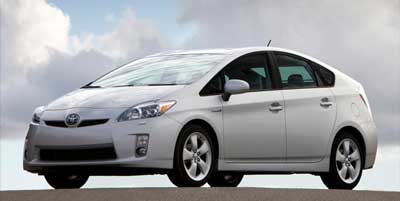
A 2010 Toyota Prius. I bet you can get a cheap lease deal on a 2011 model!

Customers are understandably angry. First, the safety issues and then the reliability problems degraded residual values and put more people upside down in their loans.  Next, Toyota flooded the market with cheap lease and finance deals that undercut all its previous deals, once again killing residual values on just about every model, including the vaunted Prius 4-wheel refrigerator.

A 2009 Toyota Camry

So how do you reward those front line people who dealt with those problems?  Well, you ask them to leave, nicely.  And to that end, the severance package appears pretty generous:  You get a one-time “transition assistance payment” of $20,000, and two weeks salary for each year employment and an additional lump sum payment of 10 weeks salary.

This would be generous in a better economy.  Once you take the buyout, if you’re not retiring, where do you go? Good jobs aren’t plentiful these days. And what if you need the medical insurance benefits that also disappeared with your job?   It’s not like neighbor Honda is hiring.   Nissan said f-u to So Cal a few years ago and relocated to a suburb outside Nashville, TN.  Who wants to go there?  Subaru’s sales are booming, but unlike other Asian manufacturers, its corporate headquarters is in Cherry Hill, NJ – near BMW and Mercedes-Benz.  Last year, VW moved all its US corporate functions from Michigan to Herndon, VA – not exactly near Torrance.

And while you can buy a house in Detroit for almost nothing, do you really want to move your family there even if you could get a job at one of the Detroit 3?  It’s not like the schools are great in Detroit.  So many people have abandoned Detroit that the City has had to close half its schools. Wonderful. Welcome to the Goldman Sachs economy of the 21st Century. Wall Street and the banks are doing very well, thank you.

The only logical move for these employees is to Hyundai with HQ offices in Fountain Valley or sister brand Kia, based in Irvine — IF they are hiring.

Then there is the elephant in the room:  What happens if not enough people take the buyout?  Toyota is silent on that point, but you all know, it will come down to more lay-offs.   The only thing “good” about firing employees is that Wall Street will upgrade your stock and applaud management for cost cutting, no matter the human cost.  Bonuses to management.

Wouldn’t it be nice if Toyota adopted Google’s corporate motto: Don’t be Evil.  I’m not holding my breath.
Evil Toyota?


It was a lovely sunny day and I was driving northbound on Griffith Park Boulevard in my new 1987 Mercedes-Benz 190E 2.6. As was my habit, I was looking at For Sale signs on some of those cute homes on the east side of the street. Those were days when you could buy one of those homes for less than $200,000.

What I didn’t notice was the gigantic moving truck parked directly in front of me in the traffic lane. My distraction turned to panic when I looked back to the street. There was opposing traffic and I had nowhere to go. I instinctively slammed the brakes, both feet, as hard as I could. While my life was flashing through my head, I heard a strange staccato stuttering sound, the brakes pulsed and the car stopped just a couple feet short of the menacing T-bar.

In almost any other car, I wouldn’t have stopped in time and I would have been seriously injured or worse.

In those days, anti-lock brakes were the domain of German luxury cars. Lexus and Infiniti didn’t exist yet and the Detroit Three were floundering in mediocrity.

I was aware that my car had the feature, but in the fraction of a second I had to react, it didn’t cross my mind. I’m thankful the Mercedes had anti-lock brakes. The new era of electronic driving assistants became very real and tangible to me in that instant.

Two other factors favored me that day. In addition to the ABS system, the car had nearly new tires with lots of tread (translate: grip) and the road was clean and dry. Most people ignore their tires and this can be a fatal mistake. Worn tires and ones that are either under- or over-inflated tires, rob your vehicle of its best stopping power and accident avoidance agility.

Fast forward more than 20 years and virtually every car sold has ABS. Electronic stability control is also now mandated on most new vehicles. But what’s really changed is that your car has become a sophisticated mash up of high-strength steel, greasy bits, plastic and high-speed computers that control almost every aspect of driving.

Computer programs can instantly change the way the steering and throttle respond to driver input. Computers control the valve timing and fuel injection systems. They can deactivate cylinders and new stop-start technology automatically kills and revives the internal combustion when it’s not needed. Sensors monitor and adjust anything from the climate to the ambient lighting.

The most significant advances have been made in expensive electronic and mechanical vehicle safety. Electronic nannies do amazing things to keep you safe. Air bags at every corner of a vehicle protect you in a crash and are even being placed in seat belts. High strength, lightweight alloys guard the passengers.

This year, Toyota made the headlines with wild tales of runaway vehicles with sticky throttles and bunched up floor mats. Toyota is now a defendant in hundreds of cases of lawsuits related to unintended acceleration; yet so far, neither government investigators, nor Toyota, nor independent scientists have been able to find a software defect in Toyota’s electronic throttles. Much of the “black box” data shows that many of the crashes were a result of driver error. People do confuse the pedals when they are panicked.

To mitigate the damage to its reputation and falling market share, Toyota has replaced millions of throttles and reprogrammed the software to automatically cut off the fuel supply when it detects both accelerator and brake pedals pressed simultaneously.

Last month, I was invited to a Lexus safety demonstration event at the Toyota Motor Speedway in glamorous Irwindale. I arrived an hour early, and to my delight, they were all set up and ready to go so I was offered unhurried drives on the various courses demonstrating a host of electronic nannies on 2011 Lexus (and Toyota) vehicles.

Lexus Safety Event Registration

Lexus calls its unintended acceleration mitigation system “Smart Stop Technology” and it’s standard on all 2011 Lexus vehicles. Lexus needs to reassure its customers that the electronic drive-by-wire throttle systems are safe and that they won’t die in a fiery crash like the one that happened in a 2009 Lexus ES350 in northern San Diego County on August 28, 2009. (more…)