It’s about time the Germans and Japanese had some competition at the top end of the luxury food chain. There’s a chunk of prime red meat out there and finally, a big English cat has pounced and claimed its rightful share.

The 2011 Jaguar XJ L in Liquid Silver at the Pacific Design Center
Jaguar is no longer a mismanaged unit of the ill-fated British Leyland conglomerate or a starved luxury brand in Ford’s portfolio. The Jaguar Land Rover Group is owned by Tata Motors of India, whose controlling shareholder, billionaire Ratan Tata, is an avowed car guy with a keen sense of Jaguar’s heritage and its rightful place in the global automotive world. Under Tata’s stewardship, the Jaguar brand has a renewed sense of pride and passion and that shines in its new products.
For the 2010 model year, Jaguar’s design team, led by superstar design boss Ian Callum, graced the world with the stunning, all-new, XJ. The avant-garde, futuristic design features a coupé-like roof line that blends seamlessly into the trunk. It really looks like a lithe, muscular jaguar leaping on its prey.

The Jag's stunning roofline is sexy from any angle. It belongs in front of the Pacific Design Center.
I picked up my gorgeous Liquid Silver XJ L at the West Hollywood location of Hornburg Jaguar Land Rover on the Sunset Strip, across the street from Hamburger Hamlet #1 and next to the fantastic newly-refreshed Luckman Building.
When you first sit in the car, you are in awe of the lavish use of flawless cow hides. A small army of seamstresses must have toiled endlessly to French-stitch practically every surface in leather.

The attention to detail is first rate.
The interior feels like the cabin of an expensive yacht. Elegant wood veneer sweeps the forward cabin and graces the rear doors and picnic tables. The headliner is upholstered in sumptuous, premium Suedecloth (similar to Alcantara). Piano black plastic, plated aluminum and chrome accents surround the air vents, center console and arm rest controls. Phosphor-blue LED “halo” lights illuminate all the controls. Fit and finish is first class.
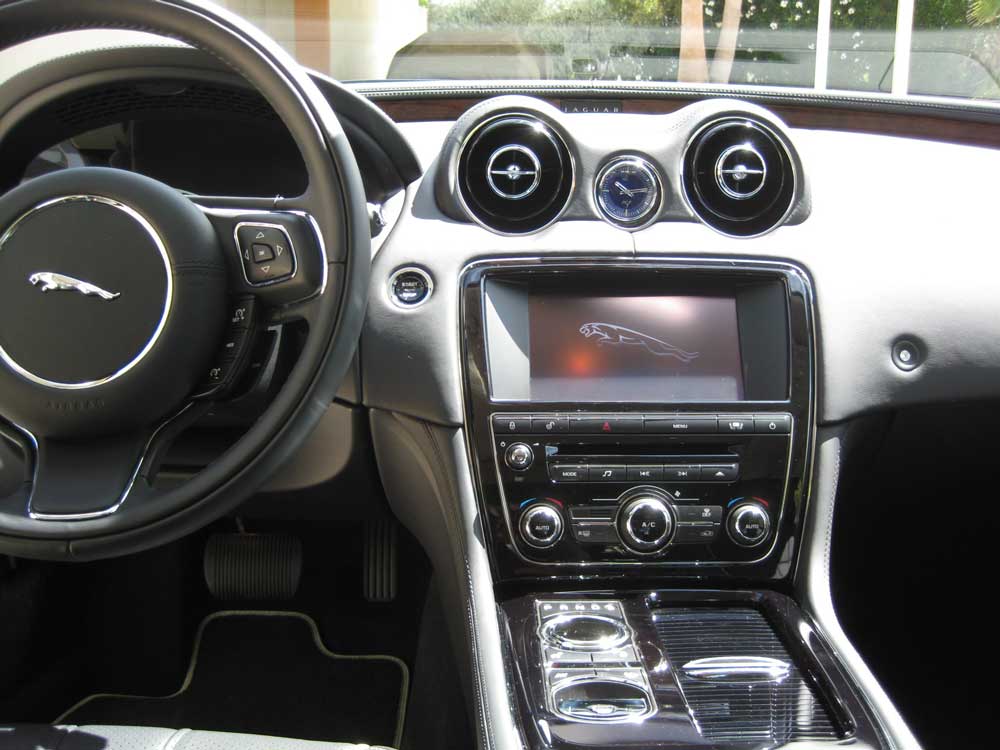
The 2011 Jag XJ's center console and steering wheel. Even the AC vents are covered in leather.
When you start the car, you realize that there are no dedicated analog or digital instruments. In place of the normal gauge cluster is a 12.3” thin film transistor (TFT) liquid crystal display (LCD) that mimics the expected analog gauges (speedometer, tachometer, fuel, engine temperature, etc.).
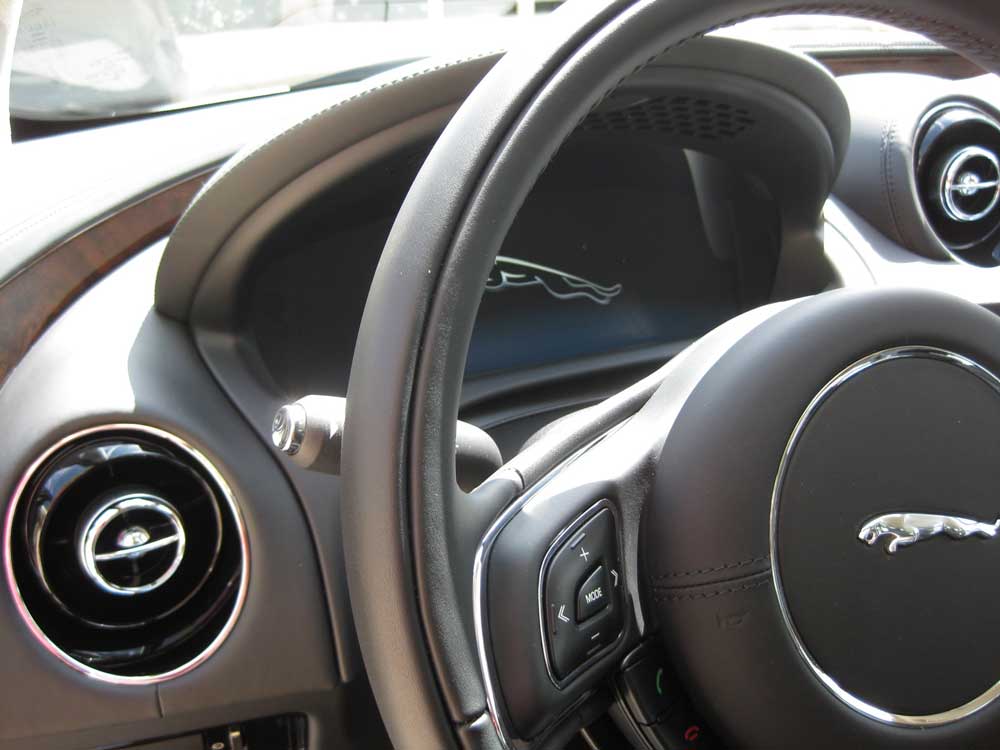
Behind the wonderful steering wheel is the TFT screen. Before start up, it displays the Jag logo.
The center dash is dominated by a large, 8” full-color touch-screen that controls the entertainment, navigation, telephone and seat functions. Hold on, seat functions? Yes, in addition to the standard 20-way power three-person memory seats for the front seats, both front and rear seats are heated and cooled. And if that’s not enough, the front seats have back massage functions. All these standard luxury functions are controlled through the center multimedia touch screen. Heaven on Earth.
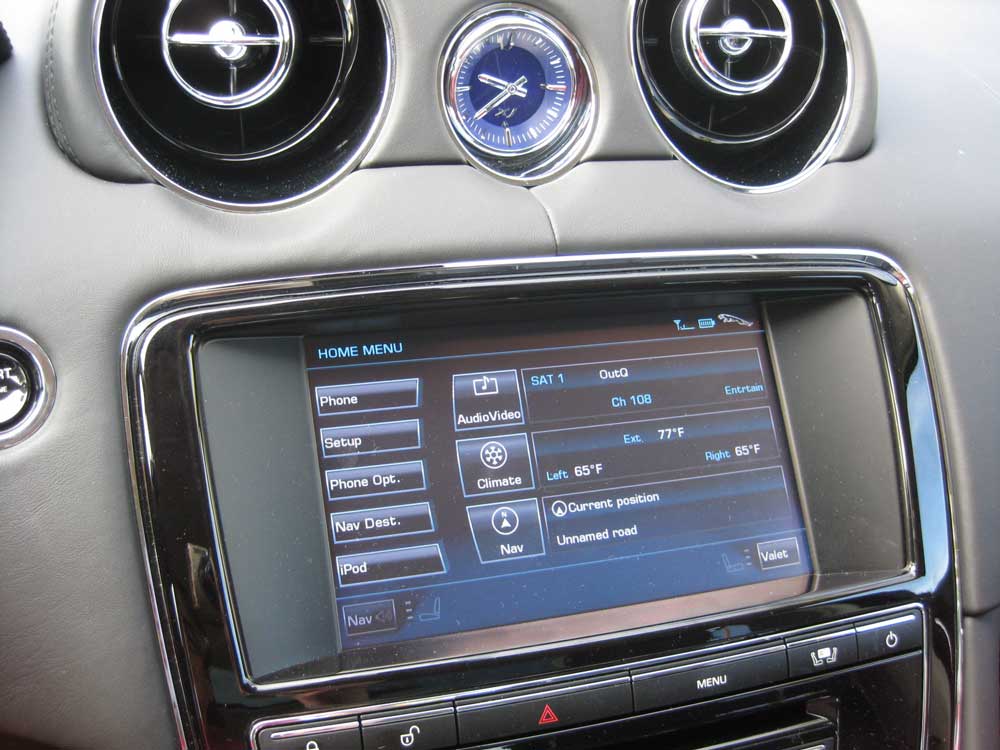
The analog clock is a jewel-like old-school touch above the very modern infotainment screen.
The XJ L’s standard four-zone automatic climate control system can be operated either by (1) the touch screen (2) the redundant “old school” controls on the dash, or (3) by voice command. The heated leather sports steering wheel (again, standard) is activated by a steering wheel-mounted switch.
The Xenon headlights got the obligatory LED eyeliner treatment, but it’s the vertical taillights, with cat scratch-like strakes rendered in blood-red LEDs, that define the XJ’s design . Heads turn when this car prowls the streets. It exudes a sense of graceful, modern luxury.

Note the verticle strakes illuminated in LEDs.
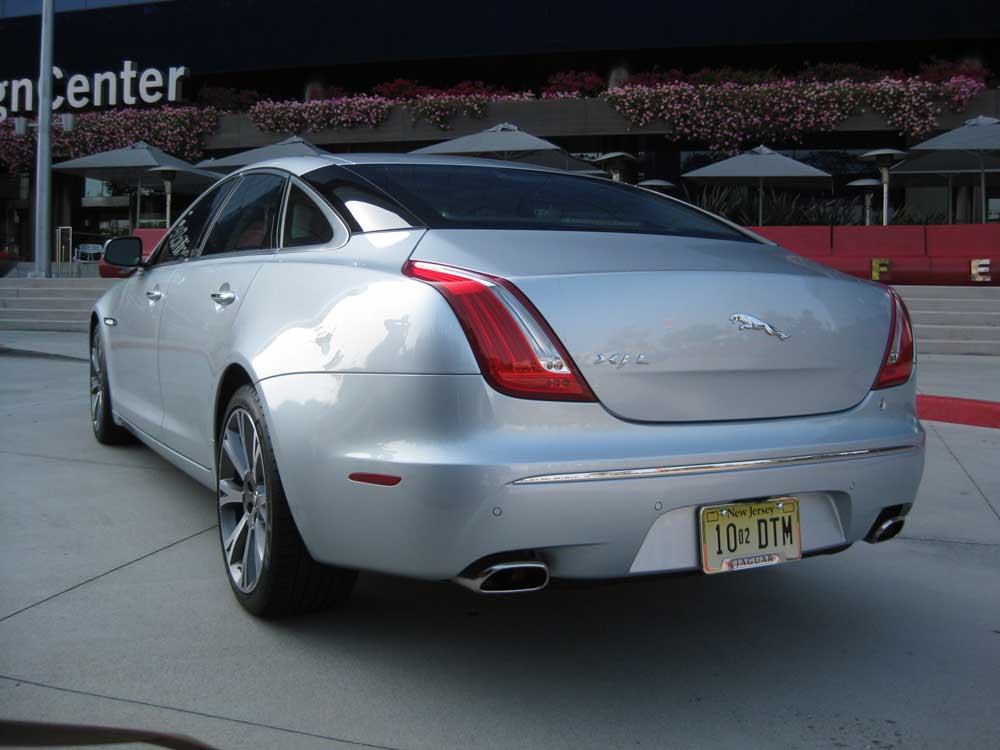
The taillights reach up to the black glass roof.
The list of standard features goes on: automatic headlights, rain sensing wipers, garage door opener, keyless entry and ignition, power trunk lid, and a 600 watt infotainment system that includes hard drive navigation and music storage, stereo Bluetooth 2.0, iPod/iPhone direct connect outlets, HD and Sirius Satellite radio all with voice control. Amazing.

The spacious trunk has a small opening, but it's deep. It opens and closes with the touch of a button on a remote or on the trunk lid.
The only major option packages are the Bowers & Wilkins 1200 watt, 20 speaker, 15 channel sound system with Dolby Pro-Logic IIx ($2,300), a Visibility Package with Adaptive front headlamps and Intelligent High Beam, an Adaptive Cruise Control Package ($2,300) and Rear Seat Entertainment ($2,200).
While the body and interior are complete departures from the past, the aluminum space frame and greasy bits, including the drivetrain, are heavily reworked versions of the former XJ. Behind the new shiny interior veneer are controls and mechanical systems that are a mixture of old and new.
The new XJ is longer, wider, sleeker and sexier than ever. The US market gets six variants: The XJ (standard 119.4 inch wheel base) and the XJ L (long wheel-base with an extra 5 inches) are the base platforms and both come standard with Jag’s 5.0 liter naturally-aspirated, direct-injected V8 with a generous 385 hp and 380 lb-feet of torque. Customers can opt for the Supercharged or the (special order only) Supersport package on either wheelbase. Both upgrades feature an Eaton supercharger that pumps up the standard 5.0 liter V8 to either 470 hp/424 lb-ft torque or 510 hp/461 lb-ft.

The 5.0 liter naturally-aspirated, direct-injected Jaguar V8 produces gobs of creamy torque.
A smooth, quiet, six-speed automatic with Jaguar Sequential Shift and steering wheel paddles is the only transmission on all models. All variants are rear-drive only. The ultra-cool JaguarDrive selector, a beautiful chrome knob that rises from the center console the moment you press the standard keyless ignition button, is easy to use and a delight to see. It never gets old.
There is no all-wheel drive option – at least not yet. That’s unusual because all its competitors, the Mercedes S-Class, the Audi A8, the BMW 7-series, the Porsche Panamera and the Lexus LS all offer awd as an option or standard equipment. Jaguar leaves the inclement weather traction issues to the vast array of standard electronic stability and traction control nannies.
The basic XJ chassis is primed for more than just the luxurious, satin ride that you expect in a Jaguar. It’s well-sorted and you feel in control in any driving condition. The (relatively) lightweight XJ L rockets from zero to 60 mph in only 5.4 seconds. Freeway passing is effortless. When I slammed on the anti-lock brakes (no one was around), there was little nose dive and no fuss, just massive stopping power.
However, not all is perfect. I have a long list of nit picks and annoyances with the Jag. I thought there was too much interior bling – the chrome and piano black surfaces reflected in my eyes and I thought they looked almost like a Buick, save for the higher quality. The rear windows didn’t roll all the way down. Then again, when you have four-zone climate control, who’s rolling the windows down? Speaking of climate control, I think my tester had a flaw. I had to set the zones at 65 degrees in order to get the proper cooling level. I should be able to set it at 70 and forget it.

Rear seat climate control is set to 65 to cool the cabin down. It was only around 90 degrees in Palm Springs that day.
The only option on my car was a pricey ($3,500) set of 20 inch Orona Alloy wheels and performance, low-profile Dunlops. The base XJ chassis is already sport tuned, and the combination wheel/tire package made the standard (rear only) air suspension dance rather than float over bumps and increased road noise (although the interior is still very quiet by comparison to most cars).
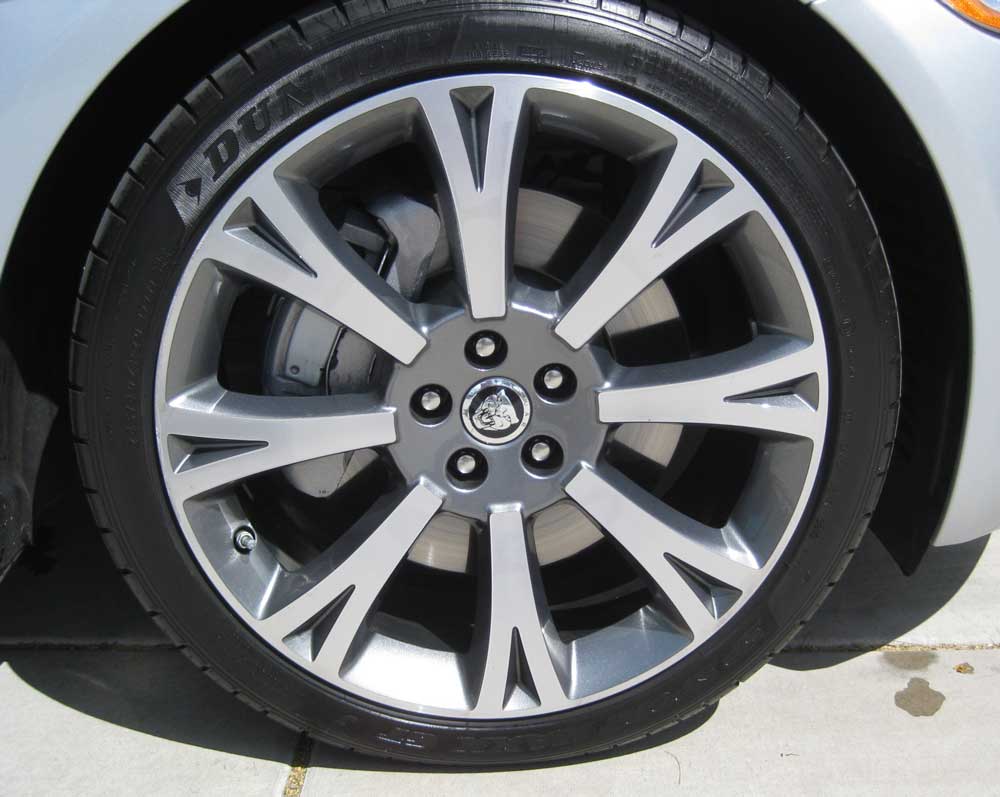
The optional 19" wheels and low-profile Dunlop sport tires look great but detract from the luxury ride of the XJ L.
I found the simulated gauges to be gimmicky and a bit drab. I wished for a digital compass in the rear view mirror. And while the navigation system worked well enough, I wanted to kill the electronic lawyers.
The touch screen wasn’t as responsive as I’m used to. In the age of the Apple iPhone and iPad, the graphic user interface (GUI) seemed unresponsive and slow. That’s an easy upgrade on future models.
Rear and side visibility was a problem; but you kind of get used to it over time. The steeply-raked (but insanely-stylish) black glass roof creates narrow side and rear windows with large blind spots, particularly when you’re backing up. The helpful standard backup camera display flashes yellow and red trajectory lines, while frantically-beeping front and rear bumper-mounted ultra-sonic sensors warn of impending disaster. Danger, Will Robinson, danger! Where’s the volume control?

The steeply-raked rear window limits visibility; however, the back up camera and front and rear sensors make up for that.
In stark contrast, the always-on standard blind spot cameras with orange indicator icons embedded in the side mirrors were the model of quiet simplicity. They simply flashed the visible warning icons without so much as a peep.
The key fob is like a bright, shiny ostrich egg designed to be soffited in a Hermès purse, not in a pants pocket. This should be a priority and easy fix on future model years.

The key is pretty, but it's much too big. It needs to go on a starvation diet pronto.
Fuel economy may not be a concern for people paying $80,000 or more for a car, but I was surprised at how well the muscular kitty sipped fuel. On the highway, the trip computer told me I averaged 22 mpg, and in town,15 mpg – exactly what’s the EPA predicted. It’s the first time I’ve ever got what the EPA estimated – highly unusual given my lead foot. Over 300 miles, two-thirds on the highway, I averaged 17 mpg. I may not have driven the posted speed limits.
So who is the target customer for this new-born Jag? In the past, the out-dated big Jags appealed mostly to affluent older women and elderly couples. Jag didn’t want to ditch its traditional, valuable customer base, but it needed a rebirth to appeal to a broader demographic in order to survive.
In this business, the ultimate product differentiator is design. There’s no question that the XJ’s design is as unique as it is beautiful. It’s inspirational and aspirational – a rare duo in the automotive universe. The Museum of Modern Art should put one in its permanent collection.

There is no bad angle for the Jaguar XJ

The leaping Jaguar hood ornament is gone. The chrome wire mesh grille with the Jaguar badge is better.
The magic of the new design is that it appeals to all ages and genders. Dress it in Ebony black with a Jet black interior and it becomes a testosterone-dripping panther. Opt for the softer Vapour Grey metallic with the Ivory and Truffle interior and it is befitting of the Ladies that Lunch set. In a more neutral color like my Liquid Silver tester, either sex would feel comfortable behind the wheel.
The new XJ is a statement of style and sensibilities. It’s English. Who else puts wood veneer and chrome picnic tables on the back of the front seats for the lucky rear occupants? Yeah, they’re mostly useless, but you expect them in a top-drawer Jaguar.
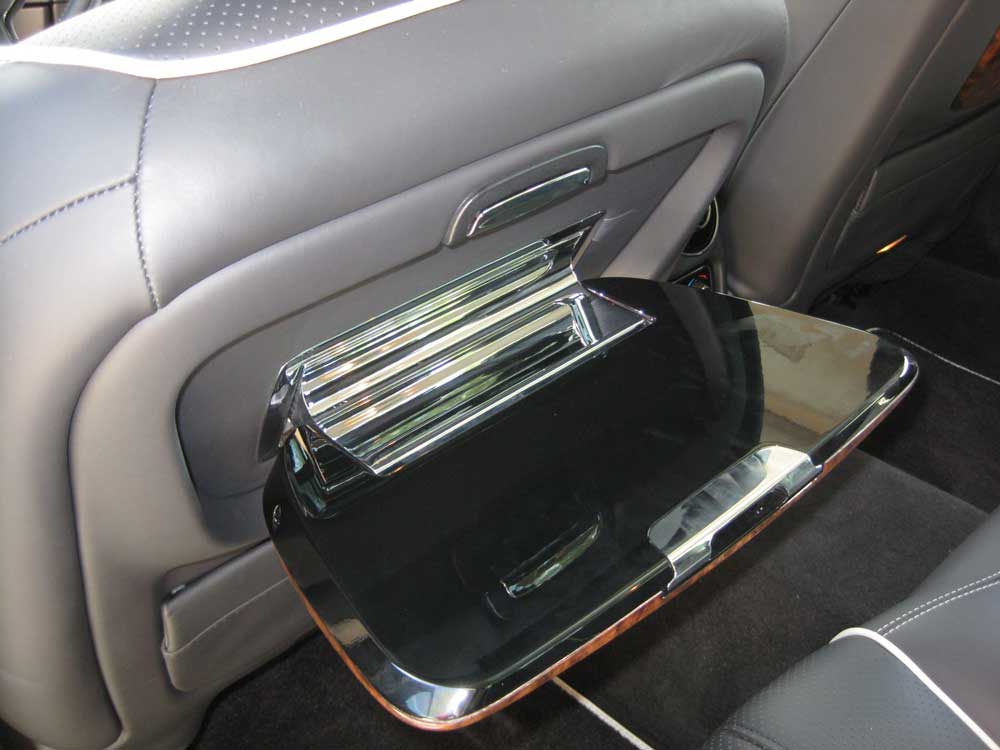
Chrome and wood veneer picnic tables are a signature design element for the big Jaguars.
At $79,700 ($83,200 with the wheels), the generous standard kit of the Jag XJ L makes it thousands less than similarly-equipped competitors. If you’re choosing solely on style, look no further than the XJ. However, if you look deeper, I think the XJ lacks the gravitas, and depth of engineering of something like the Mercedes S550.
There is one last thing that may sway your opinion. Jaguar’s new “Platinum Coverage” factory warranty offers best-in-class coverage. The new vehicle limited warranty is for 5 years or 50,000 miles (a year longer than the competition) and customers get complimentary scheduled maintenance, no-cost replacement of wear and tear items, and 24/7 roadside assistance.
The XJ is a deeply-personal expression of high style. For a growing number of people (sales are thirty times higher than last year), the new Jag is just the English ticket out of the German austerity.

A head-on shot of the 2011 Jaguar XJ L at the Pacific Design Center.
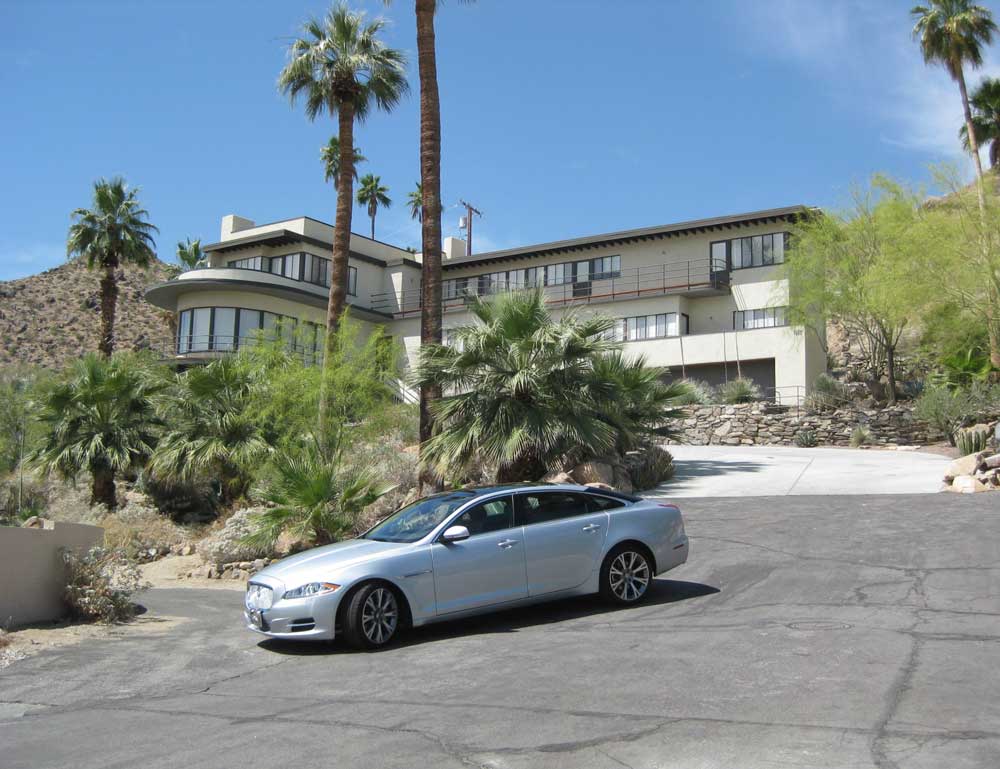
The Jag in front of the Ship House in Palm Springs.

The back seat compartment on the XJ L has an additional 5 inches of leg room. It's a nice place to spend time.

The Jag looks gigantic compared to the small Pontiac Solstice in the driveway of this modern home in Palm Springs.
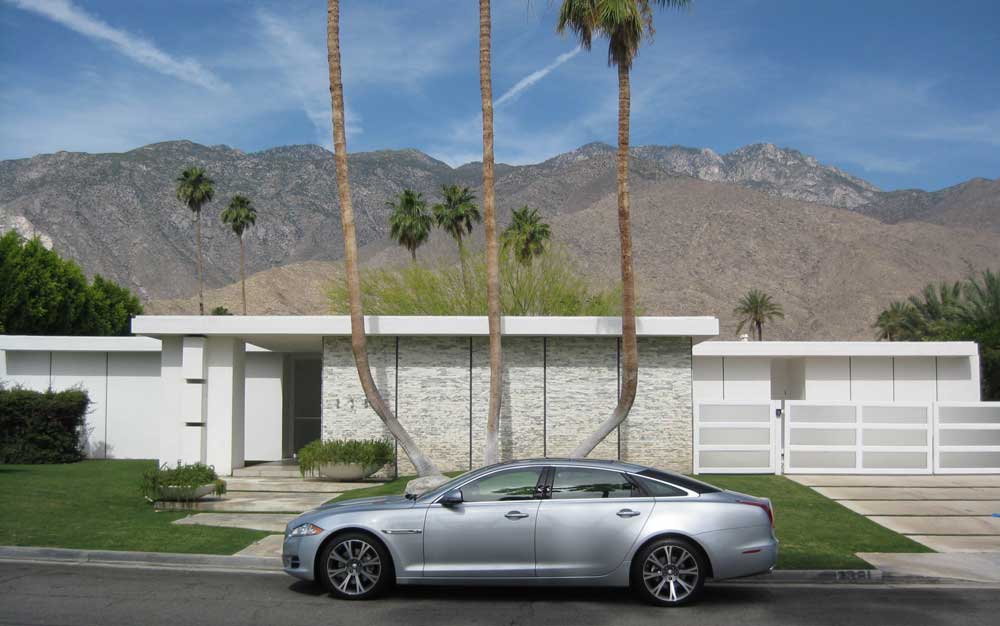
Long, low and flat. Just like the house.

Perfectly centered.

This house was for sale, so we parked the Jag in the driveway and it looked at home.

Tow a travel trailer with your $80,000 Jaguar? It could happen.
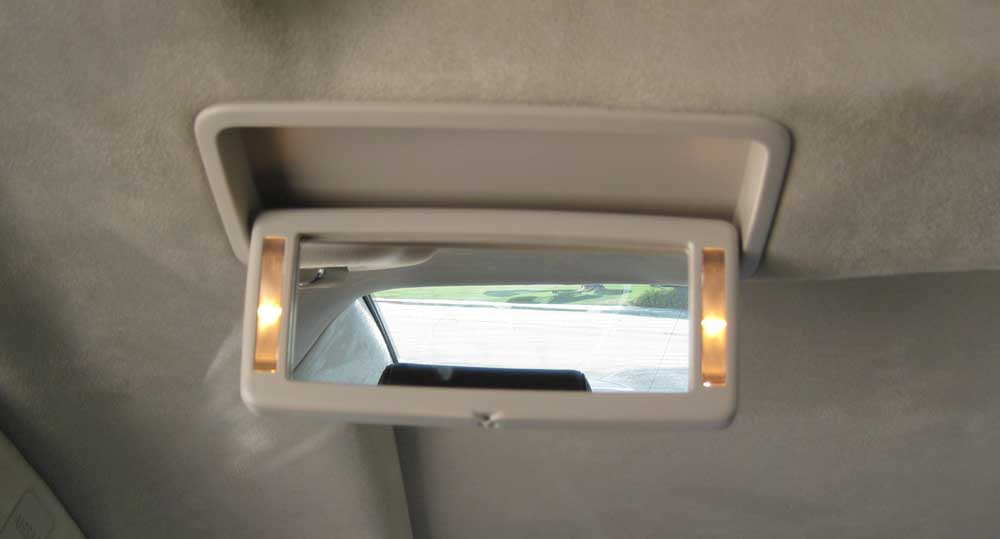
Rear seat passengers are treated to lighted vanity mirrors.

The Liquid Silver XJ L looks at home in front of this aluminum-sided home.