Archive for the ‘Los Angeles Specific Issues’ Category


Good News: It will be easier to find a space in Downtown LA and you may never get a parking ticket for an expired meter again.

Bad News: “Dynamic” (a nice word for increased) parking meter fees are now in effect in parts of Downtown Los Angeles,

The parking rates at meters and city-owned lots are currently between $1.00 and $4.00 per hour depending on the location of the space.  Under the new LA Express Park project, the amount you pay for an hour of parking could range from as low as $0.50 to a high, but reasonably palatable, $6.00.   Dynamic prices means that the rates will change depending on the time of day and demand.  I’m willing to bet that most people will end up paying more at a meter; however, it’s going to be easier to find a space and to pay for it.

The one year pilot program employs wireless pavement sensors and other technology to detect open spaces and demand.   What makes this system both cool and unique is that you can check for parking availability before you leave home on the website for LA Express Park or through the Parker smartphone app (iPhone, iPad, Android and Blackberry).  The app, using built-in GPS sensors in your phone, will detect where you are and show you the closest open parking spaces as well as the current meter rates.  Parker was developed by Streetline  just for the pilot program in Los Angeles; but of course, there is hope that these kinds of services will be rolled out in cities all over the world.

Sure, this will add to distracted driving and increase the number of people sitting at a stoplight who don’t notice when the light turns green, but hey, you might find a space!  At some point, the information even may be integrated into portable and in-dash GPS devices.  By that time, you’ll be in your Google-driven Prius and the car will not only find the space but park itself.  The technology exists today, so it’s only a matter of time before it’s integrated into new cars.

Now that you found that Doris Day parking space, you have to pay for it.  Through a smartphone app called Parkmobile, (iPhone, iPad, Android and Blackberry) you sign up with a credit card and the license plate number of  your car.  The app lets you not only pay the meter but it will send you a text message reminder 15 minutes before your time is  up and you can refill the meter right through your smartphone.  You can register multiple vehicles through Parkmobile or change the license plate on the fly. Helpful if you’re in a rental or a friend’s car. You can also kiss those outrageous parking tickets goodbye.

If you frequently park in metered spaces or city lots in the pilot zone shown on the map below, I’d highly recommend using this new technology. No more fumbling for change. No more running into a nearby sandwich shop to buy a bag of chips just to get change.  No more parking tickets if you mind your text messages.  And a bonus with Parkmobile you will have a detailed record of your parking expenses and a reminder of where you’ve been and on what day.  Very helpful for expense reports.

[Update May 30, 2012: I heard a report about the new system on TV the other day and it’s important to note that the communication about your parking space, your car and time on the meter is a two-way street.  Parking enforcement knows when your time is about to be up and could be waiting to give you a ticket as soon as the green lights turn red. So far, they have to be there in person to write the ticket, but I could envision a time when Big Brother could just issue a ticket automatically or from a desk and computer system. ]

Councilman Bill Rosendahl explains what’s going on:

Here’s a map of the LA Express Park pilot project zone:
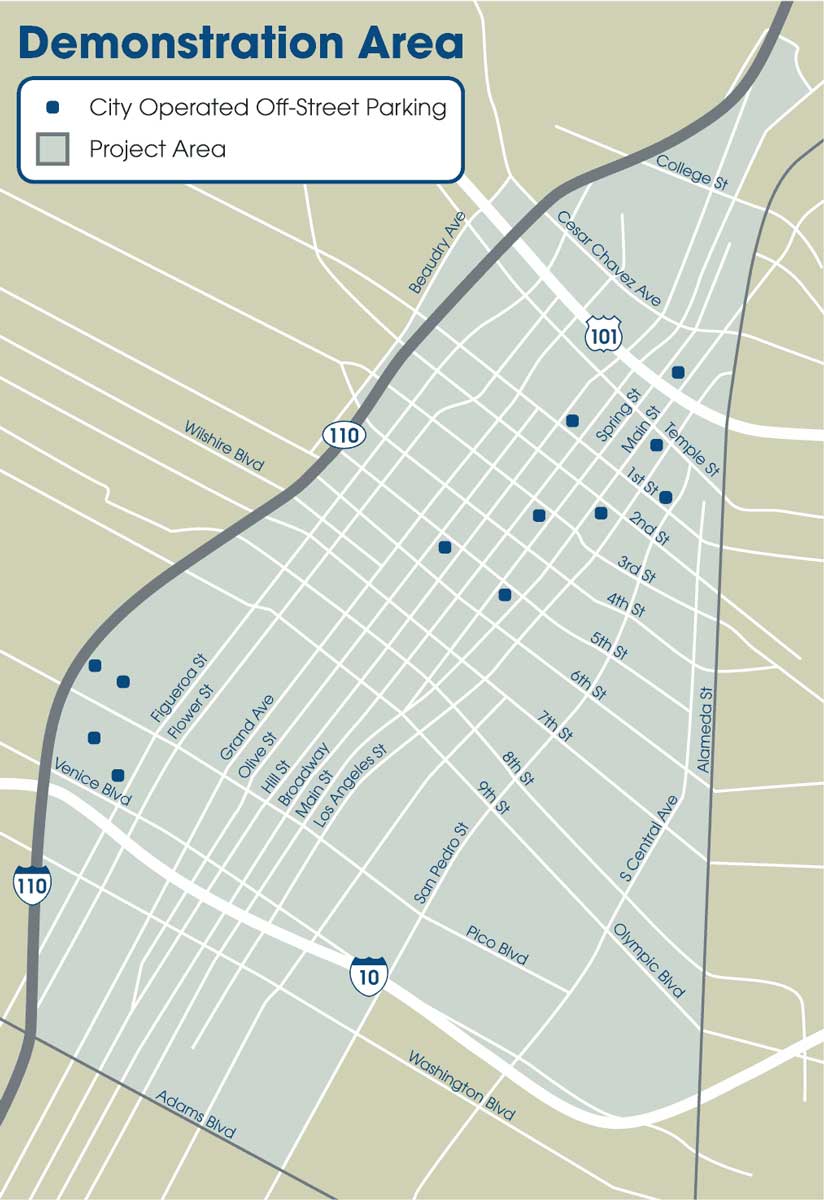
LA Express Park Map

Press Release dated May 22, 2012:

Yesterday, Mayor Antonio Villaraigosa unveiled a new program that will change the way people park in downtown Los Angeles. LA Express Park, a year long demonstration project, is a technologically advanced parking system that will notify motorists where parking is available by using in-ground sensors on city streets and lots. It will also introduce dynamic pricing to parking spots on city streets. Under this project, prices for parking will be based upon demand; when demand is high parking rates will increase and when it is low rates will drop. This will help keep traffic moving and take the hassle out of parking in what is Southern California’s largest generator of economic activity.

“Downtown is the heart and soul of Los Angeles, and has experienced significant growth over the last decade,” said Los Angeles Mayor Antonio Villaraigosa. “LA Express Park’s dynamic system will make parking in Downtown easier, faster, and smarter for all Angelenos.”

“Downtown Los Angeles is one of the largest employers in the region. Coupled with its emerging reputation as the sports and entertainment hub of Los Angeles, it is the ideal location to launch the LA Express Park program. New meters, new technology, and flexible payment methods afford greater ease and convenience in parking and visiting our dynamic downtown,” said Councilwoman Perry.

Bill Rosendahl said “As Chair of the Transportation Committee, I have proudly supported bringing innovative parking management and congestion reduction strategies to the public,” said Councilmember Bill Rosendahl. “Hats off to LADOT for investing in smart technologies that brings real benefits to the public.”

The LA Express Park demonstration area involves only City of Los Angeles-owned parking spaces and facilities in a 4.5 square mile area in downtown. It will include approximately 6,000 high-tech parking meters that take debit and credit cards. LA Express Park is being developed in partnership with Caltrans and the Los Angeles County Metropolitan Transportation Authority supported by $15 Million in grants from the Federal Highway Administration and $3.5 Million in matching City funds. For more information on LA Express Park and to use it, visit the project website.
This film was produced by General Motors sometime in the mid-1950s to “solve” the problem of traffic congestion in major cities.  Just in case  you were wondering, the plan didn’t work.

Without seeing the pictures of mid-20th Century America, and with only minor tweaks to the script, you’d swear that it was a speech at a modern meeting of urban transportation planners.  GM’s solution to the traffic problem was more buses produced by, of course, General Motors.  GM wanted people to ride on one of their buses to work and for downtown shopping but still own at least one or two (GM) cars to park in their suburban carports to be used for off-time recreation, family shopping and errands.

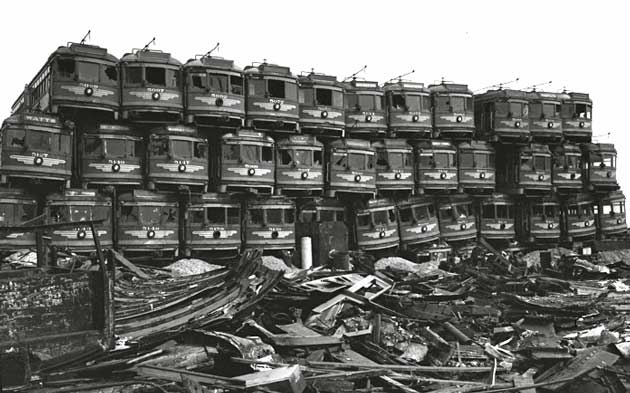
We know from history that GM, Standard Oil and Firestone conspired to purchase and then kill the extensive system of commuter railroads that used to crisscross Los Angeles.   Right here in West Hollywood, the rail yard and main hub for the Pacific Electric Railway was on the southeast corner of Santa Monica Blvd and San Vicente, now home to a large MTA bus yard. In fact, West Hollywood used to be called Sherman, after Moses Sherman, one of the owners of the railway.  (Sherman Oaks is also named after  him.)

A pile of Pacific Electric Red Cars waiting to be crushed.

GM’s reasoning sounds simple.  People work and shop in congested downtown districts filled with highrises and streets that were built before the advent of the automobile.  It would be very difficult and expensive to widen the streets and building downtown public parking would be expensive – up to $4,000 per space.

Because of the burgeoning population, people were moving to the suburbs and as a result, they drove themselves to work, usually alone (sound familiar?).  Studies at the time showed that the average passenger car carried only 1.5 persons.  Even the 101 freeway, which was built to connect the San Fernando Valley to Downtown LA, had bumper to bumper traffic in the 1950s!

One easy way to widen a street is to remove street parking and parking meters. That way, you gained one traffic lane each way to help relieve traffic; however, as the logic went, if we opened up another lane of traffic, it too would fill with cars unless public transportation, using comfy GM buses with air conditioning and air suspension, were placed into service.  The first part of that assumption turned out to be true. Unfortunately the second part, public bus transportation, didn’t.

GM estimated that for every bus, 34 cars would be taken off the road during commuting hours.  With an extensive bus system, privately operated, municipalities and states would be able to dramatically reduce taxes as there would be no need for expensive widening of streets and motorways (what we now call freeways).

GM saw no need for publicly-funded, inefficient and expensive public transportation systems (like the NYC subway) because private bus companies could easily earn a reasonable profit.  Yeah, right. GM even argued that a bus company should even be taxed less than other businesses because they would be providing such a great public service that saved taxpayers so much money.  Oh, if only this was true.

To service the suburbs, GM advocated for perimeter parking – something still being built in Los Angeles today near new light rail and subway hubs.  As the theory went, commuters would park in these lots and then ride the bus into the congested downtown business area. The parking lots would be much cheaper because land was cheaper in the ‘burbs – and it used to be.  People would board a bus that leaves every five minutes (!!), exit at a stop just a few steps or a block away from work/shopping and then apparently be able to catch a bus from downtown that got them back to the perimeter parking lot with equal alacrity.  Not only that, but they would arrive at their destination well ahead of driving time.  Unfortunately, that wasn’t true either.

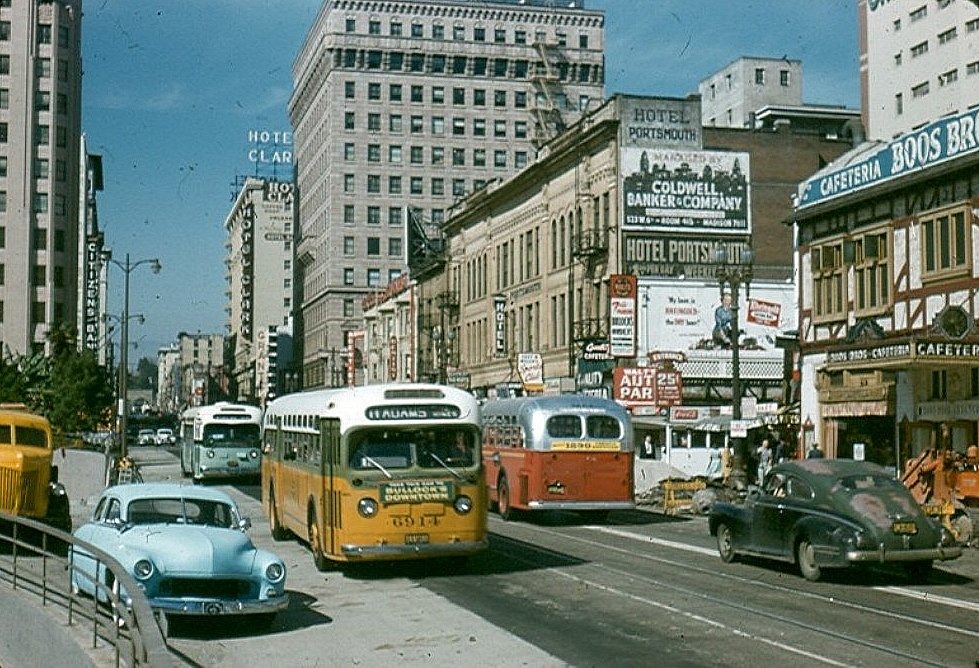
Downtown LA traffic and a bus from the 1950s.

Los Angeles is still trapped in this illusion that buses are going to lead the way to alleviate traffic.  Even the light rail we’ve built during the past two decades crosses city streets and is often halted by traffic accidents.   When my parents bought their home in 1955 in Tarzana, they were just a stone’s throw from railroad tracks belonging to the Southern Pacific Railroad. They were told at the time that a commuter rail system would be going in there “soon” and that it would be easy for us to take public transportation.

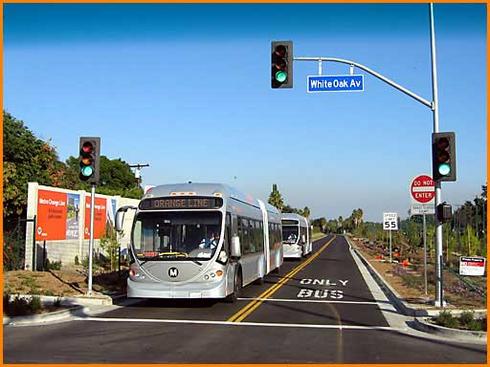
Fifty years later, that railway was transformed into the MTA Orange Line bus line.  Just as GM predicted in this short film, there would be roads specifically dedicated to buses.  The Orange Line runs lovely, modern accordian buses but it’s hobbled by the fact that it has to cross normal streets with crossing guards almost identical to ones still used by railroads.  Naturally there are accidents at those intersections because drivers are either too distracted or too stupid (or both) to stop when they see the flashing lights.  Under- or overpasses would have solved this problem, but it was too expensive to contemplate.

At least the Orange Line is nicely landscaped and has lovely bike paths.  Unfortunately, the Orange Line didn’t solve the cross-Valley and Warner Center traffic problem.

What happened in Los Angeles and countless mega-cities across the country was that they were built to cater to automobiles.  Los Angeles County is so large and so sprawled out that it would be impossible to provide bus service sufficient to significantly dent the surface street traffic.  While buses help, they move just as slow or slower than normal traffic. Transferring to another line or route adds significant time to any trip.

Also, Downtown LA is not the center of jobs and shopping.  As with the population, centers of commerce also left downtown. You can work at Toyota in Torrance and live in Tarzana.  No bus line, subway or light rail is going to get you there faster than a car.

Something GM couldn’t have predicted is that we now live in a 24 hour economy. No longer is work from 9 am to 5 pm. If only! People work odd and long hours and many have to drive during work hours every day.  No private company could run the MTA bus/rail/subway system for a profit and still have riders.  People work from home and drive to meetings all day long.  Private cars are now second offices.  And for many, their daily drive has become their only private time.

The 27 minute film, uploaded to YouTube, has flaws and sound problems. Stick with it, if you can, as it’s a fascinating history lesson. The pictures of mid-Century Los Angeles come on around 5:09.

Now that you’ve had a good laugh of GM’s vision for the past, check out GM’s latest vision for the future. The EN-V (electric networked vehicle) concept sure sounds amazing, but one has to wonder how it would work in the snow. Any chance we’ll see this happen in LA or anywhere outside the Arabian Peninsula in the next 50 years?