Tesla Motors, the Silicon Valley electric vehicle start up company, is working feverishly to bring its “affordable” (base MSRP $49,900) Model S family-sized sedan to market. Tesla needs the money. You know, a public company can only lose money for so long before the Wall Street overlords demand to see some signs of a profitable business.
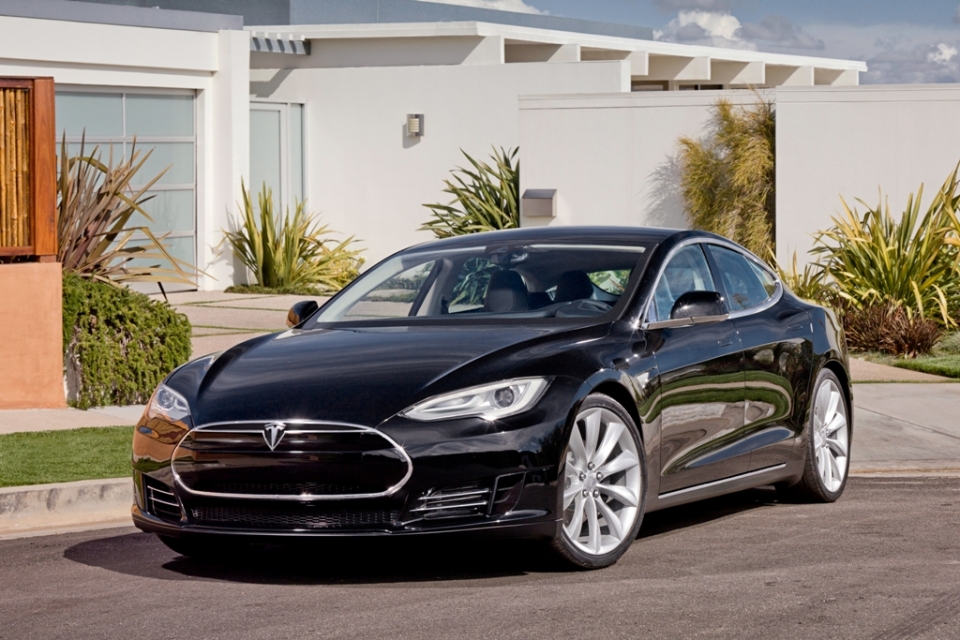
The Tesla Model S sure looks great -- and it's BIG. Photo: Tesla

The interior of the Model S is futuristic and functional. Large LCD high-def screens replace the dash gauges as well as most center console functions like infotainment and HVAC. Photo: Tesla
Tesla is winding down production of its iconic Roadster (base MSRP $109,000), the company’s first BEV (battery electric vehicle) based on a Lotus platform. Accordingly, it’s time for a new car.
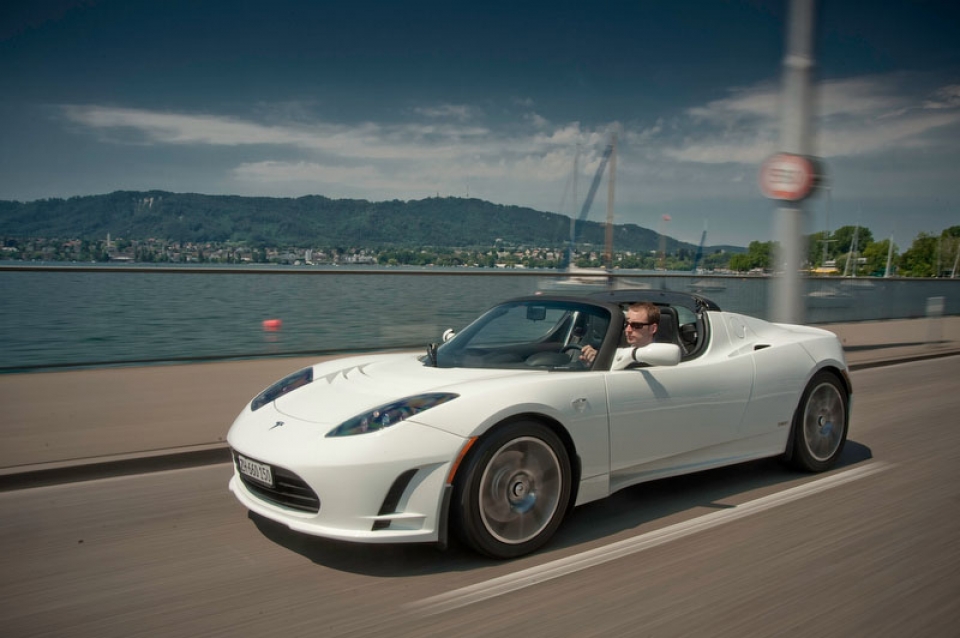
2011 Tesla Roadster 2.5 Photo: Tesla
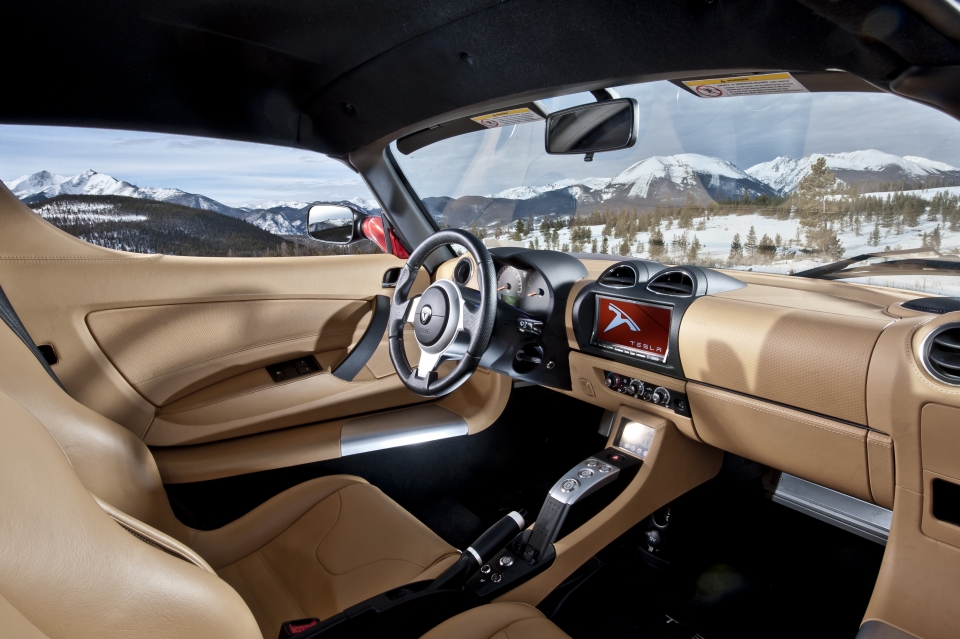
The sweet interior of the Tesla Roadster. It should look good for more than $100,000! Photo: Tesla
Production of the Model S will be at the shuttered Toyota-GM joint venture, New United Motor Manufacturing, Inc. (NUMMI), in Freemont, California, that Tesla bought in May 2010. Production of the Model S is projected to begin in mid-2012 and Tesla says it will create 1,000 new California jobs.
In 2010, Toyota and Tesla announced a $100 million joint venture deal to build the 2012 Toyota RAV4 EV at Tesla’s Freemont plant. However, on August 5, 2011, Toyota said that it will build the RAV4 EV at its Woodstock, Ontario (Canada) plant. Toyota will pay Tesla $100 million for an electric powertrain that includes the RAV4’s battery module, electric motor, gear box and electronic components. Those parts will be shipped to Ontario for assembly. Tesla will manufacture these components in its smaller facility in Palo Alto (used for the Roadster) rather than the Freemont plant.

2012 Toyota RAV4 EV, electrified by Tesla Motors Photo: Toyota
According to Tesla, the Model S can seat 7 people: Five adults and two children. The Model S features two front seats, a rear bench seat for three adults, and optional rear facing jump seats designed for two children. The jump seats will be similar to those available in some station wagons (like the Mercedes-Benz E-Class wagon). The rear hatchback design endows the Model S with class-leading cargo capacity.

The open hatchback of the Tesla Model S Photo: EVAuthority.com and Jalopnik.com
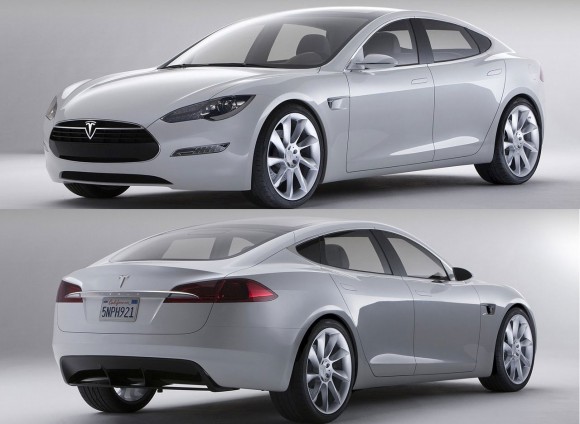
Tesla Model S Prototype, front and rear. Photo: Tesla
The most important issue for most EV buyers is range and their own range anxiety. Tesla says that the standard-issue battery is good for 160 miles – nearly double the range of a Nissan Leaf. For a whopping $10,000 extra, you can get a 230-mile battery pack and for a mind-numbing $20,000, Tesla crams the 300-mile battery pack into the Model S. Suddenly that $50,000 car becomes $70,000 – without any other options. Who do they think they are – Porsche?

The Tesla Model S almost looks like a Maserati from this angle. Very sporty! Photo: Tesla
Check out the Tesla-produced videos below. You get a good idea of just how much time, energy, high-tech components and sheer brainpower goes into producing a pure electric vehicle from a clean sheet of paper. It’s really impressive to see what is happening right here in California.
Tesla Vehicle Engineering – Part 1 from Tesla Motors on Vimeo.
Tesla Vehicle Engineering – Part 2 from Tesla Motors on Vimeo.
Tesla Vehicle Engineering – Part 3 from Tesla Motors on Vimeo.
This video is a bit boring, but it’s short and it really gives you a sense of what the Model S will look and sound like on the road. Almost all of the “sound” is road noise. In the “biz” this is referred to as NVH – noise, vibration and harshness. There are small armies of engineers (at every auto manufacturer) who spend their waking hours worrying about NVH and fine tuning the suspension, wheels, tires and chassis to minimize these problems.
Model S Alpha Hits the Road from Tesla Motors on Vimeo.
Tesla teases us with the actual Model S road testing in thin disguise. I think the test area is somewhere near Tesla’s Headquarters in Palo Alto, CA. With the 300 mile battery pack, I think I could live with one. Now if I could just afford one.
Tesla Model S Sneak Peek: Alpha Drives from Tesla Motors on Vimeo.
If you want to know more about the Model S, here are the FAQs from Tesla Motor’s website.
North American Model S
How will I service my Model S?Tesla operates stores and service centers across North America and plans to open additional locations. In addition, the “Tesla Service Ranger” program sends mobile technicians to customers’ homes in remote areas. Read more about the Service Ranger program.
Reservations
What is the difference between Model S and Model S Signature?The first 1,000 Model S vehicles delivered in the United States and the first 200 in Canada will be Signatures. Similar to other ‘limited edition’ offerings, Model S Signature will come very well-equipped, potentially with colors and options not available for Model S. Model S Signature will come with the 300-mile range battery pack. Reservation payments vary by country of use:
Model S Model S Signature US $5,000 USD $40,000 USD Canada $5,000 CAD $40,000 CAD Is the reservation payment refundable?The reservation payment is 100% refundable. All reservation holders receive a one-page reservation agreement, including refund details, during the reservation process.
Ownership and Pricing
When will features, options, and pricing be announced?Options and pricing for Model S are in development and will be announced when finalized. Tesla will invite reservation holders to configure their Model S approximately three months before their car is produced.
What are the prices of the different battery pack options?Three battery options are offered: 160-, 230-, or 300-mile range. Model S comes standard with the 160-mile range battery at the quoted $49,900 base price (after the $7,500 Federal Tax Credit). The 230-mile and 300-mile range batteries are optional upgrades. The 230-mile range option is priced at about $10,000 more than the base and the 300-mile option at about $20,000 more than the base.
May I delay production of my Model S?Yes. You will be contacted by Tesla approximately three months before production of your vehicle to select your options. At that time, you will have a one-time right of deferral. This means, should your life circumstances dictate a delay or a desired option is yet not available, you may relinquish your reservation sequence number and defer to a later position.
Is the $7500 United States Federal Tax Credit likely to be available in 2012?The $7500 federal tax credit is expected to remain available for many years. The community of EV owners and general enthusiasts can contact government officials to encourage the longevity of the credit. Read more about the current Plug-In Electric Drive Motor Vehicles tax credit.
Are financing and leasing available?Yes. A full suite of payment options will be offered. Further details will be announced closer to launch.
How does electric vehicle ownership compare to that of combustion vehicles?Electric vehicle ownership is extremely advantageous compared to typical premium sedan ownership – gasoline is not needed and routine maintenance is minimal. We calculate that fuel cost reductions alone will save Model S owners approximately $8,000 USD over a 5 year ownership period versus comparable vehicles like the BMW 535i.
Can I import a Model S into a market not supported by Tesla Motors?Tesla vehicles are designed and built to meet the unique requirements of each market and are physically different country to country as required by law. Customers should reserve Model S in the market they intend to register and drive their vehicle. Exporting cars into different markets is not supported by Tesla Motors.
Development Plan and Production
When will Model S be available for a test drive?Reservation holders will be invited to test drive in early 2012. The Model S Design Prototype will be on tour in some markets in 2011. It is not available for test drives. The production-intent Beta vehicles, produced at the Tesla Factory, will start to be available in late 2011.
When will Model S production begin?Model S production is scheduled to begin in mid-2012 with the Signature Series. After the Model S Signature Series, production for North America will continue with the 300-mile batteries, followed by 230-mile and 160-mile battery options later in 2012.
How many Model S units will Tesla produce each year?Tesla plans to produce 20,000 Model S units annually. In 2012, Tesla expects to produce around 5,000 to 7,000 vehicles as the Tesla Factory reaches its planned production capacity.
When will a Canadian version of Model S become available?Production of Canadian Model S vehicles will begin approximately three months after the US start of production.
Performance
Has Model S been tested for crash safety?Model S is engineered with the intent to achieve 2012 five-star NHTSA safety ratings. Final safety data is not yet available.
How fast is Model S?Model S accelerates from 0-60 mph in approximately 5.6 seconds. Model S has a top speed of approximately 125 mph.
How does Model S perform in extreme temperatures?Model S is engineered to perform in extreme hot and cold weather. The sophisticated Tesla battery management system uses re-circulating propylene glycol to either heat or cool the battery as necessary.
Is the Model S front, rear, or all wheel drive?The Model S is a rear wheel drive vehicle. Tesla traction control technology provides excellent grip, even in low-traction conditions.
Range and the Battery
Do Tesla battery packs suffer from “memory effect?” Is it necessary to completely discharge the battery to maintain its capacity?No. Tesla uses lithium ion cells, which do not suffer from memory effect.
If Model S is parked and not charging, will the battery lose its charge?Loss of charge at rest is minimal. For example, Model S owners can park at the airport for extended vacations without plugging in.
How does accessory use (radio, climate control, headlights) affect driving range?Accessory use does not have a dramatic impact on driving range. Exact range fluctuates based on vehicle speed, driving style, road conditions, and weather. Holding these factors constant, using higher consumption accessories like climate control will reduce range approximately five to ten percent. Read a broad discussion about range.
Will Model S use regenerative braking to recharge the battery?Yes.
How many years will the battery last?Based on testing, Tesla expects the battery to retain approximately 70% of its initial capacity after seven years or 100,000 miles.
How much does a battery replacement cost?Given rapidly changing battery technology, it is impossible to accurately forecast the cost of future battery replacements.
How far can Model S travel on one charge?Three battery options are offered: 160-, 230-, or 300-mile range. Model S comes standard with the 160-mile range battery at the quoted $49,900 base price (after the $7,500 Federal Tax Credit). The 230-mile and 300-mile range batteries are optional upgrades. The 230-mile range option is priced at about $10,000 more than the base and the 300-mile option at about $20,000 more than the base.
Features and Options
What options and features will be available?We are finalizing the list of features and options. As production nears, Tesla will release exact specifications, options, and associated prices. Tesla expects the 17” infotainment touchscreen to be standard on every Model S. The panoramic glass roof and rear-facing child seats are planned optional upgrades.
I’m very tall – will I fit?Yes. Model S is a premium, full-size sedan slightly larger than BMW 5 Series, Mercedes E-Class, or Audi A6. Tesla’s unique powertrain packaging frees up space for passengers and cargo.
Approximately how much will it cost to insure Model S?Model S is expected to have insurance premiums consistent with other cars in its class.
How does Model S seat seven people?Model S seats five adults and two children. Model S features two front seats, a rear bench seat for three adults, and optional rear facing jump seats designed for two children. The jump seats will be similar to those available in some station wagons.
Will Model S fit in my garage?Model S has approximately the following dimensions:
Overall length 16’4″ (4973 mm) Overall height 4’8″ (1426 mm) Overall width with mirrors 7’2″ (2189 mm) Ground Clearance 4.46″ (113 mm) Charging
How does Model S charge?Model S can be charged by plugging into any regular 110 volt wall outlet. Typical 220 volt outlets (like the ones used for kitchen stoves and clothes dryers) charge Model S more quickly.
What charging infrastructure will I need in my home?Model S plugs into any standard outlet. No additional infrastructure is needed.
How long does it take to recharge Model S?Charging times are based on battery size and the combined voltage and amperage of the power source. Regular wall outlets carry an electrical feed of 110 volts at either 12 or 15 Amps and charge slowly. A 220 volt outlet, such as your clothes dryer outlet, can charge Model S from empty to full overnight. Model S is capable of recharging in 45 minutes using a fast charging station.
When should I plan to charge my Model S?To maintain optimum driving utility and long-term battery health, Tesla recommends plugging your Model S in each night or when convenient.
Is it possible to install solar panels on the hood to increase range?Model S is not currently designed to incorporate the use of solar panels.
How can I charge my Model S using solar power?The best way to charge Model S using solar power is to install a solar panel system on your home. When planning the system, you can estimate your daily vehicle power consumption with the following equation.
Assume average energy usage per mile is approximately 300Wh/mile (188Wh/km)(based on actual Roadster driving data). Multiply 300Wh/mile (188Wh/km) by your daily driving distance to estimate your daily vehicle energy consumption. A trusted local solar installer can use this figure to develop and install a system to support your total daily energy demand.




 Todd Bianco's ACarIsNotARefrigerator.com Blog