Archive for the ‘General Motors’ Category


Who knew the most charismatic Buick was also the smallest one?

Most people thought that Buick wouldn’t survive GM’s 2009 bankruptcy. Sales were in free fall and the average age of a Buick customer was pushing past 66 (one of the highest in the industry).  What most people didn’t understand was how important Buick was (and is) to GM in China, where Buick is considered a prestigious, desirable, aspirational luxury brand.

Buick is 110 years old this year. It was the first division of GM and for most of its life, it was considered the last stepping stone in GM’s divisional structure before graduating to Cadillac ownership.  In 2009, Buick was spared not just because of China, but for GM to have a near-luxury brand to do battle with the likes of Lexus and Acura.

Last year, when Buick announced that it would sell a Buick version of the Opel Mokka, most automotive insiders scratched their collective balding heads and wondered if this was the right move for Buick.

2014 Buick Encore

2014 Buick Encore

2013 Opel Mokka

2013 Opel Mokka

A very cute Meerkat

A very cute Meerkat

Way back in 2012, aside from the full-size Enclave SUV, Buick’s lineup consisted of three sedans: Verano, Regal and LaCrosse. Each is separated by about 6” in length and they look so similar that most buyers couldn’t tell them apart.

The Opel Mokka/Buick Encore is a subcompact crossover utility vehicle. It’s about the size of a MINI Countryman, but it has a tall, upright look – kind of like an adorable Meerkat.  It’s definitely the smallest car ever to wear a Buick badge.
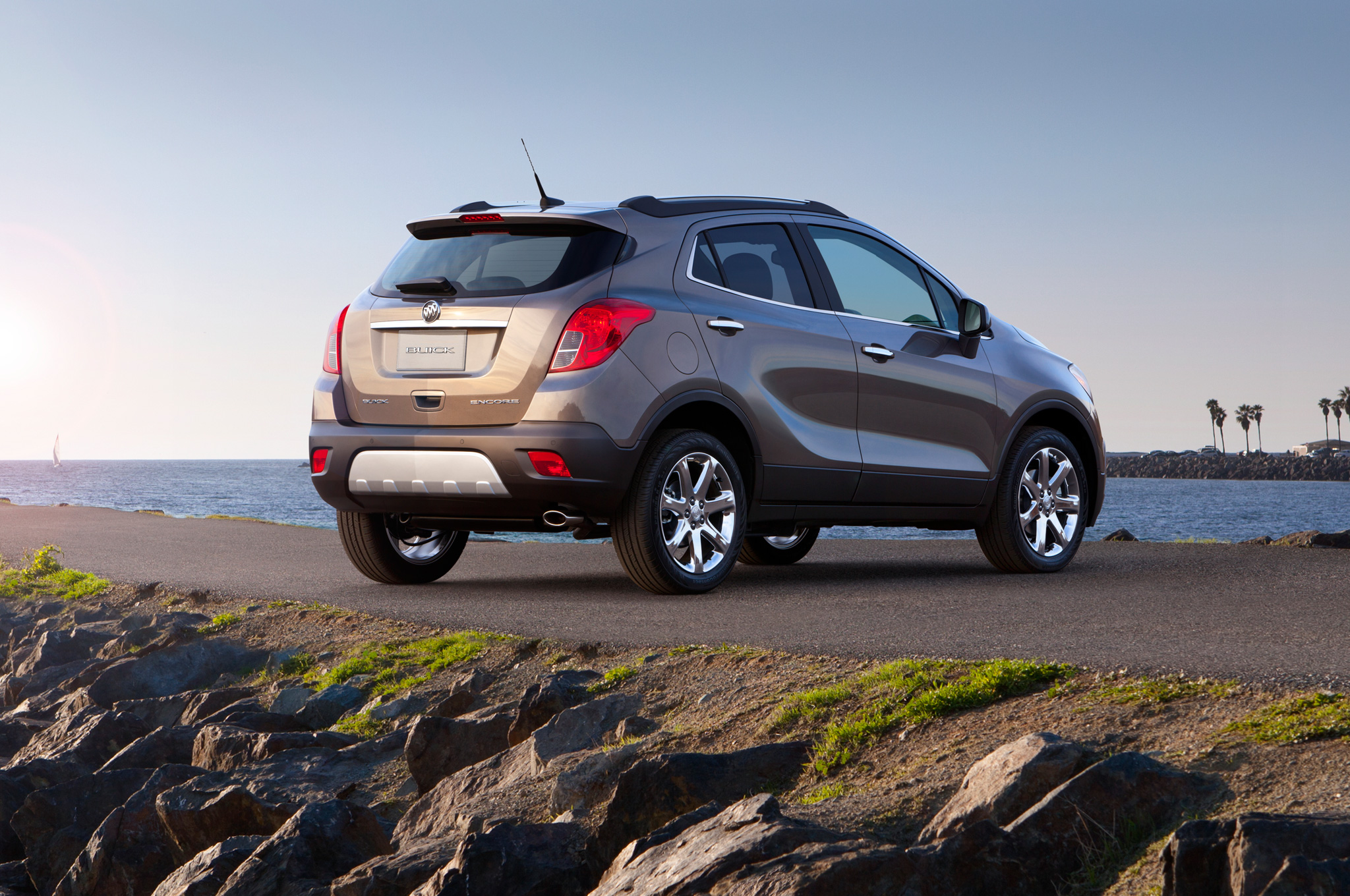
2013  Buick Encore (Exterior is identical to the 2014 model)

2013 Buick Encore (Exterior is identical to the 2014 model)

So how does this tiny ‘ute fit into Buick’s brand DNA? The size and youthful appeal is so not-Buick that at first blush, it seems like it should be in the Chevy portfolio. After all, Chevy’s smallest SUV, the Equinox, is far larger than the Encore.

What it does have is premium materials like soft-touch plastics and leather seats, luxury car features like forward collision warning, a heated steering wheel and rain-sensing wipers and Buick’s calling card, a quiet interior.

Standard on the Enclave is Buick’s QuietTuning™ which includes a laminated windshield, triple door seals and tight body panels. Also standard is Bose Active Noise Cancellation which uses the same technology in noise-cancelling headphones to eliminate that annoying road noise.
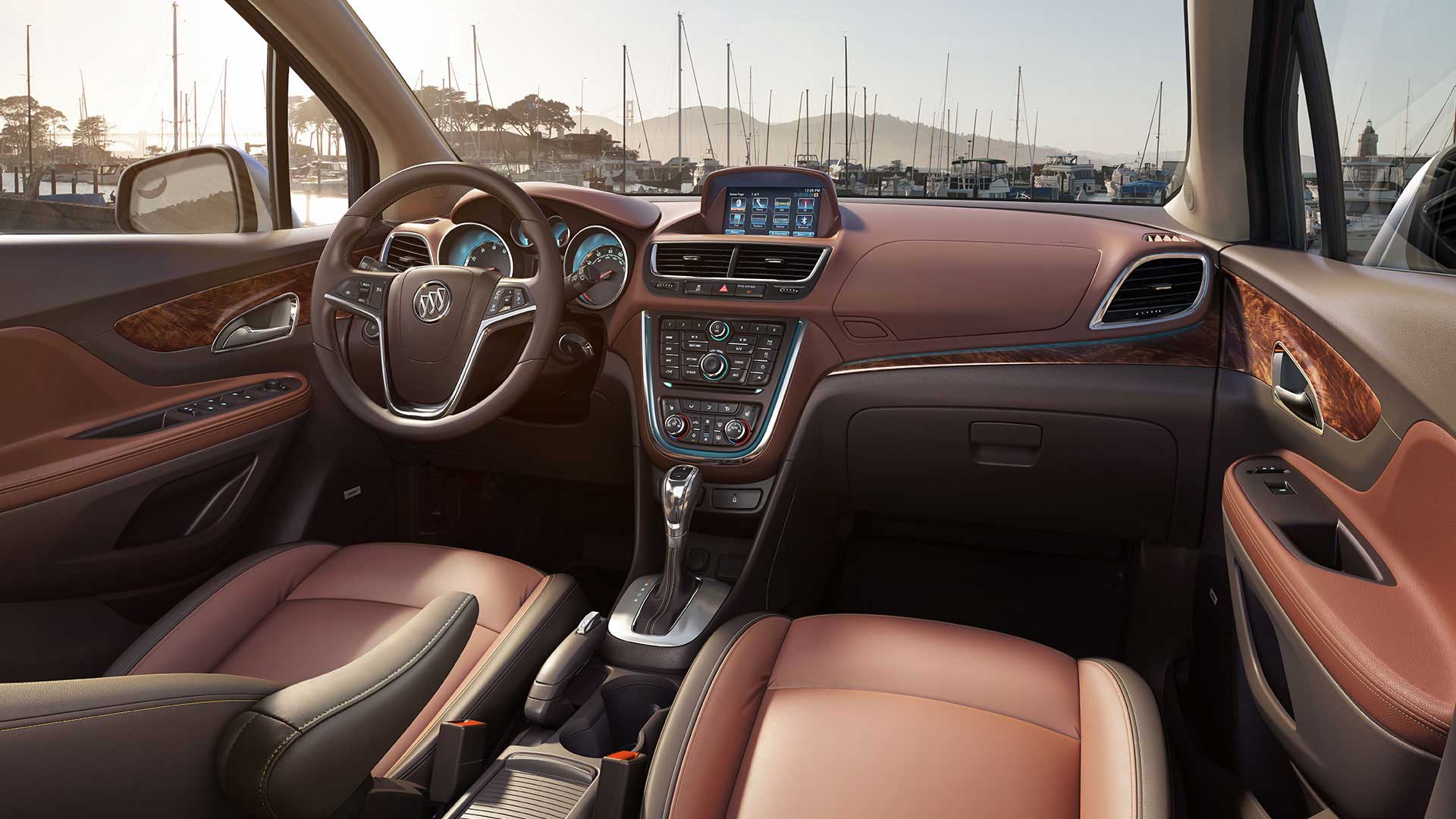
2014 Buick Encore Interior - Premium Trim level.

2014 Buick Encore Interior – Premium Trim level.

But what I found most appealing was its personality and exclusivity. No other luxury or near-luxury brand has such a small offering. The closest comparison for price and size is the much noisier MINI Countryman. The Encore starts at $24,160 and a Premium trim model with AWD tops out at around $33,000. The Countryman starts at $22,100 but a Cooper S All4 tops out at more than $36,000 with a slew of high-end BMW options.

The Buick waterfall grille is very bright. I like the new stylized tri-shield Buick badge.

The Buick waterfall grille is very bright. I like the new stylized tri-shield Buick badge.

People can’t help smiling when they see the Encore. It seems almost silly coming from Buick. You sit in a commanding position behind a very stubby nose with Buick’s large signature waterfall grille and new, stylized tri-shield badge. Forward visibility is great and it’s fun to flog around in town. It’s easy to park too.

The rear view camera (standard on upper trim levels) is a big plus as the rear window is tiny, limiting visibility. The extra visibility provided by the camera sure helps and it should be standard on all cars and trucks. Blind Side Zone Alert and rear Cross-Traffic Alert are new safety options for 2014.

The little 1.4L Ecotec turbo 4 uses all its 138 hp and 148 lb-ft of torque to entertain. Around town, it feels like it has enough power and while it won’t win a sprinting contest on the highway, I didn’t feel it was severely lacking. I didn’t notice turbo-lag in normal driving and there was only a hint of it when you mash the gas pedal. The QuietTuning™ helps reduce noise inside the cabin.

The double glove box is a nice touch. Great for small electronics.

The double glove box is a nice touch. Great for small electronics.

GM's 1.4L Ecotec engine.

GM’s 1.4L Ecotec engine.

The standard 6-speed automatic works seamlessly to row the cogs. Like all modern transmissions, it loves taller gears to save gas, but I wasn’t annoyed by constant hunting. Drive Shift Control allows the driver to choose the gear – handy when using the engine as a brake doing down hills.

The Encore is only slightly larger than the MINI Countryman, but it’s nearly 10” shorter than the Honda CR-V and 15” shorter than the Nissan Rogue. However, I think what matters to many buyers of “downsized” luxury is fuel economy.

The front drive Encore is rated at 25 mpg city, 33 mpg highway; average 28 mpg – nearly identical to the Countryman competition. The AWD option knocks 2-3 mpg off those figures.  It’s no secret that weight is the enemy of fuel efficiency. The MINI Countryman weighs in at 3,020 while the Encore tips the scales at 3,190 – a 170 pound difference.  I’d opt for the the extra weight to escape the noisy interior of the MINI.
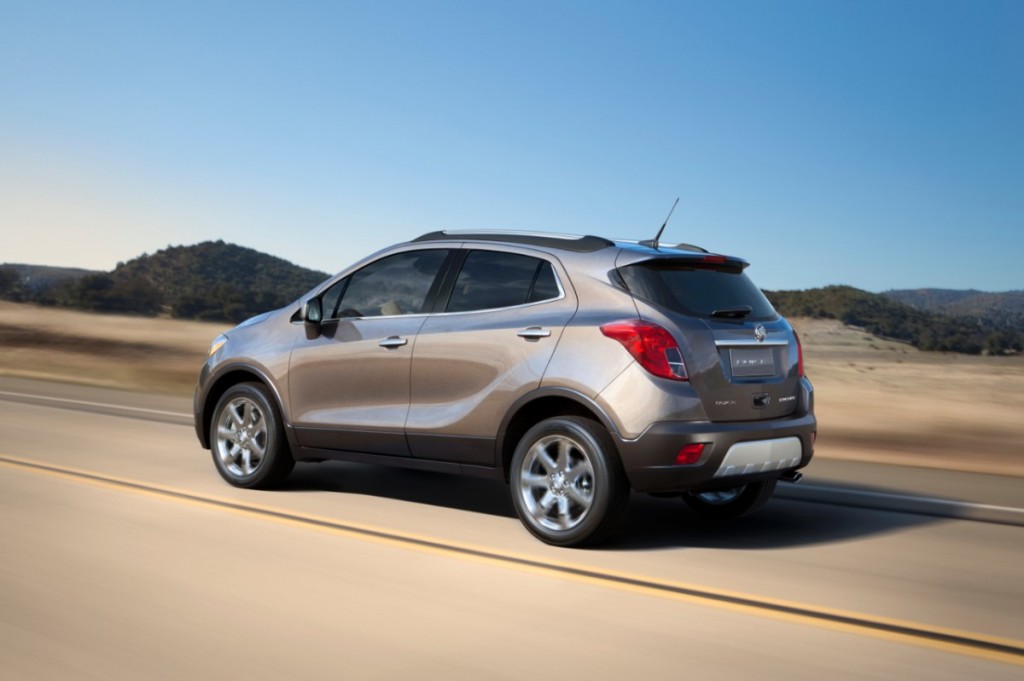
2014 Buick Encore

2014 Buick Encore

If you’re a big hauler of bulk items or regularly carry adults in the back seat, the Encore probably won’t fit your lifestyle. It’s best for 1-2 adults and maybe an infant. Total cargo capacity, with the rear seats folded is 48.4 cubic feet. That compares favorably to the Countryman which has only 42.4 cubic feet. But the decidedly more utilitarian Honda Fit, which is 7.4” shorter than the Encore, works magic to swallow 57.3 cubic feet of stuff.
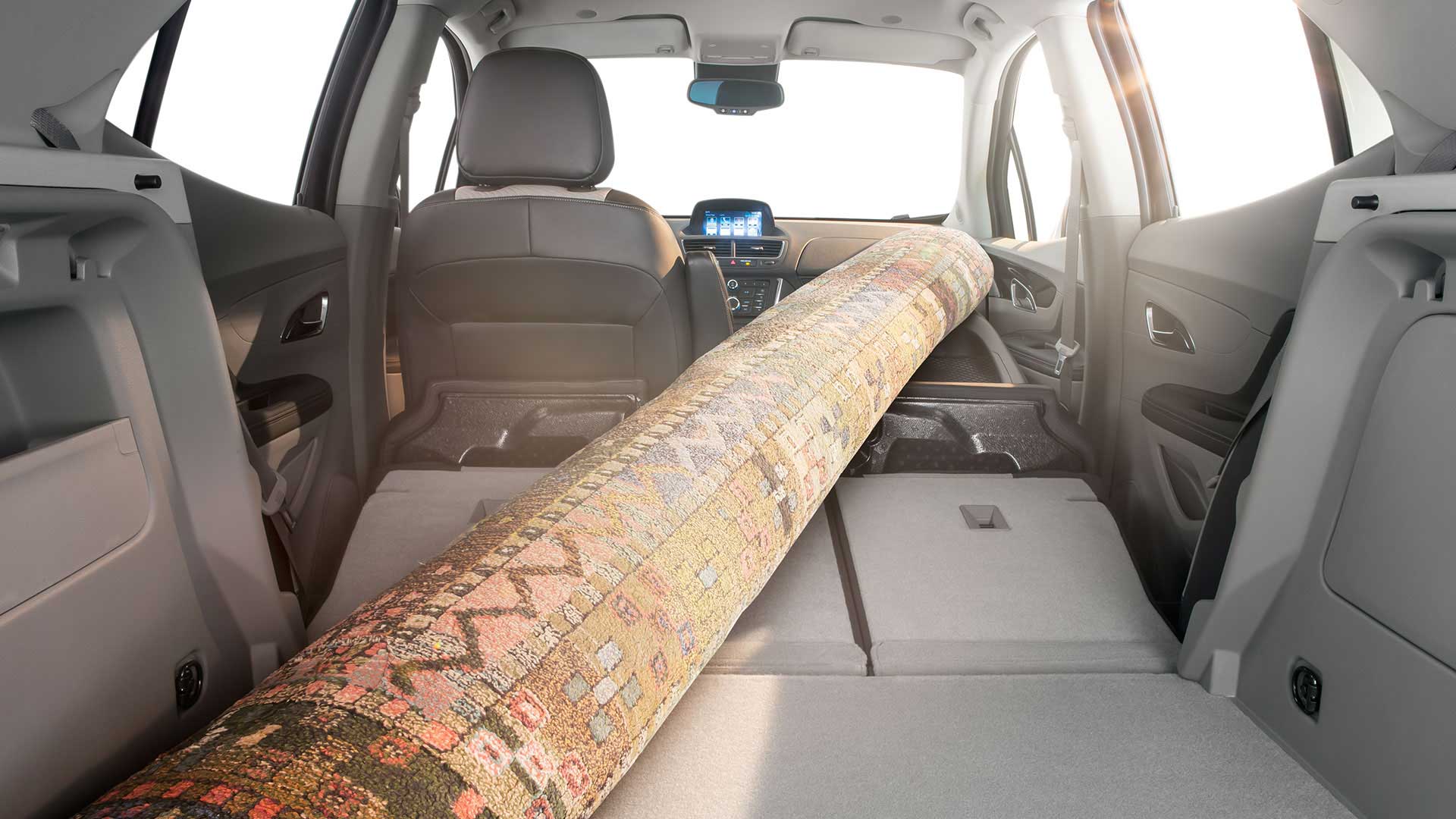
The interior of the Buick Encore. The seats fold flat and the front passenger seat also can fold nearly flat to accommodate longer cargo.
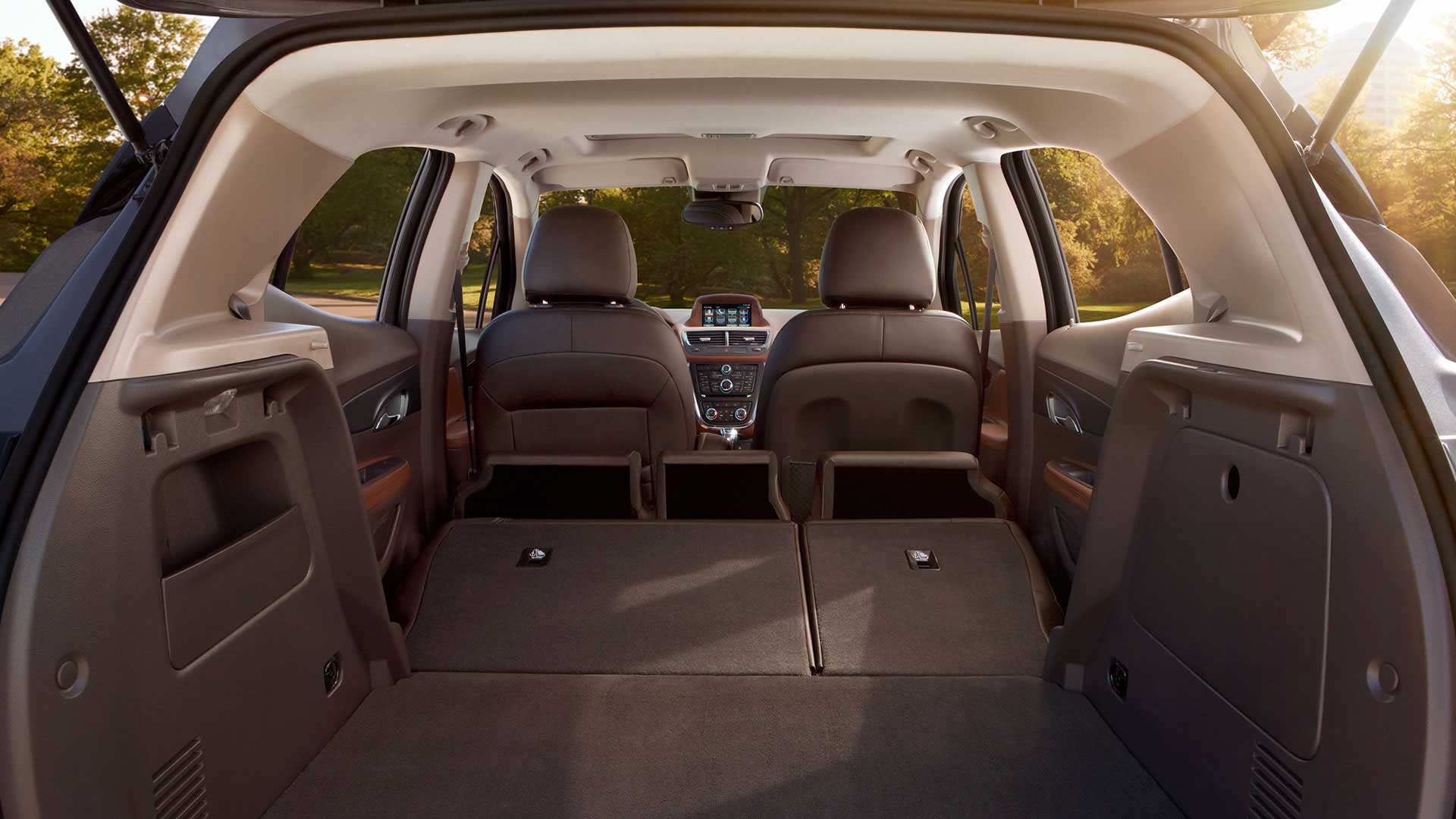
The interior of the Buick Encore. The seats fold flat and the front passenger seat also can fold nearly flat to accommodate longer cargo.

The interior looks like it could hold lots of stuff.

The interior looks like it could hold lots of stuff.

No review is complete without mention of infotainment. My iPhone synced easily with the Buick IntelliLink™ system. While the 7” touch-screen could be a bit bigger, it seemed easy to use and intuitive. I really didn’t go much further with it, but it’s far better than Cadillac’s annoying CUE system.

Buick Encore's IntelliLink touch-screen Infotainment system.

Buick Encore’s IntelliLink touch-screen Infotainment system.

So the Buick Encore is really a niche lifestyle vehicle and GM had no idea how it would go over in the US market. The 2013 Encore went on sale in February and through August, it’s sold nearly 20,000 units – three to four times GM’s original estimates. Days in inventory is a gravity-defying 15 days (normal inventory sits around more than 60 days before it’s sold). And the average age of a Buick buyer has come down by 10 year in only 8 years – so younger buyers won’t feel out-of-place in a Buick dealership.

I don’t know if I could ever own a Buick. I might still hold out for something like the long-rumored rear-drive Riviera flagship. But in the meantime, the Encore is the most tempting Buick I’ve driven in decades.


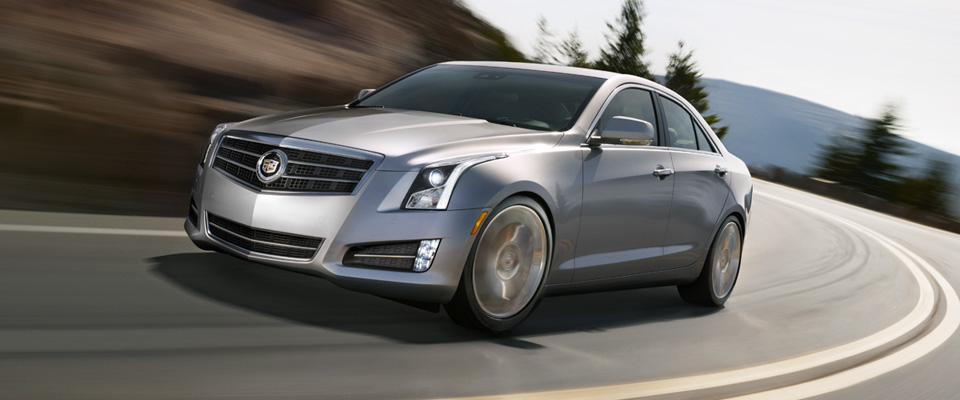
If you’re like me, you’ve read all the glowing reviews of the all-new 2013 Cadillac ATS, the entry level Caddy that was created to slay the mighty Germans, with the BMW 3-series directly in the engineers’ cross-hairs.

The first 2013 Cadillac ATS rolls off the assembly line. It was a great moment for GM's luxury division.

The first 2013 Cadillac ATS rolls off the assembly line. It was a great moment for GM’s luxury division.

I certainly was skeptical. After all, the Bavarian Motor Works has been honing its 3-Series for decades and it’s the de-facto benchmark by which all compact sports sedans must be compared. Cadillac’s engineers tore apart the 3er to see what makes it tick and then built the company’s all-new rear-drive Alpha platform to meet, match or exceed the standards of BMW.

The short answer is that Cadillac has succeeded in making a competitive, first-rate compact sports sedan. Is it a BMW? No, it’s not, but it’s a great freshman entry. It’s not quite carved from one block of granite and doesn’t convey the decades of engineering experience and crammed trophy cases that paved the way for the current (internal code) F30 BMW is built.

A BMW 328i sedan - the benchmark for all compact sports sedans and the target of the 2013 Cadillac ATS.

A BMW 328i sedan – the benchmark for all compact sports sedans and the target of the 2013 Cadillac ATS.

Perhaps I’m biased because I’ve owned at least one or more cars from all the German manufactures. Perhaps I’m predisposed to expect mediocre product from the Wreath and Crest division of General Motors. However, in the ultra-competitive luxury car market, brand image is vital and perception translates into sales reality.

GM’s luxury division is going to have to work magic to get BMW, Mercedes or Lexus owners to cross shop – particularly in a region like Southern California where a Caddy is joke punch line, not something you drive. Cadillac’s customers skew much older and attracting youth to the brand – youth that will appreciate the driving dynamics of the ATS and who will know how to use all the electronic gizmos – will be key to the future of the brand.

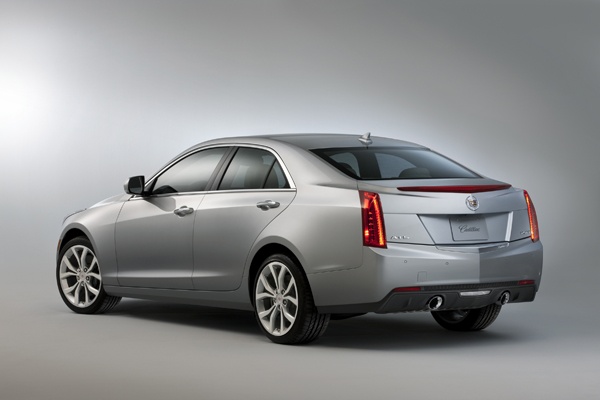
I’d like to get past the styling before we get to the actual driving experience. The ATS wears a conservative, toned-down version of Cadillac’s decade-old Art & Science theme. I like the way the vertical headlight array sweeps up the front fenders and the mini fins in back are a Cadillac hallmark. The rear center brake light is nicely integrated into the trunk lid. The whole package works well, but color choice is very important to the overall look.

2013 Cadillac ATS Luxury Sports Sedan

2013 Cadillac ATS Luxury Sports Sedan

Detail of the 2013 Cadillac ATS'  headlight module. Note how the vertical LED running lights sweep up and over the front wheel fender. A nice touch.

Detail of the 2013 Cadillac ATS’ headlight module. Note how the vertical LED running lights sweep up and over the front wheel fender. A nice touch.

The rear of the 2013 Cadillac ATS. You can still see vestiges of fins in the vertical taillights and the center brake light is nicely integrated into the trunk spoiler.

The rear of the 2013 Cadillac ATS. You can still see vestiges of fins in the vertical taillights and the center brake light is nicely integrated into the trunk spoiler.

The ATS’ Alpha chassis is text book sports sedan: Front engine, rear-wheel drive, four-wheel independent, multilink suspension, four-wheel anti-lock disc brakes and optional all-wheel drive. Like all modern cars, to save weight and engine drag, the ATS uses the latest-generation electric power steering unit from Germany’s ZF.

Cadillac offers three engine options: The base unit is a Chevy 2.5 L four-cylinder unit with direct injection making 202 hp. Next up is a 2.0L turbo four, also with direct injection, making 272 hp and the most potent engine (before the inevitable ATS-V makes its debut) is the familiar 3.6L direct injected V6 good for 321 hp.

The standard transmission on all trim levels is GM’s aging 6-speed automatic with paddle shifters. You can get a 6-speed manual transmission only on the 2.0 turbo models. GM always seems late to the party on transmission. Its competitors have been using 7- and 8-speed automatics for a while now. However there is hope. The just-introduced 2014 Cadillac CTS, which also rides on the Alpha platform, will use an Aisin (aToyota affiliate) 8-speed automatic on some models with V6 engines. The 8-speed should migrate to the ATS in the next model year. Problem solved.

I drove the ATS 3.6 Luxury with a base MSRP $42,090 – much more than the standard ATS 2.5 that starts at $34,000. Aside from the V6, 6-speed automatic and an assortment of other goodies, it come standard with the CUE (Cadillac User Experience) infotainment system (sans navigation). My tester had the optional $845 Driver Awareness Package and nothing else.

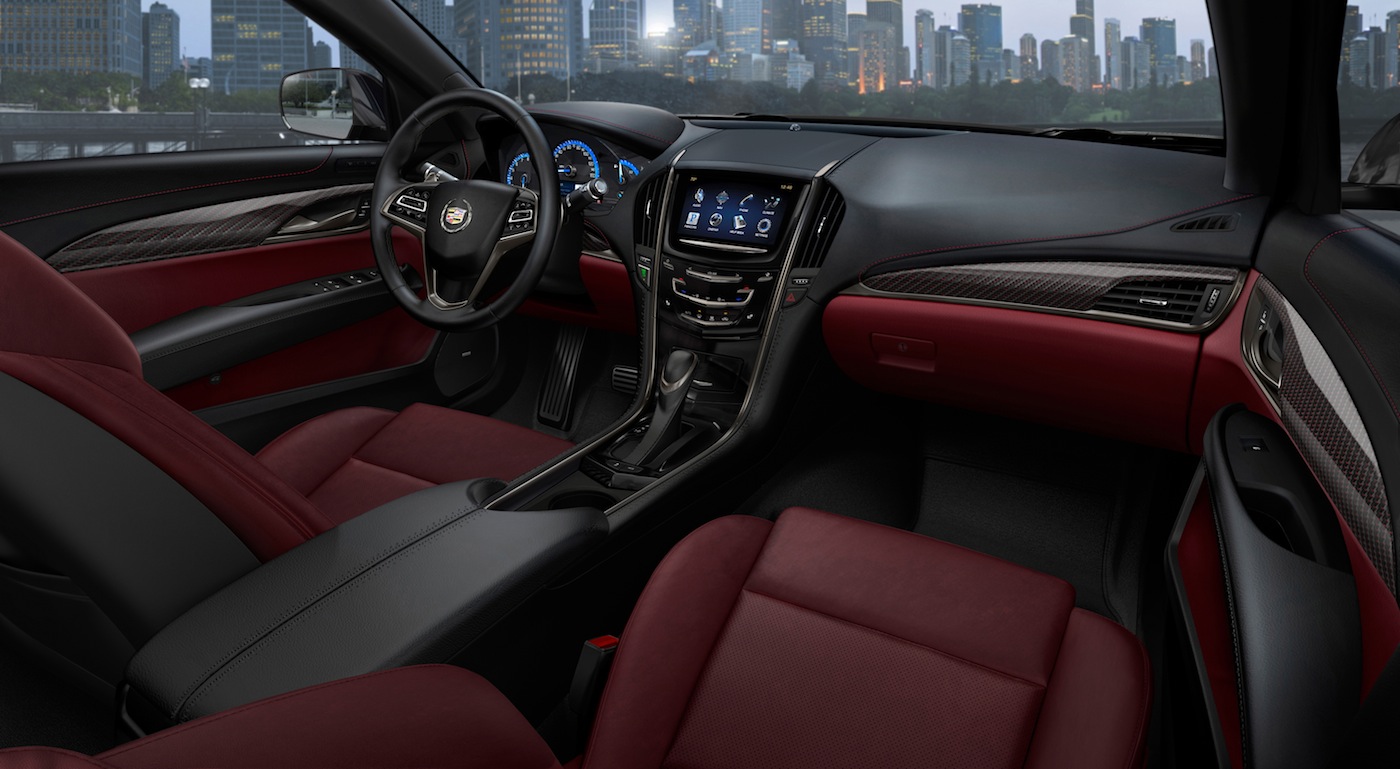
Morello Red leather with Jet Black accents is an optional interior on the ATS

Morello Red leather with Jet Black accents is an optional interior on the ATS

The ATS was a delight to drive. If this was around in the Roman times, Mercury wouldn’t have needed wings on his shoes. The 3.6 has plenty of power and a very broad torque range. It effortlessly flew up hills and down wide boulevards. This was a happy time for my right foot; just don’t watch the instant fuel economy readout.

The ATS felt light and nimble, even in “Luxury” trim wearing only standard 17 inch wheels and all-season tires. And I do mean light. The V6 ATS weighs around 3,400 – about 100 pounds less than the comparable BMW 335i. It’s also balanced nearly 50-50 front/rear, long a BMW bragging point. It easily tosses into turns and straightens out without feeling like the mass is still moving in the opposite direction.

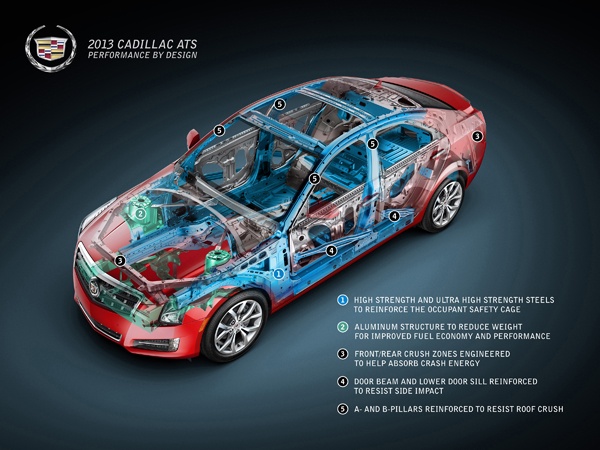
A cutaway of the 2013 Cadillac ATS shows how weight was saved by using aluminum and high-tensile steel.

A cutaway of the 2013 Cadillac ATS shows how weight was saved by using aluminum and high-tensile steel.

Fortunately, the Cadillac doesn’t use run-flat tires like almost every BMW. Even on highway braille bumps and uneven surfaces, the chassis was calm, quiet and composed, facilitating a sporty but comfortable ride. It was a joy.

Steering is light, well balanced with commendable road feel. Much can be attributed to the ZF EPS unit, but Cadillac’s engineers really spent bundles of time and untold computing hours tuning the steering – and it shows. There was no drift, and it tracked laser straight and small movements yielded exacting results. I wished for slightly better on-center feel. That said, I wished for the same things when I drove 2012 BMW 328i and it’s the benchmark.

Cabin quality was on par with the competition, but not to the level of Audi. Materials felt rich, plastics were mostly soft to the touch (with a few glaring exceptions) and I liked the French stitching on the dash. Some switchgear felt cheap.

The cock pit of the 2013 Cadillac ATS sports sedan. This one has CUE, Cadillac User Experience, the brand's high-tech infotainment system.

The cock pit of the 2013 Cadillac ATS sports sedan. This one has CUE, Cadillac User Experience, the brand’s high-tech infotainment system.

For me, the cabin was a bit claustrophobic – I’m 6’1” tall, 180 pounds. While I fit in the seat, and I liked the electric adjustments, side bolsters and the manual thigh support extension, I just felt like the passenger and I were too close. There was an unconscious jousting of elbows for the slim center arm rest.

And with me in the driver’s seat, the back seat is good only for small adults or children. There was barely room for our two dachshunds. The BMW 3 seemed to have more space. Trunk space was on par with the others in this category. If your idea of weekend fun is Swedish meatballs and flat-packed furniture, buy an SUV.

Cadillac’s CUE infotainment system is frustrating and might be enough to kill the deal. I’ve driven many cars with more responsive touch screens. I believe Chevy’s MyLink infotainment system that mixes a more responsive touch-screen with old-school knobs and buttons is far superior. While CUE’s haptic feedback is nice, I always felt a hesitation when I punched a function on the slick 8 inch full color screen. It was slow enough to make me almost want to touch the control again. Like many others, I’m used to the instant response of an iPad screen and CUE feels like the design predates the iPad which is already on its third generation.

The capacitive sensing touch screen of CUE.

The capacitive sensing touch screen of CUE.

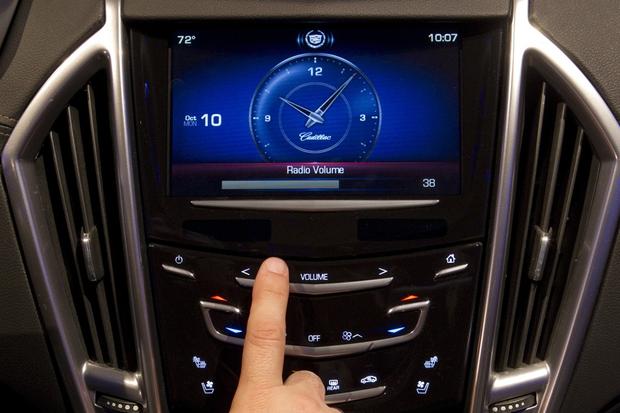
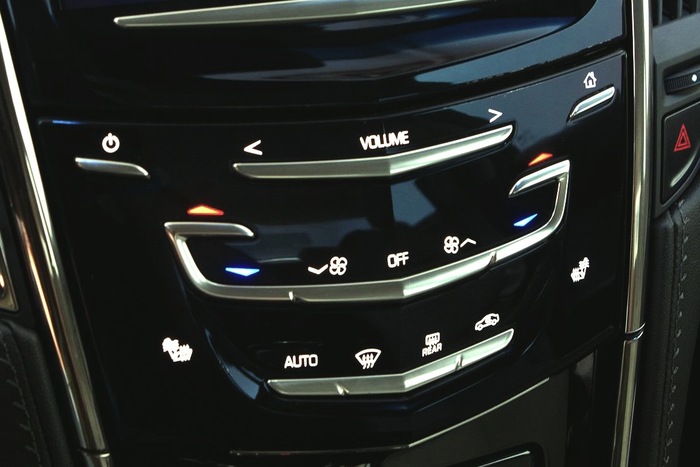
I also don’t like the lack of physical knobs for things like volume or climate control. While I’m sure you’d get used to sliding your finger over the slick center panel to raise or lower volume, I’m willing to bet users will elect to control that kind of stuff with the redundant hard buttons on the steering wheel.

The center dash touch panel of the 2013 Cadillac ATS has no knobs or physical buttons. Everything is touch sensitive. It's easier to turn the knob to turn the sound up or push it to turn the system off.

The center dash touch panel of the 2013 Cadillac ATS has no knobs or physical buttons. Everything is touch sensitive. It’s easier to turn the knob to turn the sound up or push it to turn the system off.

The very fact that the 2013 Cadillac ATS exists is a minor miracle and I wouldn’t hesitate to recommend it to someone looking for something different from the standard issue (in LA) BMW 328i, Audi A4 or Mercedes C250. But for me, it’s really the Almost There Sedan from Cadillac. It would only be attractive on a heavily-vented short-term lease. I have high hopes for the ATS, particularly when it matriculates to its 2nd generation. Maybe then, some of its freshman flaws will be exorcised and we can call it the All There Sedan.

[Editor’s note: March 2013 sales were announced two days ago. Cadillac’s March 2013 sales were up 55%. The ATS had its best month since launch, with 3,587 units sold – outselling the Audi A4/Allroad, but still a distance from the BMW 3-series with nearly 9,000 unit sales. Ward’s Automotive reports that 70% of ATS sales were “conquest sales” from BMW, Mercedes-Benz and Lexus.  Fifty percent of ATS sales were with the 2.0T engine, with the remaining half split evenly between the base 2.5L I4 and the 3.6L V6 engines. ]