It’s party time at BMW’s diminutive MINI division. Year-to-date sales are up over 26% and all is wonderful, right? However, August 2011 year-to-date sales data tell a different narrative from the spin put out by BMW PR. Most of the business is really stuck in neutral.
When you look at U.S. Light-Vehicles Sales by Nameplate, it’s always been hard to know how well any particular MINI variant has sold. That’s because all MINI sales data has been reported as one line item: Mini Cooper S car (I). (“I” is for imported as opposed to domestic production.)
Since MINI returned to the US, the official sales statistics have lumped together every variant of the MINI Cooper, including base and S-Models of the Hardtop, Convertible and Clubman. The cars with the John Cooper Works (JCW) option packages were similarly included. The public never got a breakdown as to how many convertibles were sold or how many picked the S variant over the standard Cooper.
Year-to-date, MINI has sold 27,565 cars – that’s behind 2010 year-to-date of 29,704 cars. The 7.2% decrease isn’t a good thing in a market that is seeing most manufacturers post healthy sales gains. So what’s up with the back-slapping and champagne at MINI? One word: Countryman.

2011 MINI Cooper S Countryman ALL4 with the John Cooper Works (JCW) option package.
When the Countryman was introduced, it was classified as a “truck” by the EPA and that’s how it’s reported for official sales statistics. Cars and light trucks are broken out separately as are domestically-produced models from imported ones. For example, I can tell you how many Toyota Corollas were produced in the US versus Japan, but I can’t tell you the breakdown between the sedan or the Matrix wagon. So this is the first opportunity we have to evaluate how well a single model is selling within the MINI universe.
Americans seem to be unnaturally attracted to SUVs (or is it crossovers?). We won’t buy a cool sports wagon such as the BMW 328i Touring; but we will buy one if it’s jacked up a few inches, saddled with 4-wheel drive, given some faux off-road creds (like it’s ever going to be driven off pavement) and marketed as an SUV.

2011 BMW 328ix Sports Wagon. It's a lovely car, but the X3 SUV creams it in sales.
We no longer live in the Wild West and 99%+ of the time an SUV will never drive off-road. Yet we cling to this myth that we are going to ford streams or blow through the Mohave sand dunes in the same vehicle we use to take the kids to school and fetch groceries. There is also this mistaken belief that the bigger and taller the vehicle, the safer you are in an accident. SUVs have a higher center of gravity and are much more likely to roll over in an accident. You’d be better off in a mid-sized sedan with lots of air bags.
The 2011 Countryman (base MSRP $22,350) rides on an all-new platform. Its body is welded to the chassis, so it would be best described as a crossover or CUV. It has 7 air bags and an air curtain system. And its selling like the iPad. Year-to-date sales of the Countryman are nothing short of spectacular at 10,071 units.
Although MINI’s August sales were down 30% from 2010, overall sales are up 26.7% year-to-date. The entire increase – 100% – is due to the Countryman which now accounts for more than 30% of MINI’s total sales. Apparently all it took for MINI to expand its appeal was to inject a small wagon with steroids and sprout 4 door. Suddenly Americans take notice.

The front of the Countryman looks like an English Bulldog
I can attest to seeing many new Countrymans running all over Los Angeles. Frankly, I wish it had been around before I leased my MINI Cooper Clubman S (MCCS) in 2009. I could have used four real doors and the large rear tailgate would have made it easier to load junk, not to mention carrying my dog in his crate. In short, the Clubman was just too small and uncomfortable for my lifestyle.

That's quite a cavern for a MINI
 Is Countryman handsome? Well, that’s in the eye of the beholder. I think it’s loveable like a fat, wheezing bulldog. It’s so big and cartoonish that it’s almost endearing. The interior is much the same as any other MINI except for the cool utility rail that runs from front to back. If you like MINI’s quirky interiors, then you will love the Countryman. The verdict is that it sells and that’s all that matters.
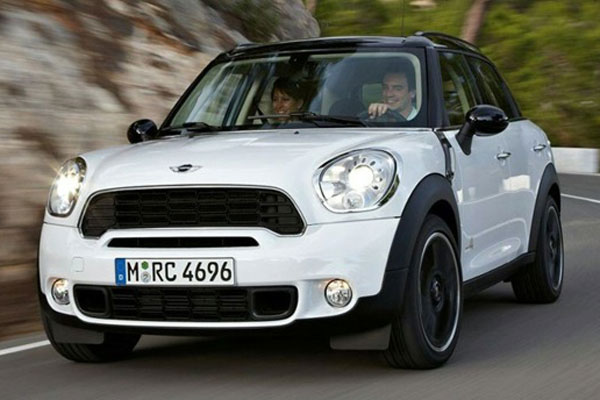
It kind of looks like an English Bulldog, no?

The Countryman's dashboard and center console is very similar to other MINI models
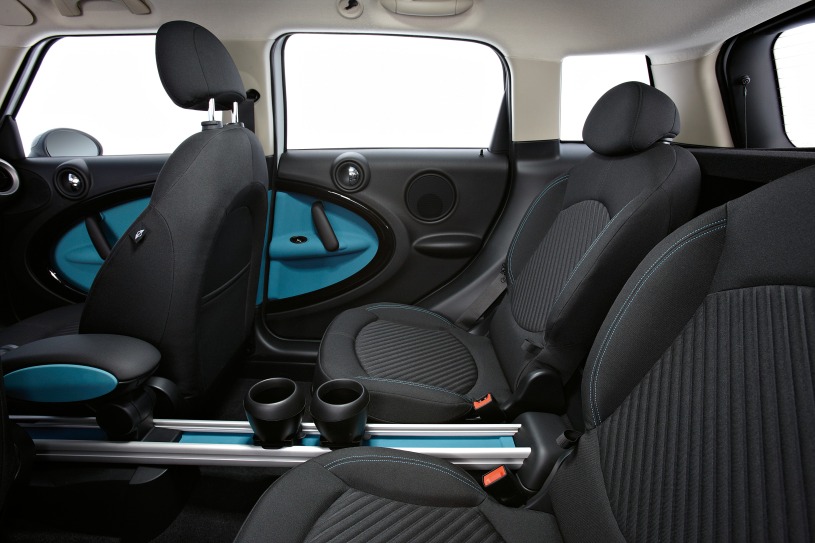
The back seats look like seats! Note the center rail that runs from the front seats to the rear seats. MINI offers several add-ons like cup holders, coin holders, etc. for the rack. You can slide them back and forth between front and back.
The Countryman is also the first MINI to offer all-wheel drive – dubbed “All4” in MINI-speak. Most LA drivers don’t need a car equipped with all-wheel drive. The system adds unwarranted cost, complexity and weight that ends up costing more to operate and maintain on a long-term basis. The front-drive Countryman (30/25/27 mpg with the 6-speed automatic) is more than sufficient for daily duties. Yet it’s somehow comforting to think that in some natural disaster – like rain – you car can save you and shepherd you home.
My MCCS was plagued with a bad case of torque steer. In hard driving, you had to really hold on to the wheel or risk losing control. The ALL4 system in the new Countryman would have directed some of that wild torque to the rear wheels making it an easier car to control. Unfortunately, I’m pretty sure that the MINI Cooper S Countryman ALL4’s extra heft (232 lbs), cost (base MSRP $27,650), reduced mpg (30/23/26 with the 6-speed automatic) and higher center of gravity would negate the All4’s superior torque management capabilities.
The next new MINI to go on sale will be the MINI Coupe. The base Coupe ($22,000) costs $1,900 more than the Hardtop and while it sports one slick backward baseball cap roof, it also loses two rear seats, rear visibility and has less cargo capacity. Early reviewers don’t think it gained any additional sporting characteristics over the base MINI Hardtop. You pay more and get less. Ah, the cost of fashion!

The 2012 MINI Cooper S Coupe with the JCW option. You can see the backward baseball cap. Style over substance.
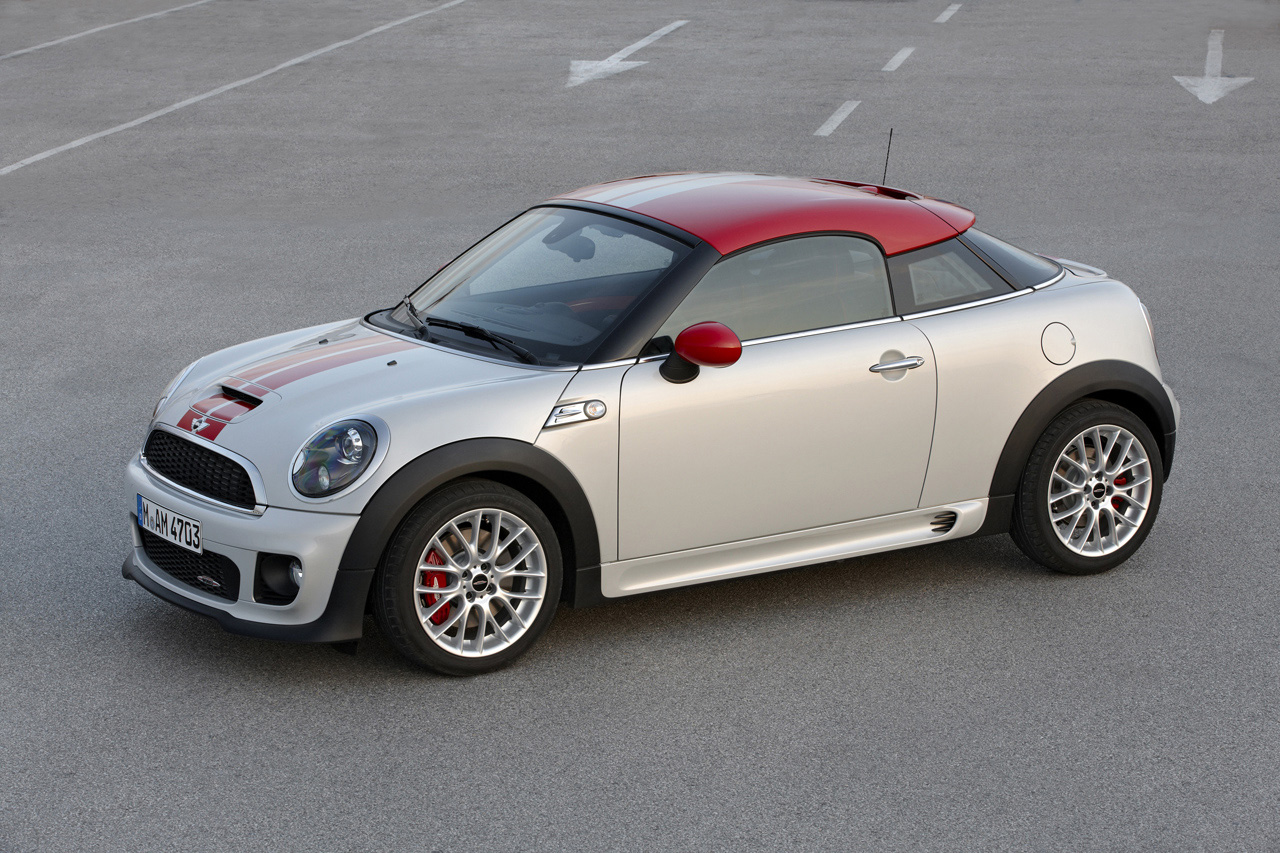
The front of the Coupe is the same as other MINIs; but from the A pillar back it gets unique sheet metal and a steeply-raked windshield.
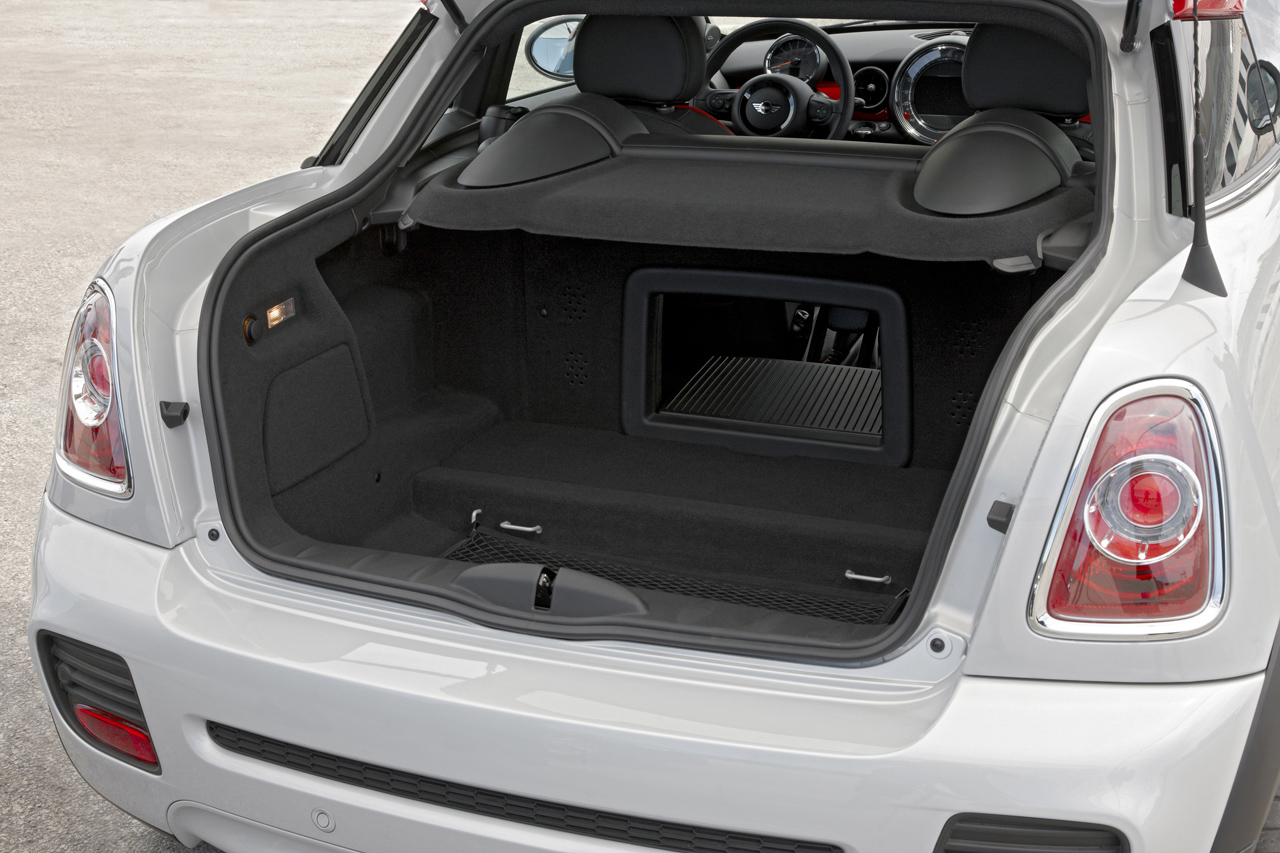
There's still space for some groceries and flat boxes. Nothing tall is going to fit in the Coupe's boot.
Unfortunately, we won’t know exactly how well the new Coupe is selling because its sales will be lumped into that catch-all single line item for “MINI Cooper S car (I).” My guess is that the Countryman will continue to be the growth engine at MINI. It’s the same thing for Porsche. If you look at its sales, the sports car numbers are dead flat (a new 911 is coming in March) while the sales of the Cayenne SUV have doubled in 2011. The American love affair with SUVs continues…




 Todd Bianco's ACarIsNotARefrigerator.com Blog