Archive for November, 2011


I know GM has had a hard time here in LA.  Even though GM now has compelling and competitive cars in the market, it’s tough to sell cars to zombies under the spell of Toyota and Honda.  To state the obvious, GM has no one to blame but itself for the horrible products it sold over the past 35 years. Year after year, generations of Southern Californians deserted GM’s crappy products and ran into the waiting clutches of the reliable, inexpensive Japanese imports.

Slowly, GM is rebuilding trust with a new generation of customers here in So Cal; but dealer choices are still pretty sparse in Metro LA.   For a while now, I’ve been fixated with the GM (Chevrolet-Buick) dealership in Santa Monica because it’s the closest dealer to me and something I drive by often. Santa Monica Chevrolet-Buick was located on a small corner lot on Santa Monica Blvd at Centinela on the eastern edge of Santa Monica (90404).   The shallow lot left little room for inventory let alone a large number of service bays.  Hell, the Land Rover dealer two blocks away has a larger, much nicer facility.

Santa Monica Chevrolet-Buick was only in business for five or six years before it seemingly disappeared overnight earlier this year and morphed into Santa Monica Infiniti.  But it didn’t disappear – it’s hiding in plain sight – or so I’m told.

To look at the dealership, you'd be hard pressed to think that any GM products were being sold there.

After Infiniti took over, the old GM logos (Chevy, Buick and Oldsmobile) were removed from the top of the building.  At first, only the large Infiniti logo and “Infiniti” lettering appeared over the showroom entrance.  A cheap temporary banner for Santa Monica Infiniti covered the GM brands at the top of the building.  About a month ago, signage reading “Santa Monica” appeared in place of the then-tattered banner.

The new "Santa Monica" lettering is nice and clear. Still no hint at any affiliation with GM.

Over the summer, I stopped at the Infiniti dealer to check into whether or not it was still a Chevy-Buick dealership. I was accosted by a slimy salesman who didn’t like the fact I was taking pictures; but, he reassured me that it was still a Chevy-Buick dealership. I drove home and checked the official websites for Chevrolet and Buick; but only Chevrolet listed the Santa Monica location as a dealer.  If I were a customer I would have been hard-pressed to find the dealer at this address. You had to look closely to see the few small GM signs around the service entrance.

That was then.  Now, today, when I checked the factory websites, neither Chevrolet nor Buick lists a Santa Monica location.  Next, I did a Google search for Santa Monica Chevrolet and found some old listings.  I called the old number: 310 828-4424 and it was answered by an operator who identified the business as “Santa Monica Auto Group.”  I asked her if they still had a Chevrolet dealership and if so what was the location. She said there was still a Chevrolet dealership and it was located on Santa Monica Blvd at Centinela Ave.  It’s like the Infiniti dealer is embarrassed by the Chevy-Buick franchise, pushing it over to a tiny, obscure parking lot on the west side of the property. Very strange.

About a month ago, a new tombstone Chevrolet sign was installed at the entrance to service.  I have yet to see either the Chevrolet or Buick logo appear on the small glass and stucco crap-box of a building.  The new Chevrolet sign says that this is still a GM “authorized dealer.”  What does it means when your location is no longer listed on the official websites of the brands you claim to represent?
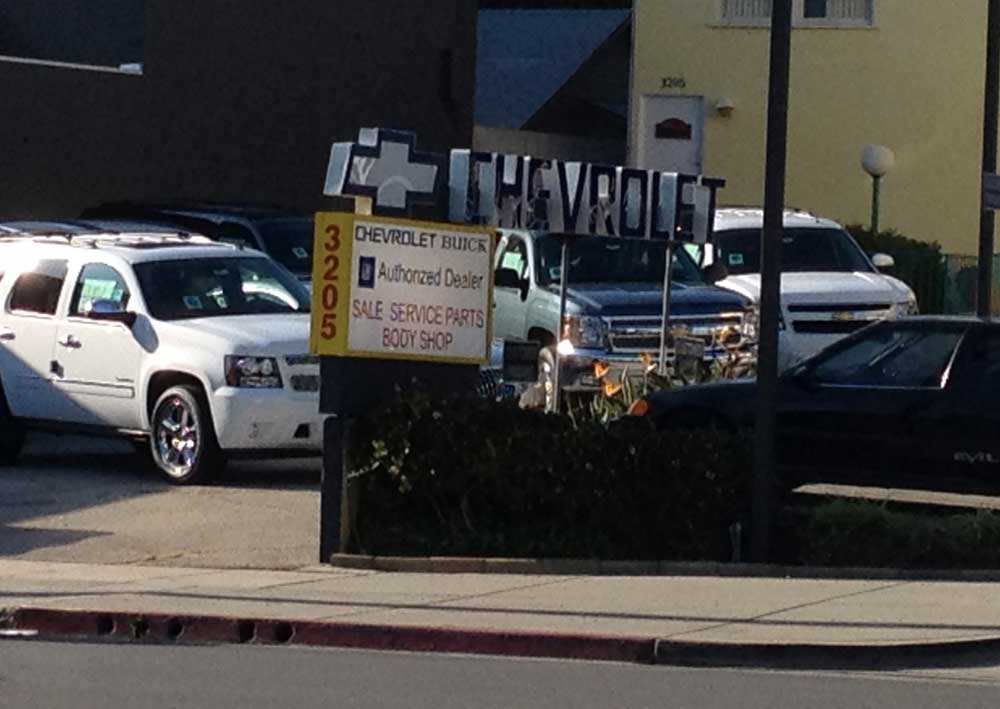
This is the new Chevrolet tombstone sign recently installed to remind customers that a dealership still exists on the site. It's not very noticable unless you're stuck in westbound traffic on Santa Monica Blvd.

I took pictures of the Chevrolet-Buick “inventory.”  I didn’t see any Buicks and only about a dozen Chevys, including the two red Corvettes by the sidewalk. Now, let’s be clear: real estate is very expensive in Santa Monica and it’s extremely common for dealers to keep lots of inventory at remote, usually covered, car parks. But I’ve never seen a franchise for such a large mainstream brand like Chevrolet relegated to a dozen cars parked on a cracked, uneven, barely-paved side lot. They don’t even get showroom space – at least not the day I drove by.

You can easily see the two red Corvettes in front; but the entire "lot" is only two cars wide and about six deep.

Here's a different view of the Chevrolet "lot." The yellow stucco building in the back is a residential apartment building, so you can see how shallow the commercial lot is.
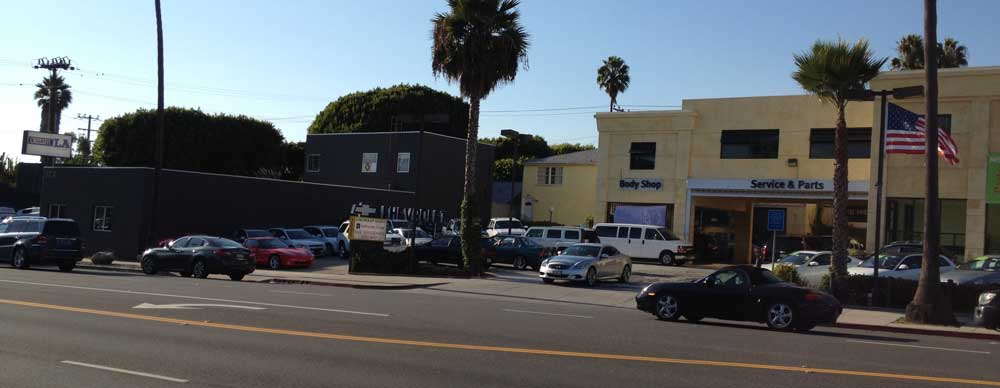
Here's a look from a distance at the Chevrolet section of the dealership. Notice that there are no signs on the service entrance to indicate anything other than Infiniti.

If this is still considered a Chevrolet-Buick franchise by someone, I think it’s the smallest one in the United States. It’s also an embarrassment to the brands and maybe that’s the reason they’ve been delisted from the corporate websites. I’d love to hear from anyone who has bought a Chevy or Buick (or any GM vehicle) from this dealer recently.


CODA Automotive, Inc. is a Santa Monica-based start-up company that has the lofty goal of putting an “electric car in every garage in the world.” While the eventual electrification of the automobile is inevitable, it’s going to be a while before that happens – probably at least a few decades. To get there, we’ll need a global shift in personal transportation thinking as well as vast improvements to the electrical grids and charging infrastructure.

The CODA 1.0 Sedan at the Westfield Century City shopping mall

The future of the electric car depends on battery technology. Currently, batteries (1) are too expensive, (2) weigh too much (weight is the enemy to efficiency), (3) lack sufficient energy storage capacity for long-range driving and (4) don’t recharge as fast as our fast-paced lifestyles demand.

You probably haven’t heard of CODA unless you’re an automotive tech geek or you’ve been to the Westfield Century City shopping mall near the AMC Cinemas and stumbled upon the CODA Experience Center, the company’s first, very slick showroom stocked with a see-through chassis and well-groomed, uniformly-dressed, ever-helpful 20-somethings called “Gurus” on their business cards.

The CODA chassis and battery

CODA thinks its proprietary battery has solved most of the common complaints about an electric vehicle. The CODA 1.0 Sedan (yeah, that’s really its name) claims a 150 mile range — much better than the claimed 100 miles for the Nissan Leaf and double or triple the EV-only range of the Chevy Volt.

For CODA’s large capacity 36 kWh 728 cell 330V battery, engineers chose Lithium Iron Phosphate (LiFePO4) chemistry rather than the more conventional lithium ion (L-i) chemistry used for batteries in the Leaf (24 kWh), the Volt (16 kWh), the $120k Tesla Roadster (56 kWh) and the Plug-In Prius (4.4 kWh).  CODA believes its battery pack is more robust, longer-lasting and safer. Manufactured in China without need for rare earth elements or cobalt, it provides greater range for less money.

The CODA’s battery also charges faster than its competitors primarily due to an on-board 6.6 kW/240 VAC charger. By comparison, the Leaf and Volt both have 3.3 kW chargers. The CODA can absorb enough juice in 2 hours to travel 40 miles – more than most people need for a day of driving. A complete charge takes only 6 hours.

The CODA's on-board charge consists of two 3.3 kW 240VAC chargers. Double the competition.

Of course, this assumes you plug the car into a 240 volt, level 2 charger at home or at a public charging station. You can plug it into a regular 110 volt, level 1 socket, however you will need 10 hours for a 50 mile charge and a whopping 30 hours for a full charge.

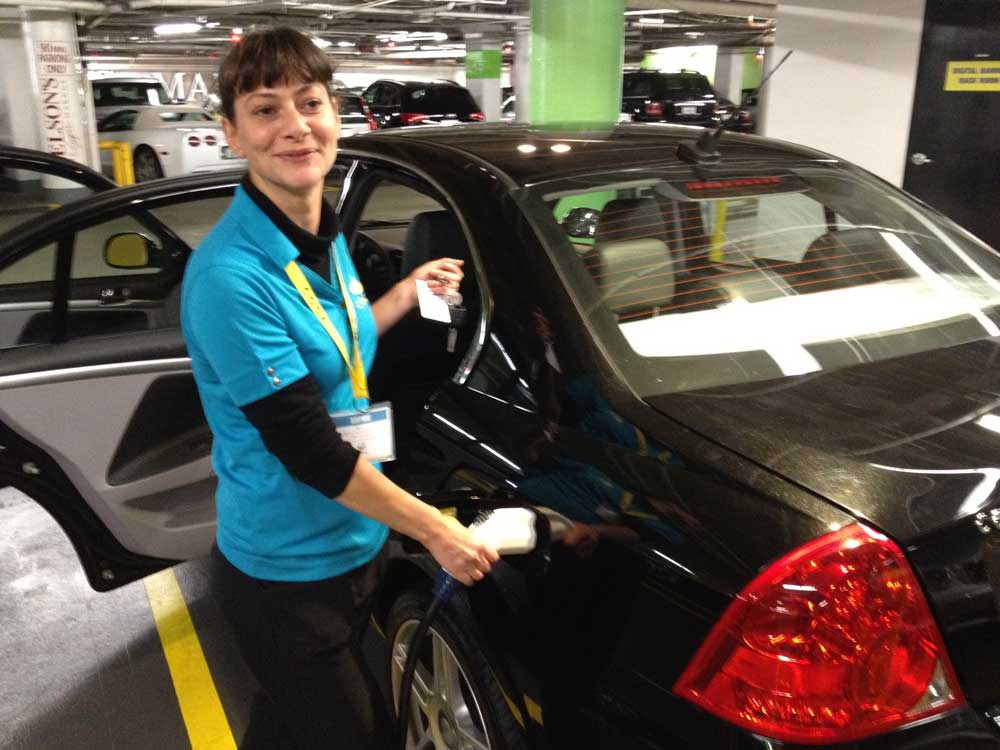
In real world driving, the Leaf is getting 70 – 80, not the claimed 100 miles per charge. I’d expect a similar decrement for the CODA; but my lovely, knowledgeable and engaging Guru, Sophie, assured me that CODA’s battery was different and better. She was absolutely positive I could cruise out to Palm Springs (125 miles), at 70 mph, with air conditioning and radio blasting, and still have extra range on arrival.

My "guru" Sophie Nenner from the Century City store. She was absolutely delightful and could answer any question I threw at her. If you're interested, you can contact Sophie for a test drive.

The battery pack and battery management hardware lie flat in the chassis, between the rear wheels and front axle, giving the CODA sedan a low CG (center of gravity). CODA’s proprietary “Active Thermal Management System” keeps the battery at an even temperature whether you’re in snow or sizzling in the desert.

Engineers claim the CODA 1.0 Sedan handles like a sports car because of the even weight distribution, low CG and 221 lb-ft of torque that is available from zero with the 100 kw/134 hp UQM Technologies motor attached to a single-speed Borg Warner transmission. A sports car it’s not, but it is a credible commuter car.

So far, all I’ve talked about is the battery. CODA’s own literature says “…Around the battery, we built a car, a company and a brand.” In fact, CODA’s first car is really just a great battery in search of better clothes and accessories.

I’ll start with the anonymous late 1990s exterior styling. Our friend Tom Pease was told it was an unproduced Mitsubishi design.  Maybe; but it could have been any econo-box from that time period. It’s hard to get excited about the sparky stuff when the exterior is such a non-conductor.

The sober and utilitarian interior is a United Nations of leftover or dated parts from Tier 1 suppliers. It all looks familiar in a generic way. You’re surrounded by two-tone imitation Apple white and dark gray hard plastic panels (the car’s one attempt at “style”), a simulated cardboard headliner, minimal instrumentation and manual HVAC controls that look like they came from a 1995 Toyota Yaris. Don’t look up – there’s no sunroof and you can’t get one.

A side view of the CODA 1.0 Sedan

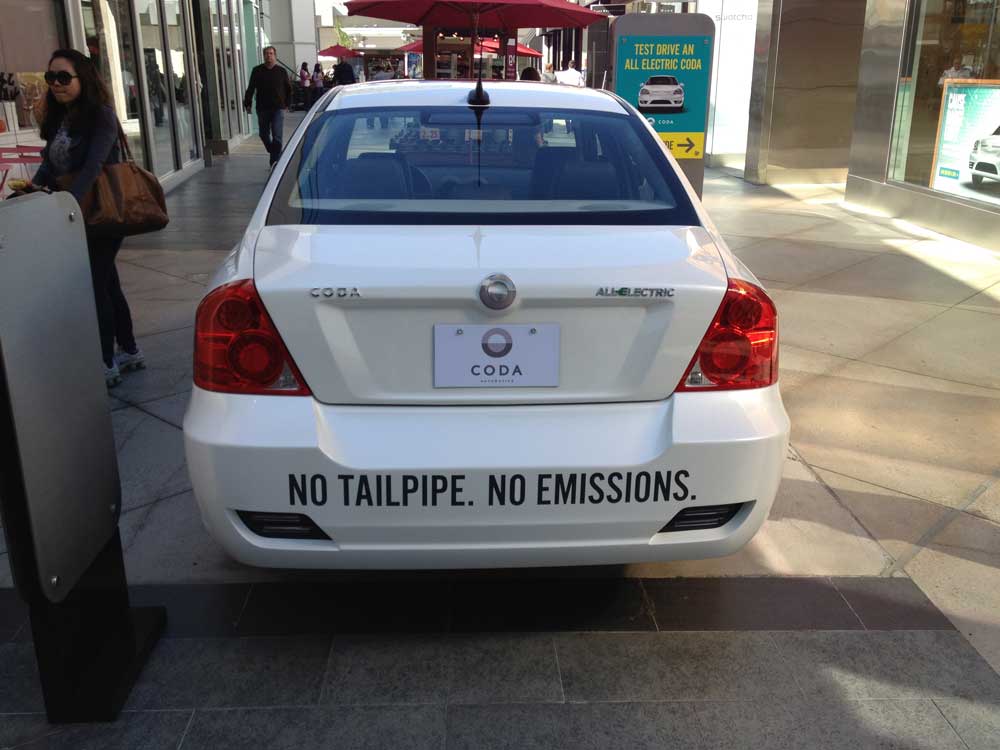
A rear view of the CODA 1.0 Sedan

The center dash houses an Alpine navigation-infotainment system with a distinctive aftermarket look. It boasts custom software to display the essential EV diagnostics, charging station locations and the all-important real-time range calculator. It was still in beta format on my test drive so I can’t tell you how well it works, but I do know it has Bluetooth and iPod/iPhone connectivity. There is no satellite radio option.

The "cockpit" of the CODA. Note the center rotary gear selector knob. This ain't no Jag.

The driver's door of the CODA. The two-tone theme was its the only attempt at "style."

The CODA’s center-mounted cylindrical gear selector looked and felt cheap. I thought it twisted too fast without easily discernible notches or stops. Is that Park or Reverse? Oops, I dinged the rear bumper on a concrete bollard in the subterranean garage.

You start the little sedan with an old-school key – no new-flanged push button start here. Except for the infotainment system, this car felt like a stripped, 15 year old Korean subcompact. The only option package available was the $1,495 leather seating surfaces and “premium” (better speakers) audio system.

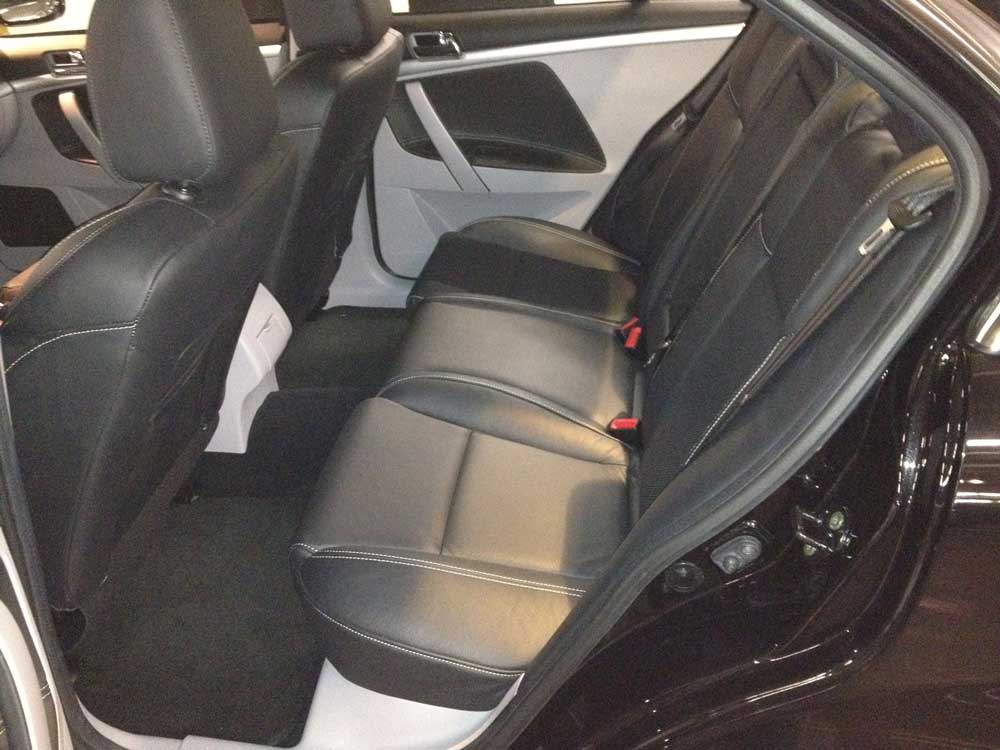
My pre-production tester had the aforementioned “premium” package. I wondered if the hard, flat French-stitched leather seats were worse than the cheap cloth “standard” seats. In either trim, only the driver’s seat gets a rake adjustment and my 6’1” frame wished for more thigh and lateral support. I wasn’t in the car long enough to judge the seat’s long-term virtues; but I’m a bit skeptical. If you have back seat passengers, they need to be short, thin and distracted. The center fifth seat should only be used to coerce confessions. At least the 60/40 split folding seats offer extra cargo flexibility.

The back seat of the CODA

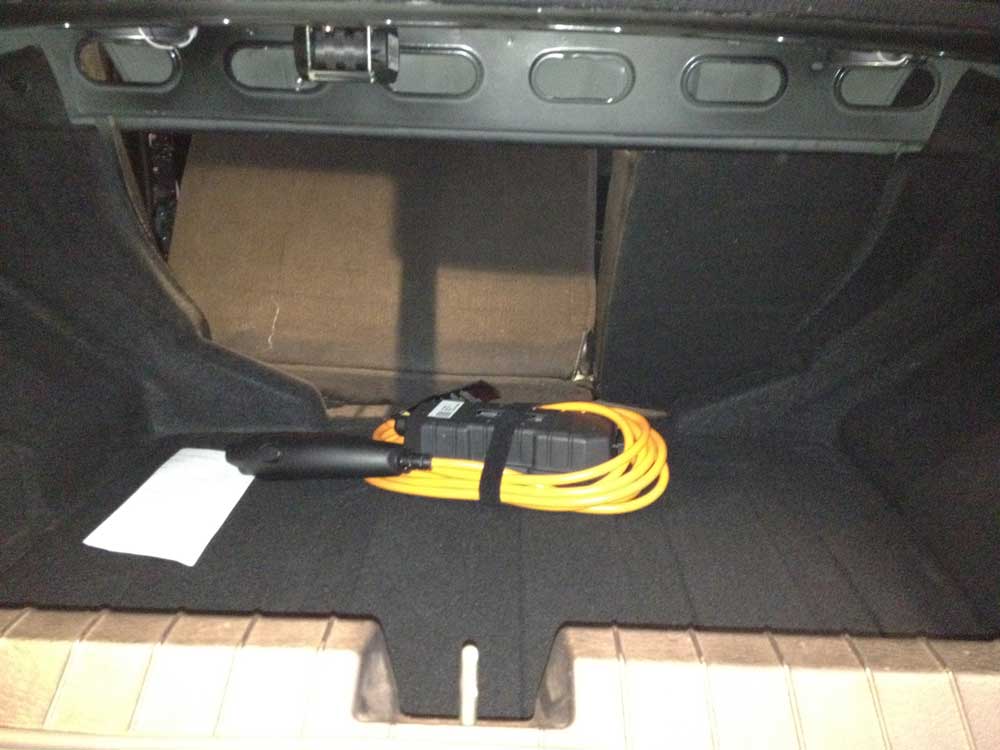
The folding rear seats do allow for some extra cargo capacity. Maybe it would work for skiis or a long narrow package from IKEA.

Emerging from the underground parking structure, I was immediately struck by the road noise – something much more pronounced on silent EVs. Your next sensation will be a moment of panic when you hit the hyper-sensitive, spongy regenerative brakes. There’s no assured linear feel here. It makes you long for the grabby brakes on a Prius.

On the plus side, acceleration was brisk and fun and the car felt solid and rattle free. The electric power steering isn’t going to win awards, but I felt in control even if there was little road feedback. While the car is a tad heavy at 3,670 lbs, the well-distributed weight didn’t seem to get in the way.

Overall, while it was a fun drive, the CODA lacked the creature comforts, advanced features, modern styling and unified design of its rivals from well-established manufacturers with vast dealer networks. The CODA’s trump card is its extended-range, fast-charging battery.

The CODA’s base MSRP of $45,795 is expensive. After the $7,500 federal tax credit and the $2,500 California BEV incentive, the price comes down to $35,795. But that’s thousands more (after credits and incentives) than a fully-loaded Volt ($33,135) or Leaf ($27,250) and about the same as the new Plug-in Prius Advanced ($35,525).

So what’s a battery with four wheels worth? CODA gives zero emissions customers the tantalizing promise of extended range, fast charging and an entertaining powertrain. For the target customer – early adopters, tech-geek and eco-freaks – the uninspired, low-rent packaging may short-circuit enthusiasm for this ambitious little car.

This slideshow requires JavaScript.

CODA Experience Center

Westfield Century City

10250 Santa Monica Blvd, #133 (near Breadbar & the AMC Cinemas)

Los Angeles, CA 90069

(424) 249-1616