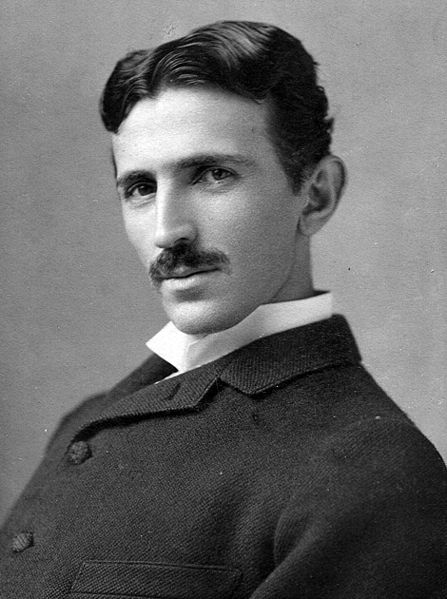
Nicola Tesla 1856-1943
Nicola Tesla was not your ordinary inventor. He patented the systems of generating and transmitting alternating current (AC) electricity used in virtually all electrical systems worldwide. He worked on wireless electricity transmission, vertical take-off flight and a “death ray” particle beam. He invented radio but Marconi got the credit. He thought that we would eventually harvest energy from the universe to power our world. Tesla was certainly ahead of his time. Maybe he had stumbled upon the hypothetical “dark energy” our current-day theoretical astrophysicists and cosmologists say is responsible for the expansion of the universe. Who knows?
Although more than a century has passed since Nicola Tesla first patented his brushless AC induction motor, essentially the same design is used for modern electric motors used in electric and hybrid vehicles, including those used by Tesla Motors in its ground-breaking Model S.
Tesla’s first piece of “technology” was the Roadster, a low-volume, hand-built sports car capable of highway speeds that used lithium-ion batteries with a range exceeding 200 miles. Almost 2,500 Roadsters were produced during its six year production run from 2006 – 2012.
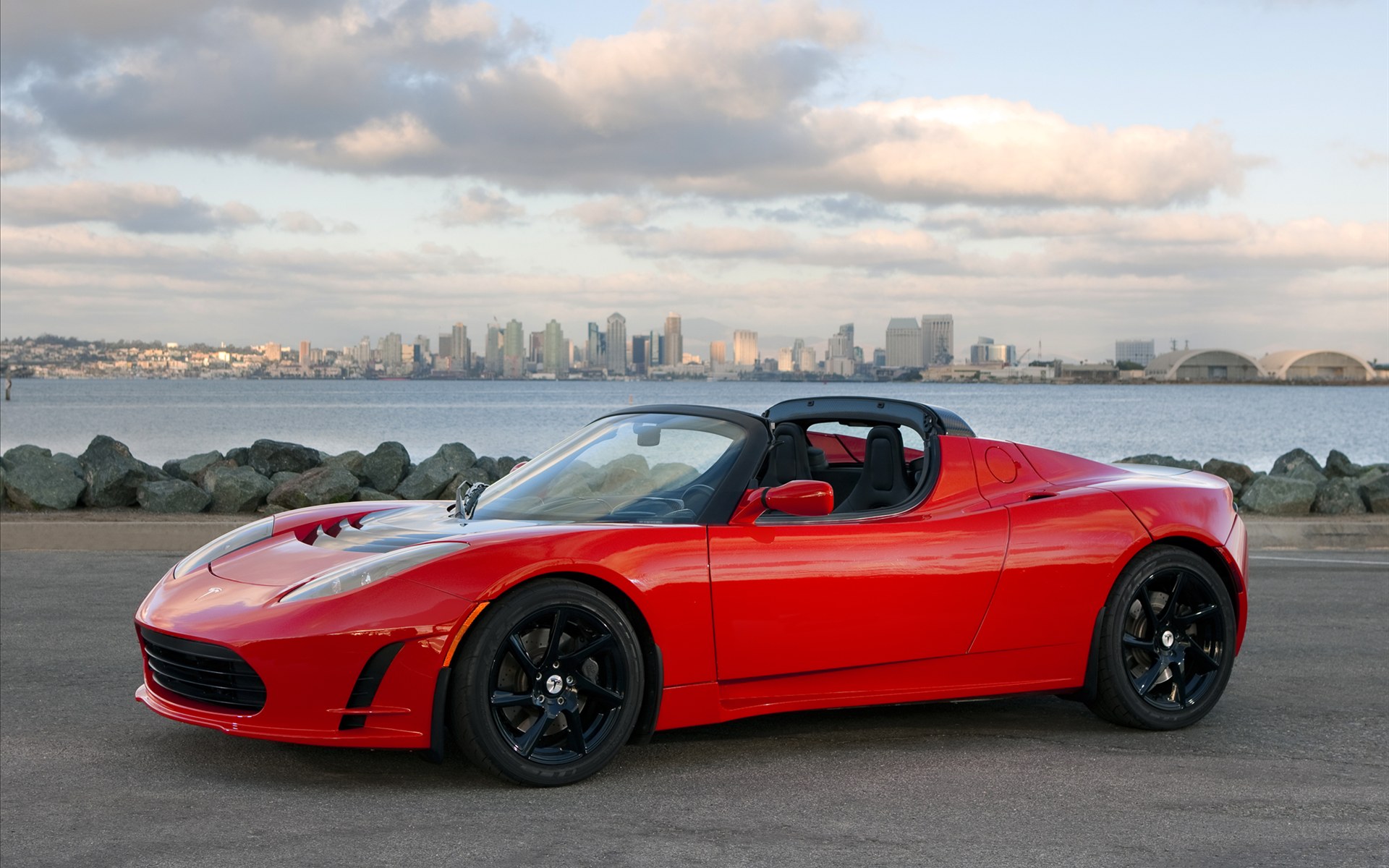
Tesla Roadster
Where the Roadster was more a proof-of-concept car for wealthy early adopters, the company’s Model S, a slick mid-sized 4-door sedan/hatchback, is the real world electric car we’ve all been waiting for. With the optional 85 kWh battery pack, it has a range exceeding 250 miles and with the ever-growing network of Tesla Superchargers, you can now drive your Model S, coast-to-coast, gas-free with free charging.
Starting at $63,570, the Model S (with the 60 kWh battery) compares most closely in size, style and price to the likes of the Mercedes-Benz CLS, BMW 6 Gran Coupé, Audi A7 and Porsche Panamera. The manufacturers love to use the oxymoronic term “four-door coupé” for these sexy, raked-roofed sedans with reduced rear-seat head room.

Tesla Model S in Grey
The P85 Performance Model S, with the 85 kWh battery pack and all the options ticked, tops out at around $118,000. The Germans can blow past that price with ease, but the P85 can hold its own in a drag race with 416 hp, 446 lb-ft of torque available from zero and a claimed zero-to-sixty time of 4.2 seconds (Car and Driver clocked it slightly slower at 4.6 seconds). That’s faster than the “standard” 2014 Mercedes CLS550 (with a 402 hp 4.6L biturbo V8) but slower than the CLS63 4Matic (with a 550 hp 5.5L biturbo V8).

The Tesla Model S P85. Just look for the badge on the left rear of the car.
But there is a problem with all these comparisons. There is no other premium luxury electric vehicle to compare with Tesla.

The P85+ Performance badge. Someone spent money!
Inside the rarified environment of an expensive German luxury car, you are surrounded by a century of progress. Everything from the switchgear to the quilted leather to the fonts on the instruments are products of a phalanx of engineers and designers and a yottabyte of accumulated customer experience and market research data. In a way, it’s kind of ponderous and calculated.
This is not necessarily a bad thing. Each brand has its identity and heritage to uphold with each new model and each new generation of existing models. And customers have come to expect certain things from a brand. Billions are spent on marketing and vanity projects like Formula 1 racing – all for bragging rights that mean something and nothing all at once.
So what happens when a completely new product shows up in the market? Something that is a creation of a Silicon Valley technology start-up, not something from an established manufacturer? What if there is no turbocharged, direct-injected, fire-breathing internal combustion engine, driven by 8 forward gears, double clutches and torque converters. A drivetrain without countless, greasy moving parts, spark plugs, pumps, fuel lines and filters?
What if there is a big, rectangular 1,300 pound 85 kWh lithium-ion battery pack that looks kind of like a waffle wafer cookie that screws into the floor pan thereby creating a very low center of gravity? What if the propulsion came from a liquid-cooled three phase, four pole AC induction motor with a copper rotor, variable frequency drive inverter with regenerative braking and a single speed fixed gear transmission?

The platform for the Model S with Air Suspension. The battery is the big flat pack shielded by the frame. Note the electric motor sitting between the rear wheels.
The entire powertrain sits between the rear wheels of the Model S. Weight distribution is nearly equal between the front/rear axles at 48%/52%.
How do you compare Tesla to other car companies when Tesla performs “service” and “maintenance” by a wireless 3G connection while your Model S recharges overnight? It sure beats taking the car to the dealer for service!
How do you compare interior volumes between a Tesla and similar-sized cars with internal combustion engines? Is it a fair comparison when the Model S uses space NOT taken up by an engine, transmission, gas tank and fluid reservoirs?
Tesla calls the front trunk the “frunk” – something Porsche has had for decades with its sports cars. You gain 5.3 cubic feet and it’s very handy. The rear hatch opens to a cavernous 26.3 cubic feet of storage space and, with the split 60/40 rear seats folded, a Shrek-sized 58.1 cubic feet opens up. You can even get a trick rear-facing seat for two children that folds into the floor.
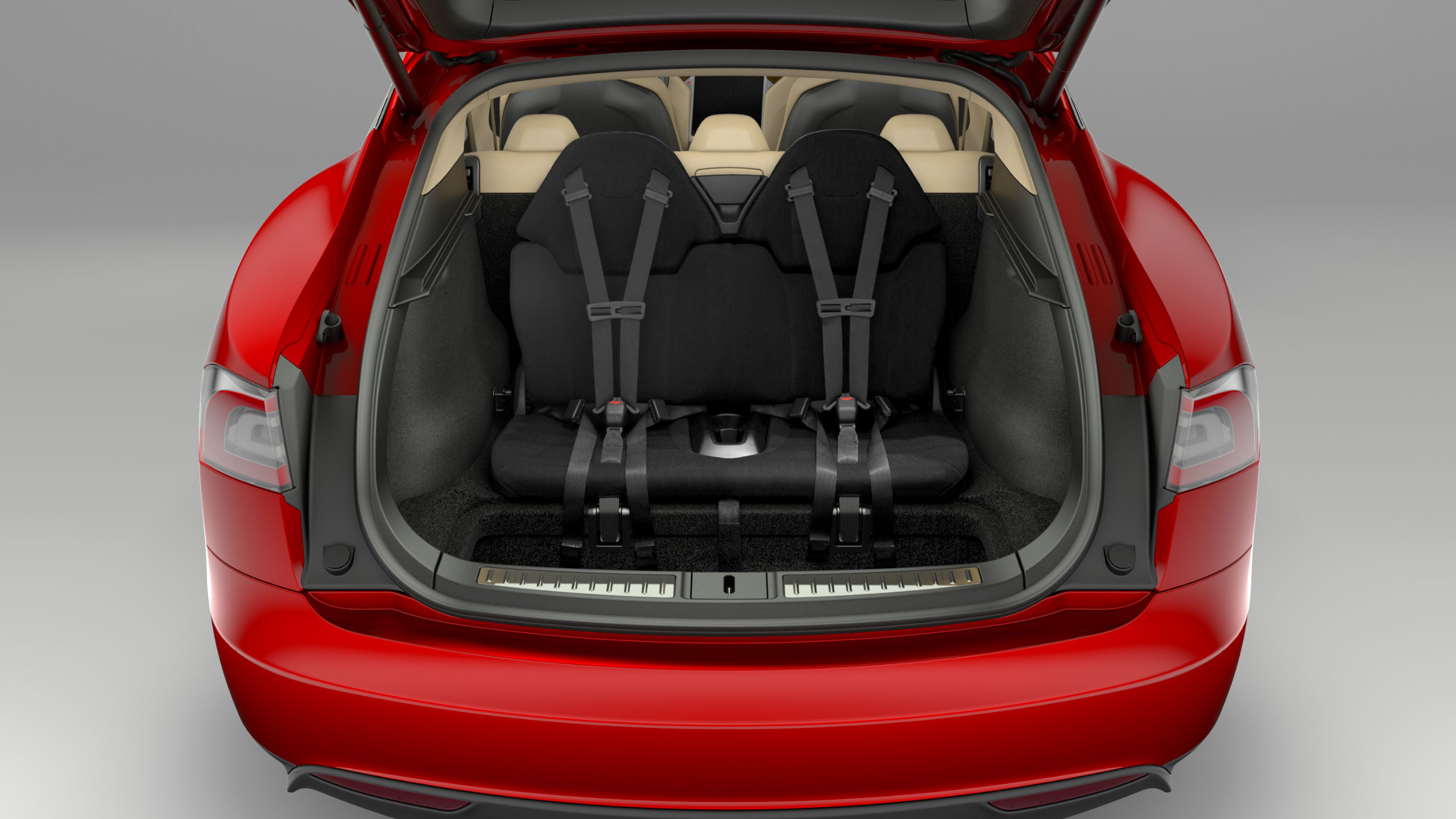
The cavernous rear compartment with optional rear-facing child seats. They fold flat into the floor.
So much is fresh and reimagined with the Model S that it’s hard to encapsulate into words. First impressions are lasting ones. The Model S is sleek and sexy. It looks fresh and modern, with tight panels and high quality paint. It easily holds its own at any valet station with all but the most exotic Germans and Italians.
As you walk up to the Model S, its flush-mounted chrome door handles glide out to meet your hand. Sitting in the comfortable pilot’s seat and you are struck by the clean, clutter-free environment. Surfaces are leather or soft-touch plastics. Fit and finish are excellent as they should be at this price point.
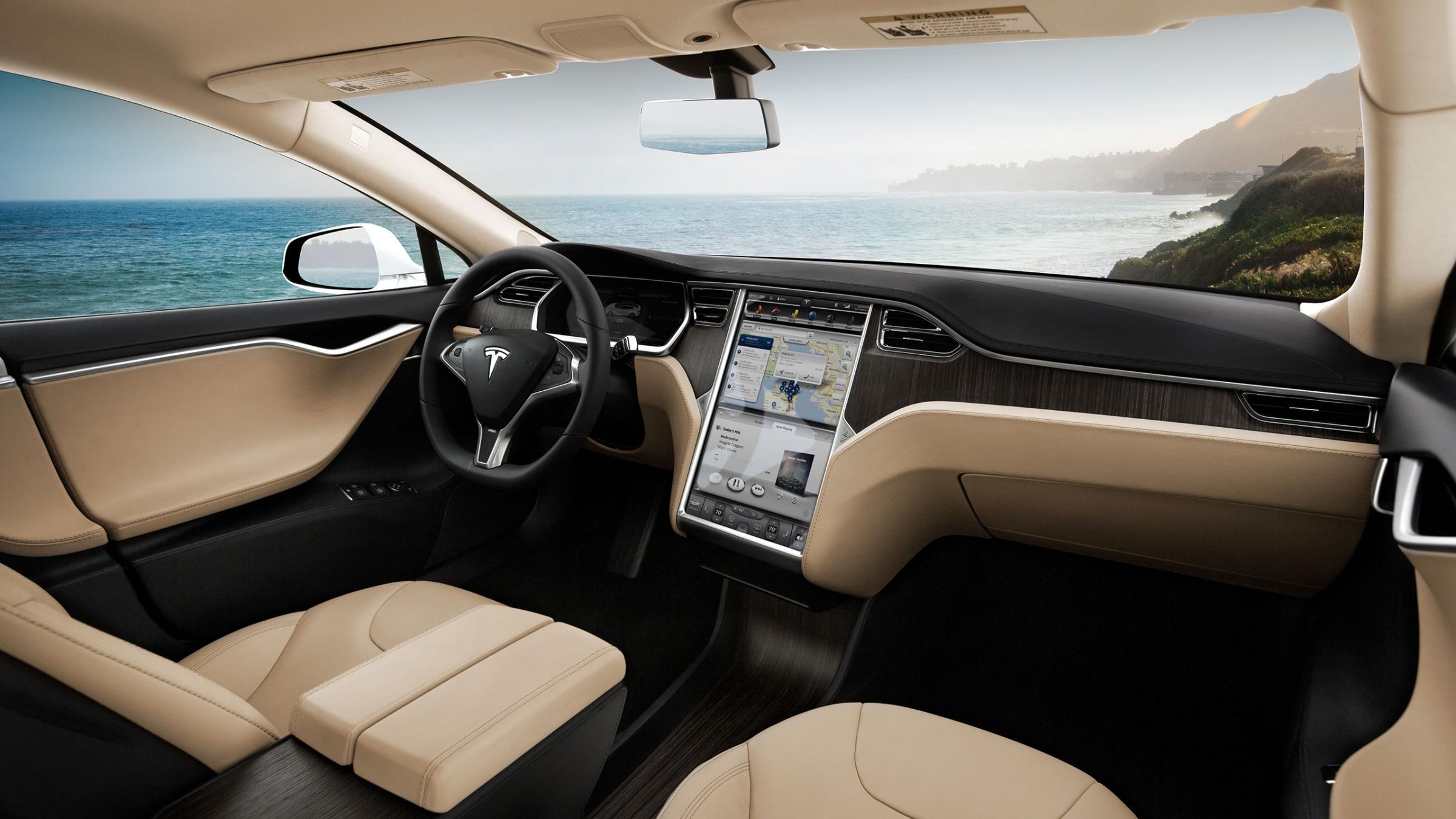
The interior of the Model S is decidedly uncluttered.
The proximity sensors in the key alert the car to come to life – there is no start or “on” button. A gigantic 17” color touch screen dominates the center stack. It pretty much controls everything with the exception of the headlights, turn signals, washer/wipers and cruise control. It’s stunning to behold and the software interface and touch capacity are easily as good as Apple’s polished iPad Air. It’s a Tesla in-house hardware-software design.

You’ve never seen anything like the 17″ touch screen control panel in the Model S.
The instrument panel is comprised of three customizable thin-film transistor full color screens with redundant navigation display.
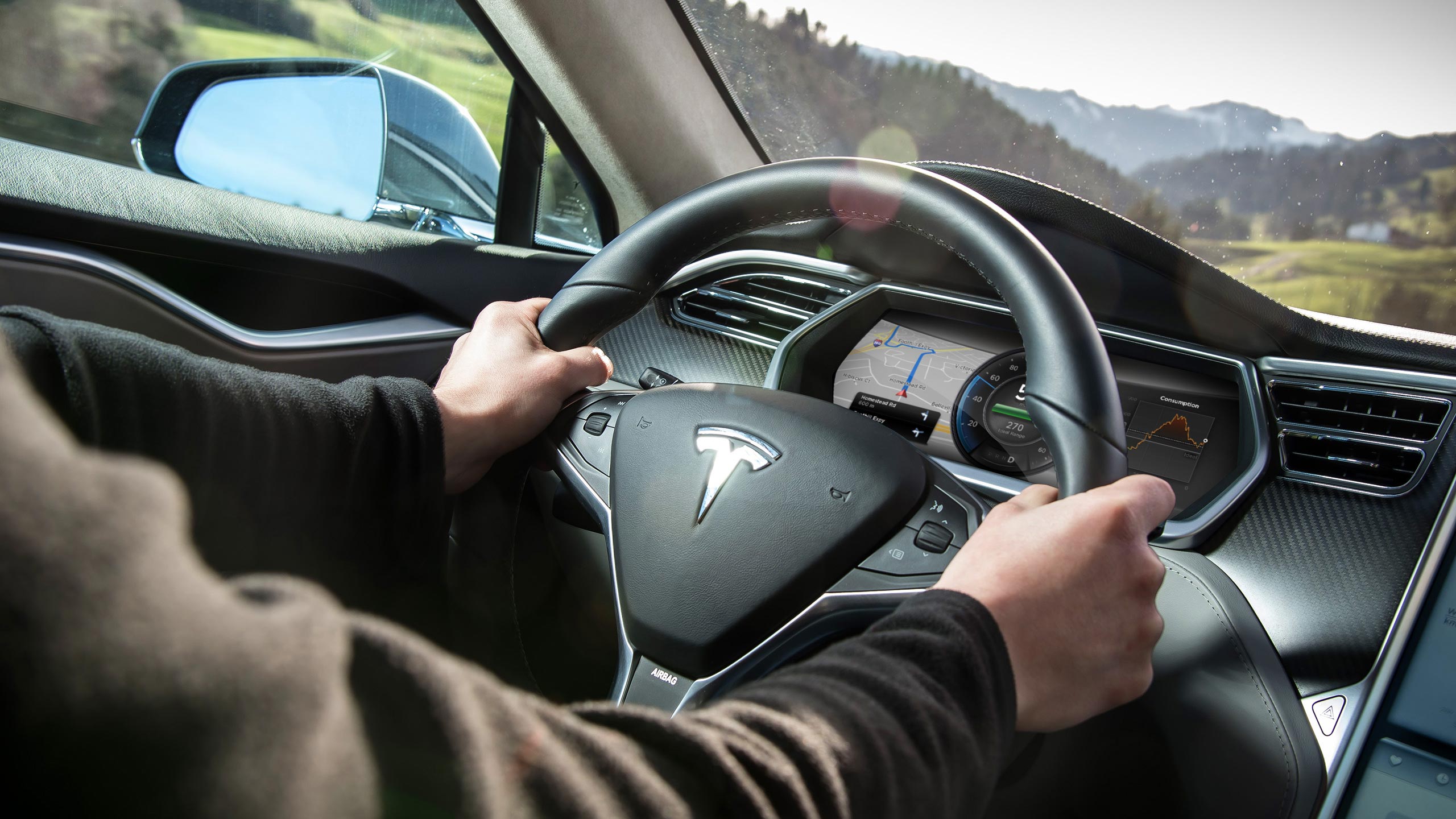
The steering wheel and instrument panel of the Model S.

Detail of the instrument panel with the optional parking sensors activated.
Switchgear (power windows, door locks and side mirrors, headlights) and steering wheel stalks are from the Mercedes-Benz parts bin (Daimler AG holds a significant investment in Tesla Motors). This is a good thing as the quality is high and it makes it easier for you to give up your Mercedes when you get your Tesla. The transmission control lever is located to the right side of the wheel. The parking brake is also electronic.
Driving the Model S is unlike anything you’ve ever driven, so comparisons are difficult. Its premium quality and advanced engineering is evident from the moment you take off. It oozes class and sophistication and it feels as rigid as a granite boulder.
I drove the P85 with 446 lb-ft of torque available from zero. Nothing is more intoxicating and addicting that having that much g-force power available without a drop of gasoline being burned. I might have broken the law.
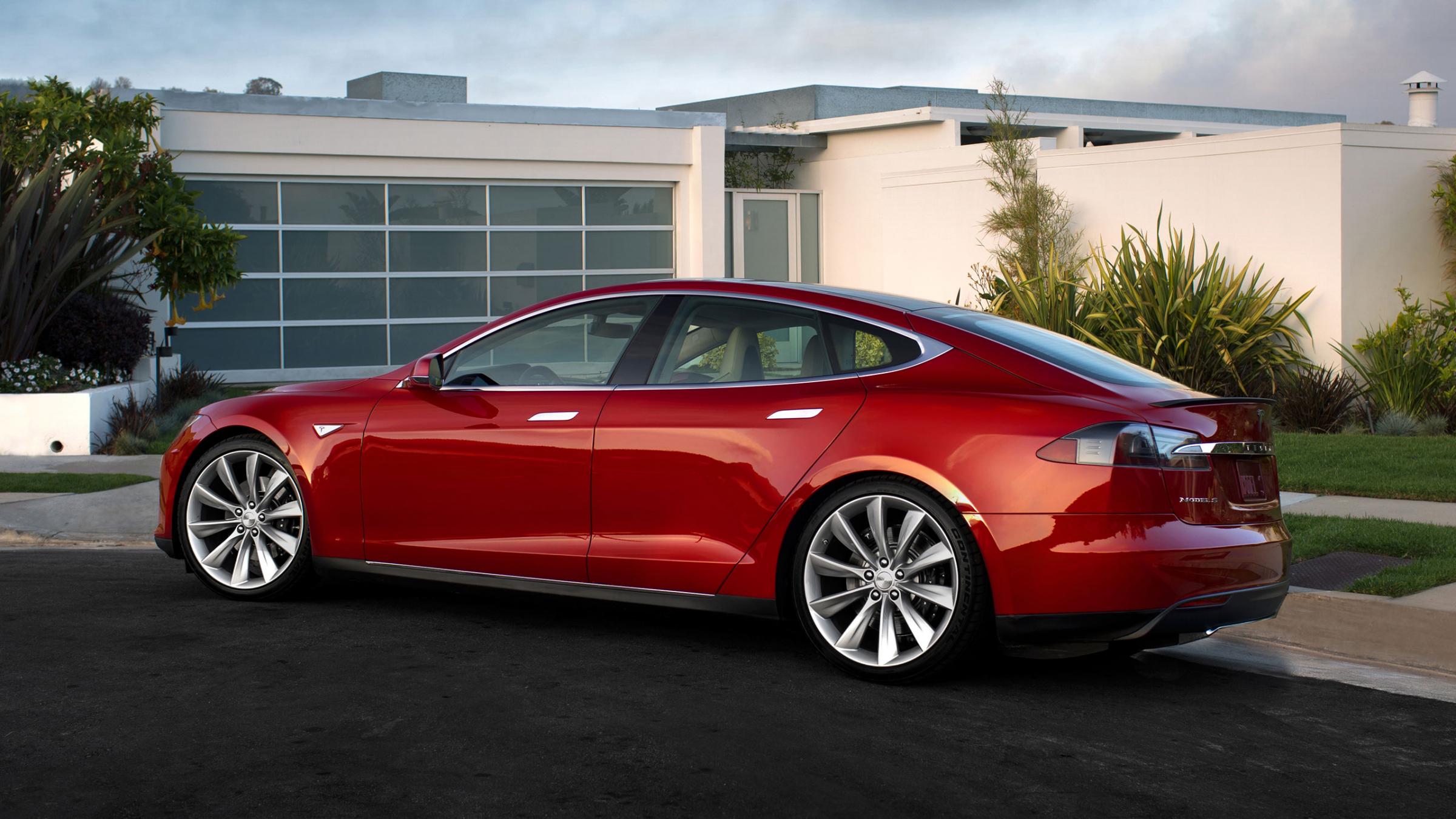
The Tesla Model S with the optional Red Multi-Coat paint.
Lift up on the rheostat and the regenerative brakes gently slow the 4,700 pound aluminum space ship without touching the mechanical brakes. Only very light braking is needed in most driving and you will find yourself playing with the regenerative braking to see just how infrequently you have to tap the mechanical brakes. Tesla allows you to choose between “standard” and “low” regen-braking power. I’d choose the standard setting as it would be the most entertaining.
Everything is hushed inside the cabin. Absent the normal hum and strum of an internal combustion engine and the steady symphony of climbing revs and changing gears, you become keenly aware of road and tire noise that used to blend into the background. There is a faint whine of an electric motor, but that’s it.

There is plenty of room in the back seat and it’s very airy with the glass roof.
The 17” center control screen can display all sorts of information and includes full internet connectivity. Tesla doesn’t treat you like a child and lock-out internet browsing while you’re driving. Hopefully you will have the good sense to leave the browsing to your passengers. Google Maps and the on-board hard-drive navigation display beautifully.
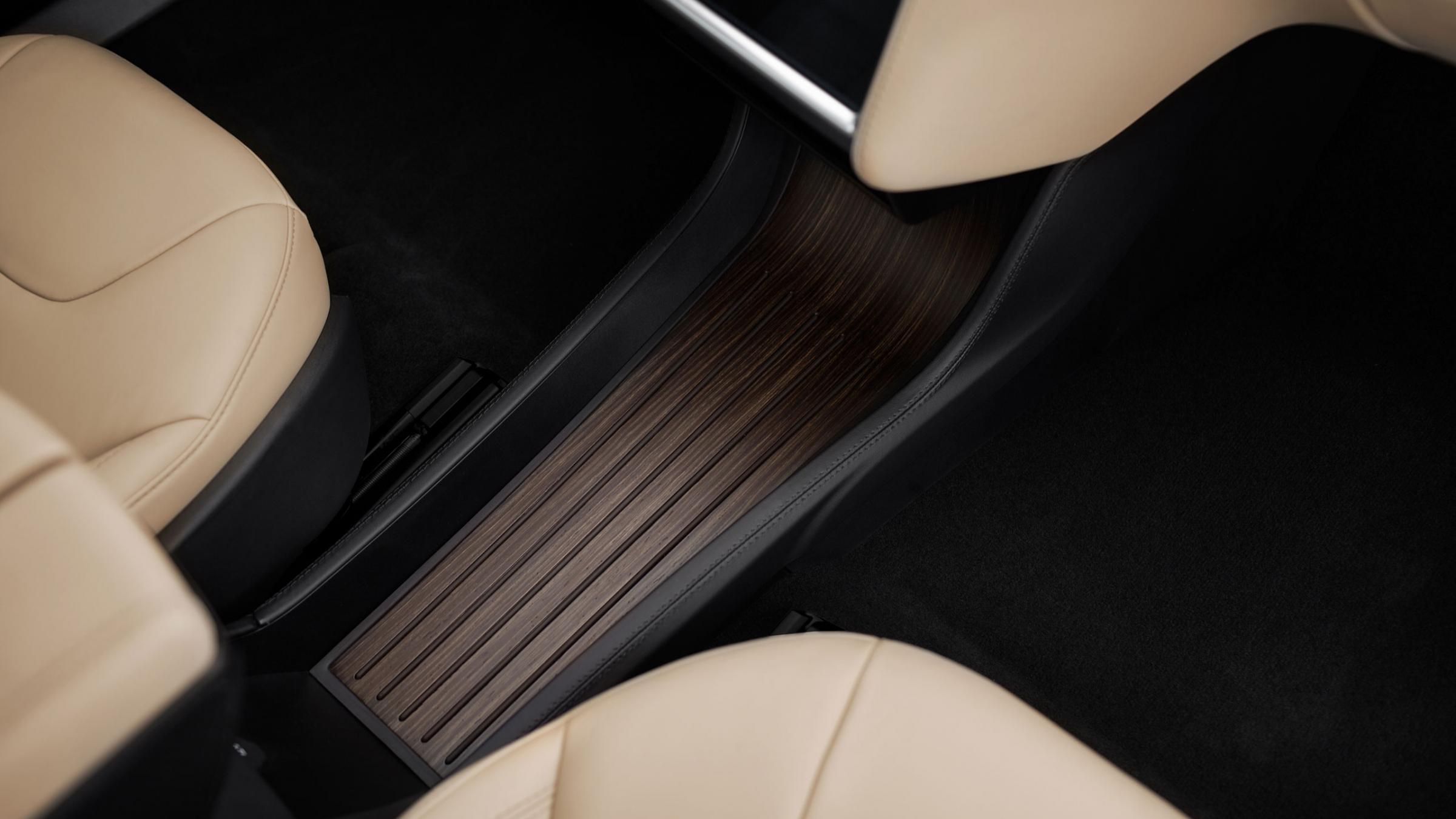
Model S interior detail: Optional console with wood veneer.
I fixated on the rearview camera. It’s a wide angle lens that doubles as a blind spot monitor. You can choose to leave the camera on while you’re driving forward. You see the nuisances in your blind spots in real-time and I found it extremely handy.
The Tesla rockets into lanes, passes with ease at any speed. Corners and curves are precise, composed and nearly flat. The standard variable ratio, speed sensitive electric power steering is tight and linear with excellent road feel – nothing like the disconnected vague feeling of most hybrids. Wind noise is kept to a minimum with a slippery coefficient drag the envy of most exotic sports cars.

The Model S in White
According to my Tesla specialist, almost everyone opts for the 85 kWh battery (265+ mile range) and the $3,750 Tech Package. Frankly, everything in the Tech Package should be standard. It adds:
- Onboard maps and navigation for North America
- Daytime LED running lights
- LED cornering lights
- Automatic keyless entry
- Lighted door handles
- Electrochromatic (auto-dimming) mirrors
- Power folding, heated side mirrors
- Power liftgate
- GPS-enabled Homelink
- Memory seats, mirrors and driver profile
You can continue to pile on options like the $2,500 Ultra High Fidelity Sound package, $2,250 for Smart Air Suspension, $2,500 for an all-glass panoramic roof, $500 for front and rear parking sensors or $2,500 for extended Nappa leather trim.

The Model S with the optional glass panoramic sunroof.
The only glaring omissions from the extensive option list are adaptive cruise control and a forward collision warning system. The price of these systems have fallen dramatically and they are available on everything from a Porsche 911 to a Honda Accord to a Subaru Forester. It wouldn’t be a deal-breaker as the Tesla is so good with everything else and I expect the company will add these options in the future.
So what makes the Tesla Model S such a killer app? Is it because the Model S is the top-rated car in the history of Consumer Reports? Maybe. Is it because of the rave reviews from the usually EV-adverse automotive press? Possibly.
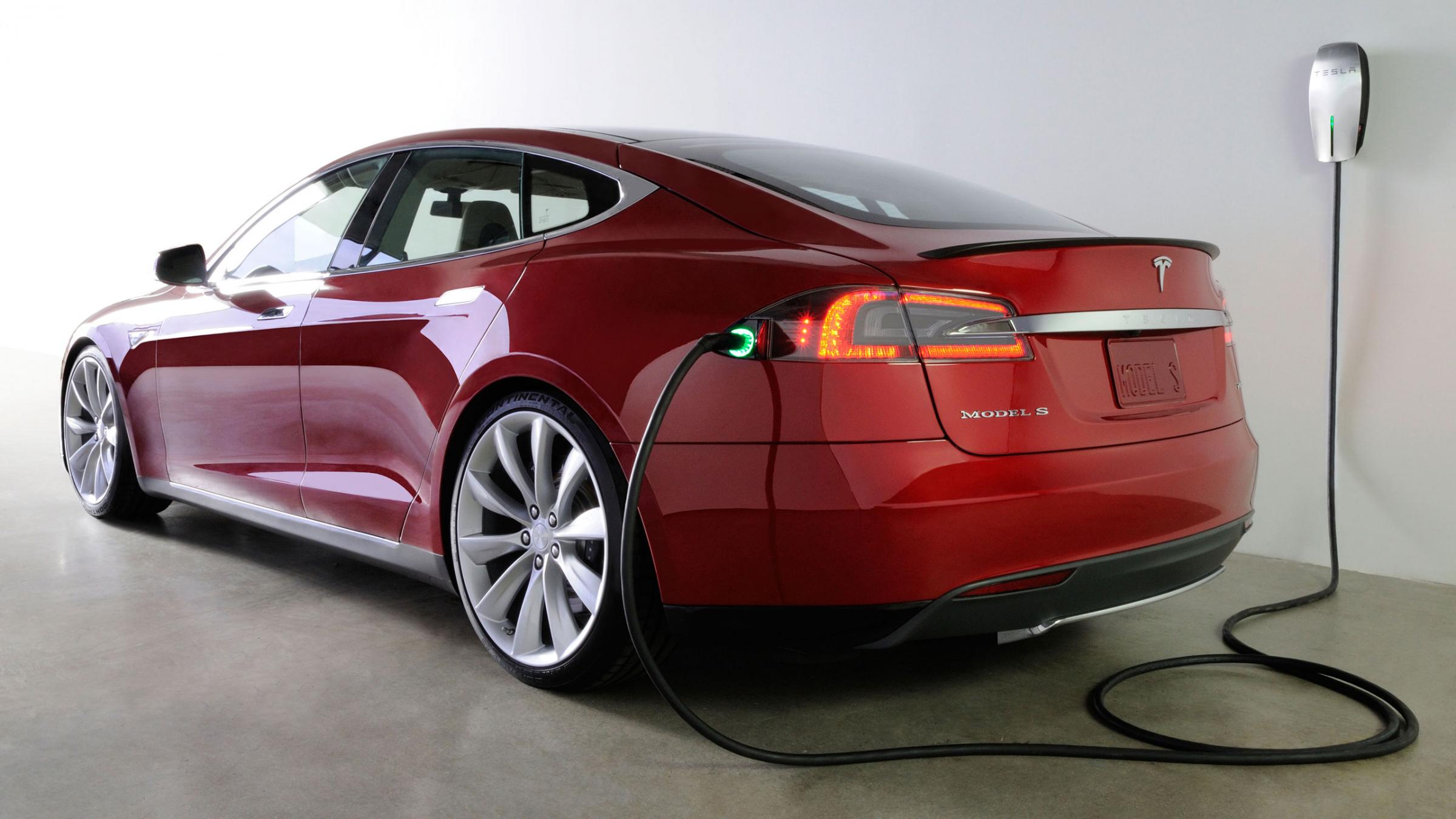
A Model S recharging in a garage. The High Power home charger is $2,700. They told me that most people just use the provided charging cord plugged into a 240 volt outlet.
But I think the reason is more obvious. The Model S is the first and only EV that doesn’t require owners to compromise. The 200+ mile range alleviates almost all of the dreaded “range anxiety.” Tesla’s nationwide network of Superchargers allow owners to top off their battery, for free, usually in less than 30 minutes. It makes travel from LA to SF a reality with only minor inconvenience. Palm Springs, Santa Barbara and San Diego don’t require any stops. In just the past week, a team from Tesla made the trip from Los Angeles to New York City in just 76 hours.

Tesla Supercharger Station
 People also love the story of Tesla Motors. Tesla’s founder, Elon Musk, a South African-born immigrant, is brilliant, a big dreamer and a big gambler (much of it his own fortune from founding PayPal) on big ventures like SpaceX, Solar City and Tesla. He is doing what NASA used to do and his unabashed evangelism for his companies can make some eyes roll. The Model S, designed, engineered and built in California by a start-up company, is the 21st Century version of a Moon Shot.
The Tesla Model S is the future of the automobile. Everything else just seems dated.



 Todd Bianco's ACarIsNotARefrigerator.com Blog