Jetta: A small family car produced by Volkswagen; basically a Golf sedan. The name comes from a German reference to the Atlantic jet stream. Also, it can be a woman’s name or a cultivated variety of potato. A potato, huh? Read on.
Until this sixth generation 2011 Jetta hit the streets a few months ago, you thought of a Volkswagen as an over-engineered German people’s car. VW’s interiors have been the benchmark for small cars for more than a decade. The seats were more substantial. The plastics had a soft touch. Fit and finish were first class. The switches had a substantial feel with positive tactile feedback. The cabin was an exercise in correct ergonomics. Leg and headroom were more generous. And it was slightly more expensive than the competition, but worth it.
In a misguided attempt to appeal to the masses and lower the base price, VW stripped the Jetta sedan of all personality. It’s devoid of style. If the marching orders were for safe and bland, then they succeeded. It’s as if a plastic surgeon pulled its facial features so taught and smooth that it’s indistinguishable from any other compact car. It just screams anonymous.

2011 VW Jetta sedan
You’ll be disappointed in the decontented chassis too. In place of the outstanding multilink independent rear suspension (IRS), the US-market Jetta gets a cheap twist beam set up. You won’t notice much of a difference on a smoothly-paved road, but once you get into the rough and tumble of the pothole-ridden badly-patched streets of LA, you will be rudely awaken from normal Lunesta driving mode.
The twist beam also wrings the fun out of enthusiastic tosses and turns and banked freeway ramps at double the posted speed. The car just isn’t as well sorted without multilink IRS. VW also cheapened the steering from a rack and pinion with electro-mechanical power assist to a Plain Jane power-assisted rack and pinion system. Tsk tsk.

2011 Jetta 2.5L Sedan
Rear drum brakes also make a resurgence on the base 2011 Jetta sedan. For years, VW featured four-wheel disc brakes; however, brakes aren’t something you skimp on. You can opt for better disc brakes, but you shouldn’t have to do it. This is a stain on VW’s German engineering reputation.

2011 Jetta 2.5 Sedan
The Apocalypse and “the horror” continues inside. The whole cabin has a thin veneer of cheap plastics. The switchgear feels solid in some places, flimsy in others. The seats still feel supportive, but I’d need a longer test drive to see if they are comfortable on a long-term basis.

2011 VW Jetta sedan interior
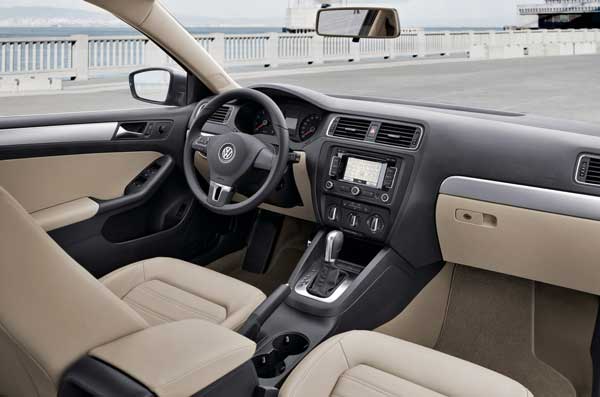
2011 Jetta Sedan - the interior in a better looking color.
The base 2.5 liter five-cylinder engine carries over from the 2010 model year. It churns out a respectable 170 hp and 177 lbs-ft of torque. Unfortunately, this cheap engine will power most of the Jettas sold in the US market.
Missing from the 2011 Jetta models is the option of the engaging and entertaining 2.0 liter TSI engine combining direct fuel injection and turbocharging to produce 200 hp and 207 lbs-ft of torque. Volkswagen promises this option will return, probably later this year as s 2012 model.
However, there is still good news on the powertrain front.
For the past few years, VW has sold a 50-state legal, sophisticated, 2.0 liter turbo-diesel with common-rail direct fuel injection (TDI). VW is the only brand to consistently sell diesel-powered small cars in The States.
The TDI’s exhaust system is so clever that it’s able to meet California’s stringent standards without resorting to the expensive urea-based scrubbing systems used by Mercedes and BMW. Long gone are the days of noisy, sloth-like diesel-powered cars belching black smoke as everyone flies around them. The engine barely is noticeable and you could stick your nose in the tailpipe and not know that the little VW burns diesel.
The desirable TDI engine is rated at 140 hp and 236 lbs-ft of torque. While the TDI has fewer ponies than the base 2.5L mill; the gobs of torque available at just 1,750 rpm make the TDI feel faster. As a bonus, VW engineers have all but eliminated any hint of turbo-lag.
All the gas-powered 2011 Jettas come fitted with an outdated, decidedly low-tech 5-speed manual transmission or an optional conventional 6-speed automatic slushbox with Tiptronic control. Probably 90% will pick the automatic.
The diesel Jetta, however, is blessed with choices of a 6-speed manual or VW’s Direct-Shift Gearbox (DSG), a high-tech electronically-controlled dual-clutch automated manual transmission that shifts faster and more efficiently than a standard automatic or any human rowing his own gears.
After bashing the new Jetta sedan, I’m delighted to remind you that there is another 2011 Jetta on the market. The 2011 Jetta Sportswagen is a carryover from 2010 meaning that it retains the “German-ness” that you expect from VW. It’s a 5th generation Jetta wagon sold along side the 6th generation sedan.
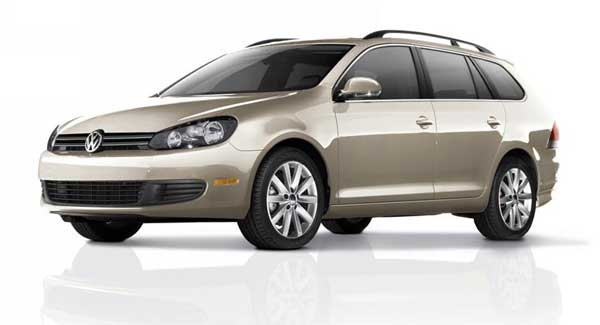
2011 VW Jetta TDI SportsWagen
The plastics are of much higher quality, soft to the touch. And when you tap the dash, you don’t hear an echo. It also retains the multilink independent rear suspension and the more responsive steering. Disc brakes stop all four wheels. Standard. Further, you can still get a 2011 Jetta SportWagen with the highly-desirable TDI package.
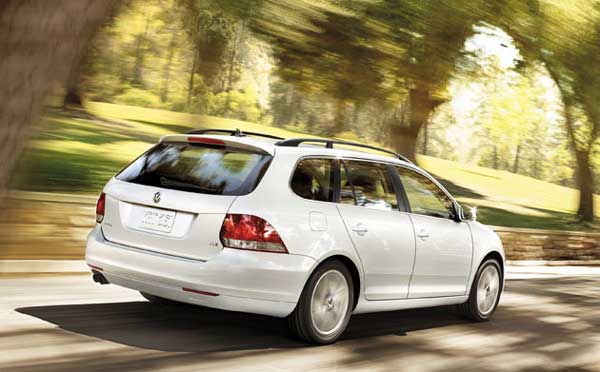
2011 VW Jetta TDI SportsWagen

2011 VW Jetta TDI SportsWagen interior
The 2011 Jetta TDI sedan is rated at 30 city 42 highway. The 2011 SportsWagen TDI is rated at 30/41 mpg, so there is essentially no mileage penalty between the two Jettas. Anecdotal evidence from TDI owners suggest that highway fuel economy can hit the 50 mpg range. That’s Prius territory free of Toyota taint.
While I was at the VW dealer, I checked out a new 2010 Jetta TDI Cup Edition. The TDI Cup Jetta sedan comes with all available options including some aerodynamic lower body panels and tasteful decals. The TDI Cup package also is endowed with the supportive dark plaid and black cloth sports seats from the GTI. These great seats aren’t available on any 2011 Jetta. Some new 2010 Jetta TDI Cup Editions are still for sale. If it appeals to you, it may still be possible to find one and get a great deal.
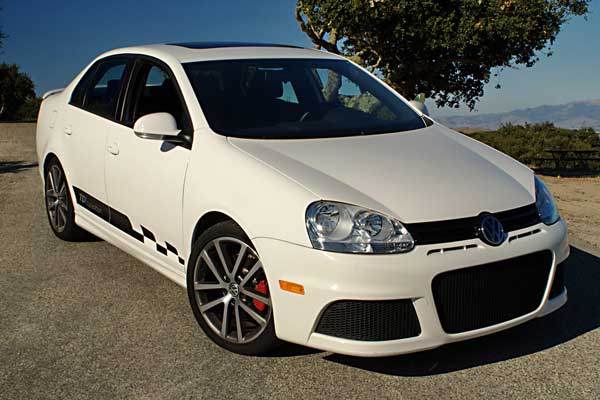
2010 Jetta TDI Cup Edition
As I inspected the 2010 Jetta TDI Cup, kicking the tires, slamming doors and opening the trunk, I found a striking difference between the 2010 and 2011 models that sums up the 2011 Jetta’s inter-generational differences.
The trunk hinge and gas struts on the 2010 model are a classic example of German over-engineering. It’s a complex setup of scissor hinges connected to gas-filled shocks. The system is fastened to the trunk’s inner deck, between the gasket and outer body. As a result, the opening action is beautifully dampened and the hinge doesn’t interfere with the inside storage capacity. In all, a very satisfying piece of mechanical engineering.
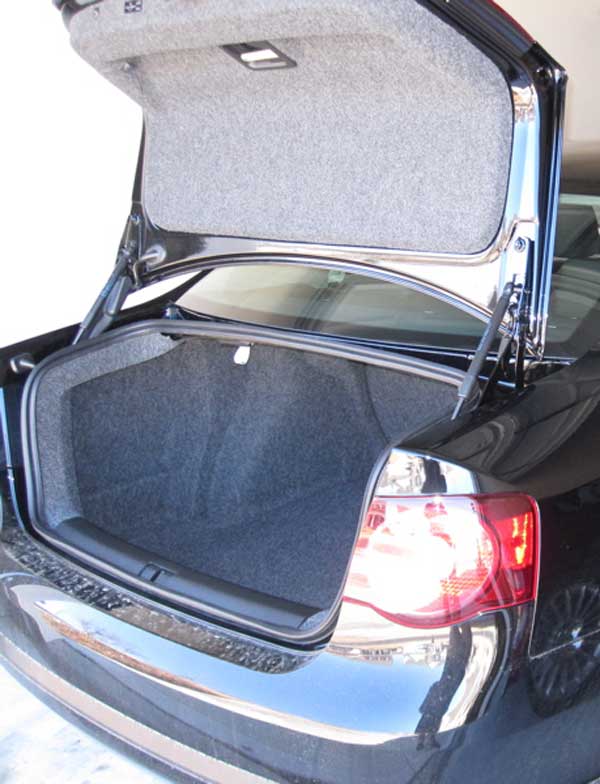
The 2010 Jetta's trunk. Check out the hinges - and notice that the under lid is nicely lined.
Pop the trunk on the 2011 Jetta, and the hinge is a simple steel arm attached to the underside of the lid. It has no dampening and and it closes into the storage area. No shocks. No hint of engineering. I expect to see this kind of cost cutting on a cheap Chrysler rental car, but not on a Volkswagen.
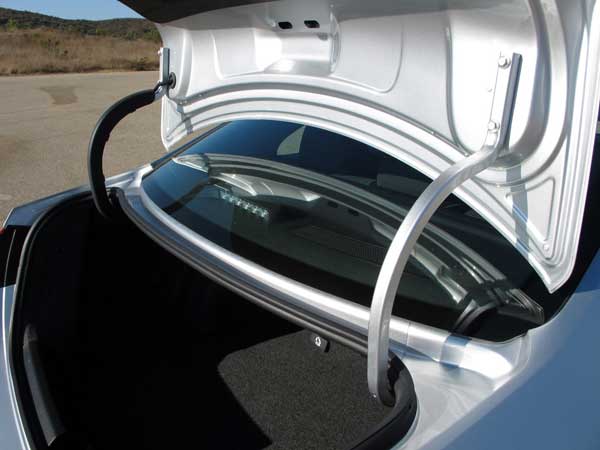
The 2011 Jetta's trunk. Those hinges don't look so nice now, do they? And the lid lining has disappeared.
Overall, I was very satisfied with the sporty drive, good manners and powerful diesel engine mated to the DSG – all in the SportsWagen. I found little flaw with the DSG except for some muffled downshifts at low speed in traffic. Under hard acceleration, it performed flawlessly and I never felt I was in the wrong gear. The software shift programs make the most out of the diesel torque and it never felt underpowered.
If you are in the market for a compact sedan, don’t buy the 2011 Jetta. Instead, consider the 2011 Jetta SportsWagen TDI. It’s stylish, drives like a proper sporty compact and has tons of cargo space. Skip the Prius, be the different kid on the block. You will get the kind of Volkswagen you deserve, a car that delivers a deeply-satisfying ownership relationship – not one that was built to lower price, lower standards and reduced expectation.
2011 Jetta Sedan: $15,995 – $24,095
2011 Jetta SportsWagen: $19,825 – $24,730
Features/Options NOT available at any price:
- Automatic headlights
- Rain-sensing wipers
- Automatic climate control
- HomeLink
- Power seats
- Leather seats
- Parking sensors
- Rear view camera
- Auto-dimming rear and side view mirrors
- Digital compass
- Bi-Xenon headlights






 Todd Bianco's ACarIsNotARefrigerator.com Blog