Volkswagen teases us again with a car that isn’t going to be in your driveway anytime soon. VW says it will get 313 Imperial mpg which is the equivalent of 261 US mpg. Who wouldn’t want that? Well, you can’t have it. It’s a terrific concept car and some of its fuel-saving technologies will trickle down to production models at some point this decade.
I don’t get it. We get the horrible new Jetta and a decontented Passat for fat Americans. It’s obvious that the VW Group (including Porsche, Audi, Lamborghini, Bentley, Bugatti, Seat and Skoda) has a deep and talented pool of engineers and designers. Will the US market always be last in line to get the cool, efficient offerings from VW?

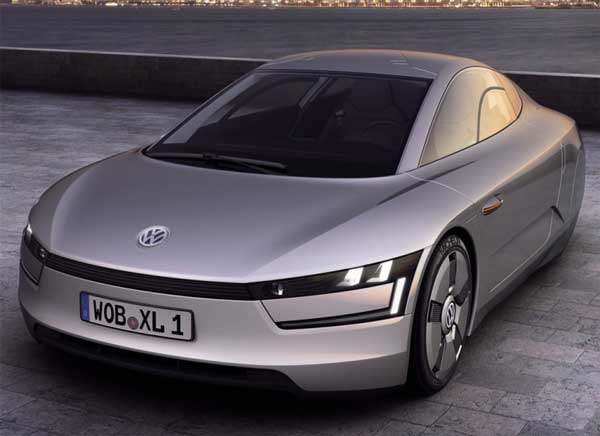
Volkswagen XL1 Diesel-Electric Plug-In Hybrid. VW calls it a Super Efficient Vehicle (SEV).
Below is the VW’s official press release from the Qatar Auto Show. Everyone else is just rewriting it, so rather than waste time, here it is from the VW spin doctors – uh, I mean PR department:
Volkswagen unveils the XL1 Super Efficient Vehicle in Qatar
The new Volkswagen XL1 Super Efficient Vehicle (SEV) has been unveiled at the Qatar Motor Show. Pioneering construction techniques, an advanced plug-in hybrid drivetrain and innovative packaging all play a part in allowing the XL1 to return 313 mpg on the combined cycle while emitting 24 g/km of CO2 to set a new benchmark for vehicle efficiency.
Powering the XL1 is a compact 800 cc TDI two-cylinder common rail diesel engine developing 48 PS. It’s linked to an electric motor producing 27 PS, resulting in a total of 75 PS – a modest output yet more than enough when the low kerb weight (795 kg) of the vehicle is taken into account.
The TDI engine is linked to an electric motor and a seven-speed DSG gearbox with an automatic clutch mounted between each unit. The electric motor can either work independently of the TDI engine or in tandem when accelerating. In pure electric mode the XL1 can travel up to 35 km before the diesel engine cuts in. Accelerating from rest to 62 mph can be achieved in 11.9 seconds; the electronically limited top speed is 99 mph.
In both its styling and packaging the XL1 draws on lessons learned from the 1-Litre car (2002) and the L1 concept (2009). The XL1 has evolved to feature staggered seating with the driver and passenger placed next to each other in a body structure made from advanced new materials providing immense strength yet weighing just 230 kg.
To make such weight savings possible, and yet viable for series production, Volkswagen developed and patented a new system for the manufacture of the Carbon Fibre Reinforced Polymer (CFRP) parts on the car called the Resin Transfer Moulding (RTM) process.
In total the XL1 weighs 795 kg. In addition to the body structure, the weight is accounted for by the drivetrain (227 kg), the running gear (153 kg), the interior including a pair of bucket seats (80 kg) and the electrical system (105 kg). In total just 23.2 per cent of the car (184 kg) is made out of either steel or iron.
Further savings are made through the extensive use of lightweight materials including magnesium (wheels), ceramics (brake discs) and aluminium (dampers, steering system, brake calipers).
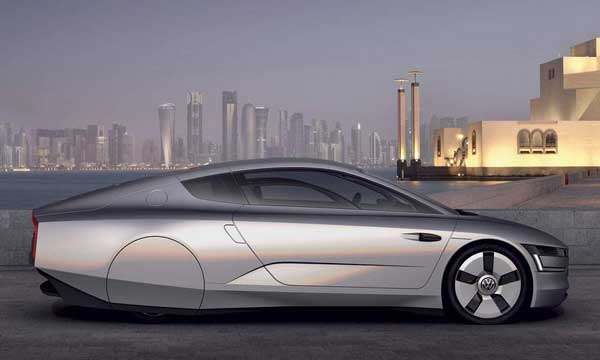
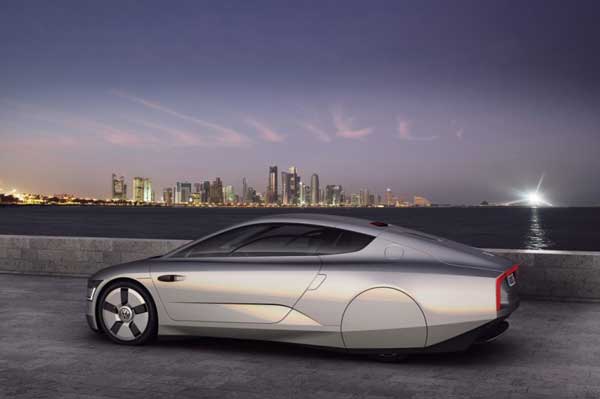
The styling of the XL1 is borne out of functional requirements – easy access to the interior is granted via a pair of elegant scissor doors that hinge on the A-pillar while the profile of the car has been honed in the wind tunnel, the result being a remarkable coefficient of drag figure of 0.186. The XL1’s overall length (3,970 mm) and width (1,682 mm) are similar to those of a Volkswagen Polo yet its height (1,184 mm) is more akin to that of a Lamborghini Gallardo Spyder.
Although the XL1 is still very much a concept, its unveiling marks the next step towards the birth of a new class of Super Efficient Vehicles, while the advent of a process such as RTM is a significant milestone.
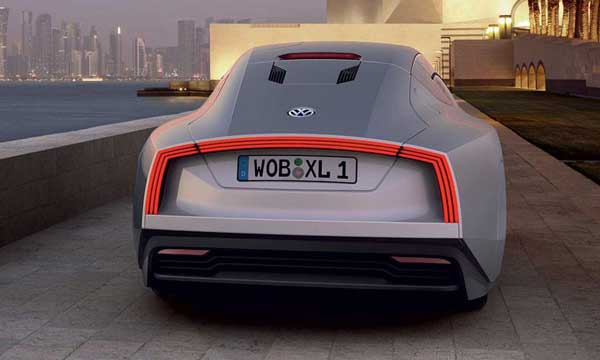
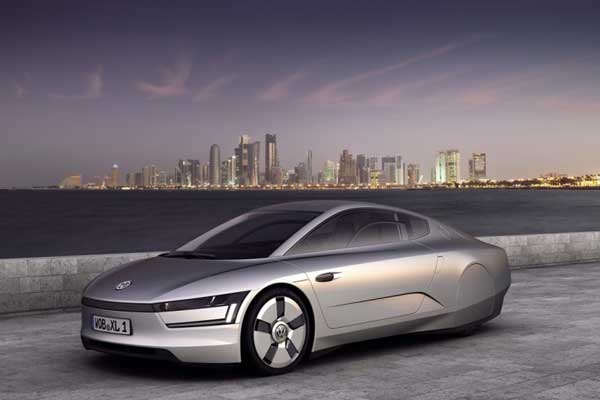
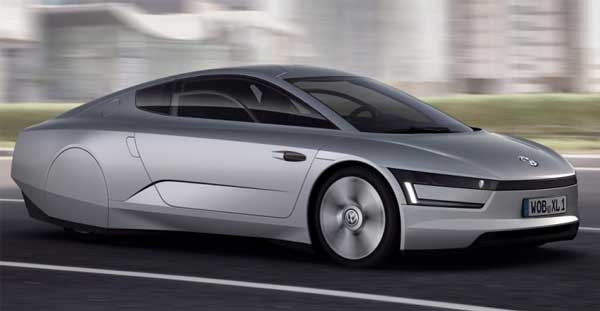
I think it looks appropriately futuristic; but opinions have been all over the map from “hate it” to “love it.” Here are some of the official VW pictures. I’ll post more as I find them.






 Todd Bianco's ACarIsNotARefrigerator.com Blog