One of the most explosive and scandalous scenes in Roman Polanski’s 1974 noir classic, Chinatown, is near the end, when Jack Nicholson (Private Investigator J.J. Gittes) asks Faye Dunaway (Evelyn Mulray) the identity of the young girl being protected by her.  The violent exchange between the two characters is known as the “Sister, Daughter” scene where Jack slaps the “truth” out of Faye.  Here’s the video to remind you if you haven’t seen Chinatown recently:

Yes, the girl is both her sister and her daughter as Evelyn Mulray was raped by her father, Noah Cross. Once you understand the relationship, the story makes sense.

I was driving west on Fountain Avenue the other day and spotted this older model (1996 or 1997?) Lexus GS300. The center trunk lid Lexus logo badge had been replaced by a Toyota badge and between the taillights, a plastic taillight surround panel with the word “Aristo” in the middle replaced the stock Lexus panel.  The Aristo panel looked like a factory fit, and even the font was similar to that used by Lexus – so I did a bit of digging.
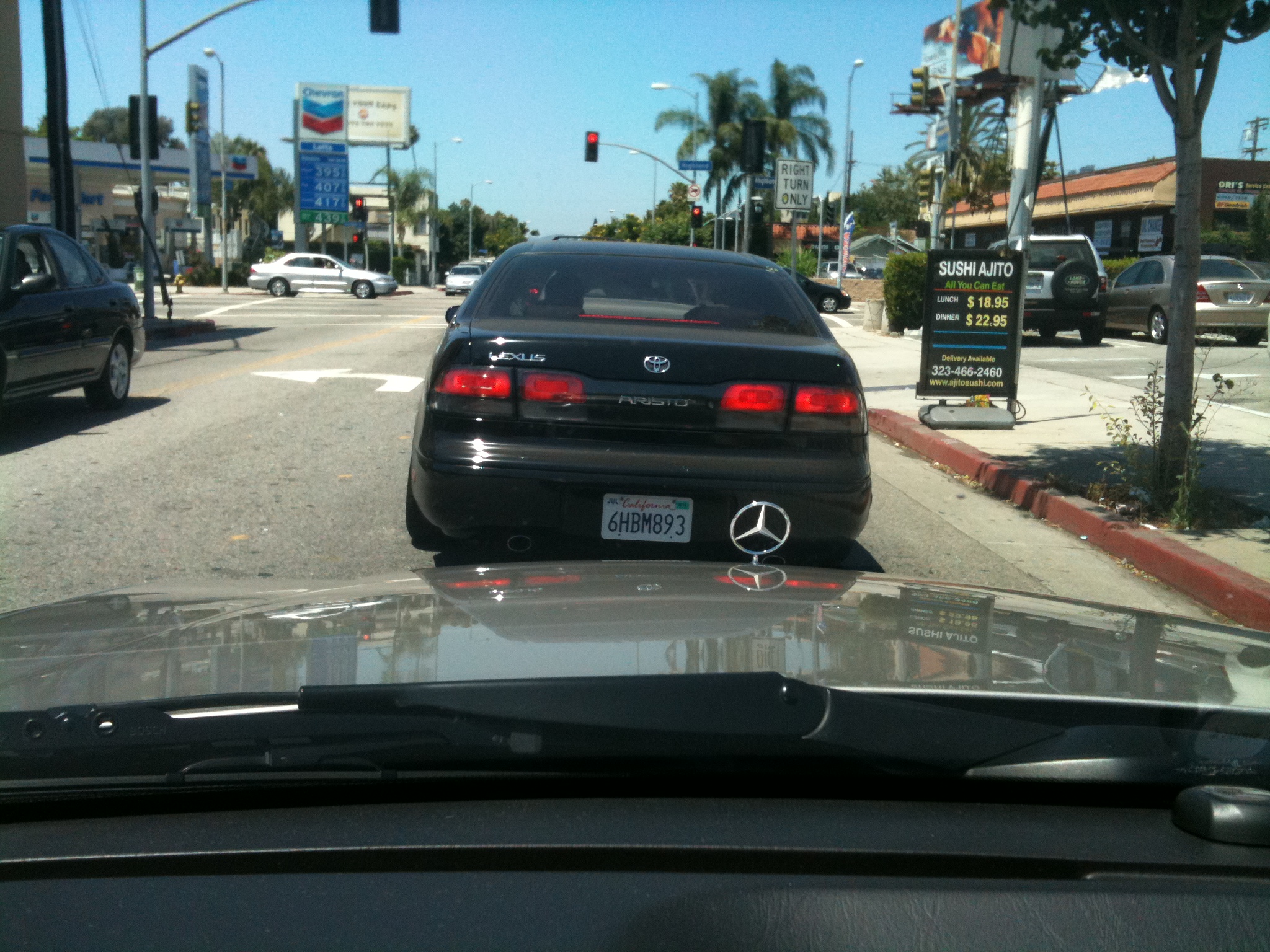
This older Lexus GS300 has had some of its badges rearranged and the Aristo nameplate substituted for the GS300 badge. (Click for larger picture and then again for full size.)

Most Lexus models are actually just big, expensive Toyotas in Japan and, with the exception of the RX350 SUV (a tarted-up Toyota Highlander), they are all made in Japan.   The Lexus brand was created specifically for the US market to get US customers to buy expensive, luxury Toyotas.  I mean if  you’re going to pay $50,000 for a car, do you want to go to a Toyota store where you have to share the air with people buying a budget Corolla, or do you want to go to an upscale Lexus luxury auto dealership where you are treated to espresso, leather sofas and a loaner car whenever you get your car serviced? If you’d pick the latter, then you’d be in the majority.

When a Japanese-market Toyota is “Lexized,” it’s given the Lexus badge, some US-market specific items and federalized.  So is it a Lexus or a Toyota? Is it a GS or an Aristo?  I guess it depends on your willingness to buy into the Lexus marketing pitch.

In Japan, the Lexus GS is a Toyota Aristo (see the Lexus GS Wikipedia entry). The plastic Aristo nameplate fascia panel seen here should fit and the fonts should look “familiar” because it was made by Toyota, in Japan, for the Japanese market version of the GS.  The Asian owner of this low-rider GS probably got the part in or from Japan or from an aftermarket supplier here in the US.  Here’s a closer look:
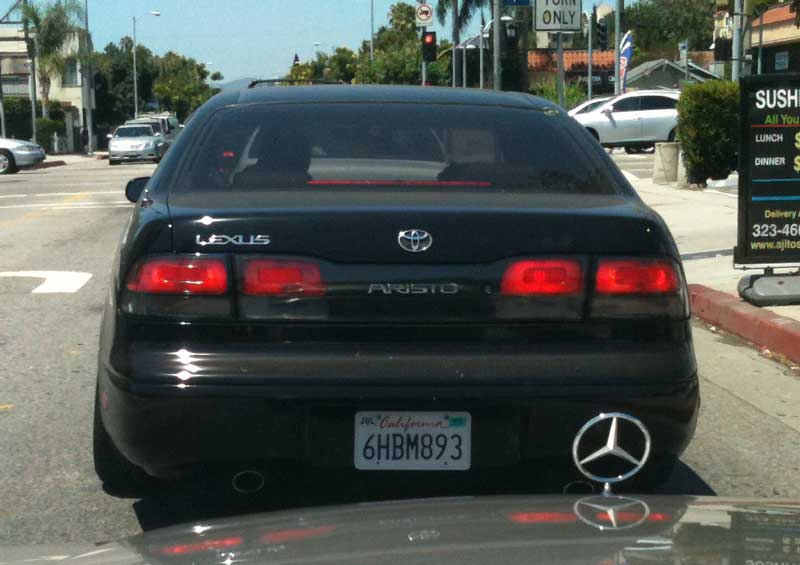
The only thing this car is missing from the customized rear of this Lexus is the GS300 badge. (Click for a larger picture.)

So it is a Lexus and a Toyota and it’s a GS300 and an Aristo.  Confusing, but it makes sense when you know the story.


I’ve always has a revulsion to the Hummer H2; but I can’t put my finger on the exact reason.

When General Motors introduced the Hummer brand and the H2 SUV in 2003, everyone knew its fuel economy sucked. But I like plenty of cars that are at the bottom of that list — think Aston Martin, Ferrari, Lamborghini, Bentley or Rolls Royce.  And I have nothing against big trucks or SUVs, per se, I just don’t like it when someone drives a gigantic barge that is completely unnecessary given the size of their family and cargo needs.  Frankly, a minivan has better people and cargo capacity than a Hummer. So big isn’t necessarily bad. One size doesn’t fit all when it comes to personal transportation.

2009 (last year) Hummer H2 Black Chrome Edition

If I had to pinpoint one thing that gave me pause, I think it was the Incredible Hulk size with the matching cartoonish styling cues.  It just wasn’t authentic.  Heavy fake body armor was applied to a heavily-modified Chevy Suburban platform to make it look like the original Desert Storm military vehicle, the AM General Humvee H1. Add a $50,000 + price tag and you have an expensive exercise in faux masculinity.

GM touted the H2’s prestigious off-road credentials; however, the H2s I’ve seen are more likely to drive over a curb or across a center median than they are to actually go off road.  You know, the sand and dirt would decimate those 30″ DUB chrome wheels with low-profile tires and acres of aftermarket chrome bling.

The military H1 used in both Operation Desert Storm (the first Gulf War) and Operation Iraqi Freedom (the post 9/11 invasion of Iraq).

After the H2 hit the roads of LA, in addition to my initial dislike of the size and design, I gained a jaundiced perception of the people who drove these monsters. Lanes were hogged. Turn signals remained unused.  Side mirrors weren’t checked for a lane change – you just got out of their way.  Parking took two spots.  Some didn’t fit into underground parking structures. If you were behind one, all forward visibility was obliterated.   Hell, you couldn’t even see the Ferarris parked in front of Sunset Plaza restaurants when an H2 with a celebrity occupant got front placement.

The H2 was much better suited for large suburban tract homes and extra-urban locations configured for travel trailers or mobile homes. Think Wal-Mart Super Centers.  Six-lane wide open roads with center medians.  Large box stores and shopping malls with acres of outdoor parking.  Paranoid survivalists in Idaho or Texas.

But what most people didn’t realize is just how heavy these things were. In fact, its curb weight (take a deep breath) of 6,614 lbs blasted it out of the requirement to be tested by the EPA for fuel economy!  The GVWR (Gross Vehicle Weight Rating) was a staggering, Hulk-size 8,600 lbs.  The EPA didn’t think that any “passenger” car or SUV would ever weigh that much. Vehicles that heavy were usually  large commercial trucks, farm or heavy construction equipment or special-purpose vehicles like an electric utility vehicle or a tow truck.  Bottom line: GM never published official fuel economy estimates for the H2.

Over its production life (2003 – 2009), the H2 was tested by most car/truck magazines and consumer websites – all with dismal fuel economy results (although consumers tended to give the vehicles overall high ratings). In 2008, Car & Driver observed fuel economy of 10 mpg while Edmunds.com found a 2007 H2 was worse at 9.2 mpg.  Let’s be charitable and call it an even 10 mpg.

In 2008, when the first great gas panic hit, people couldn’t get rid of them fast enough.  People do tend to vote with their pocket books.

Where I live in LA, you rarely see them anymore.  As fast as the H2 gained popularity with certain subcultures (think Rap Artists and aftermarket accessory retailers), they disappeared even faster. It was like a fashion trend changed overnight.  Although most H2 owners could probably afford to fill the 32 gallon gas tank with $4.50 gallon gas, the poison darts of derision and scorn shot by pious Prius owners was probably too much to bear.

I still see them on a regular basis in the Coachella Valley. The roads are wide, traffic is nothing compared to LA and parking is plentiful. Last weekend, I found this Black H2 towing a beautiful boat parked over six empty parking spaces at the Palm Springs Home Depot.  Good thing the whole row was empty, because you aren’t going to parallel park that combination.  I’m willing to bet that with the added extra heft of that boat, that thing sucks gas faster than Dean Martin sloshed down martinis at the Sunset Boulevard Hamburger Hamlet.

The H2 can tow up to 8,000 lbs. That boat isn’t that heavy, but it’s probably at least two tons.   My guess is that with the boat and a family of four, that thing gets no better than 5 mpg.  What do you think the fuel costs are for a fun boating weekend in Laughlin, Nevada? I hope the family credit card isn’t maxed out.

The Hummer H2 looks like a brick compared with that slick speed boat. It does look nice against the background of the San Jacinto mountains.

I'm a bit closer here, but with something that long, it's hard to get a close up and still get everything in the picture.

The sunlight conspired to make the front of the H2 look like a Darth Vader helmet.