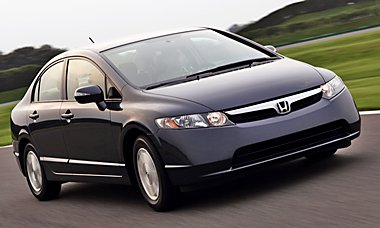
2006 Honda Civic Hybrid

On February 1, 2012, Heather Peters, owner of a defective 2006 Honda Civic Hybrid (HCH), was awarded $9,867.19 in her Small Claims Court suit against Honda Motor Co.  Ms. Peters has reached out to other disgrunteled HCH owners through her website DontSettleWithHonda.org.  She urges owners to opt out of the class action cases and sue Honda directly in Small Claims Court.

On January 3, 2012, the case, Heather Peters vs. American Honda Motor Co., Inc., was heard in Small Claims Court in Torrance, California (Honda’s US headquarters is in Torrance).  The court ordered an additional hearing on January 25, 2012, to tie up some loose ends.  Approximately 90 minutes of testimony was given on each day – a very long case for Small Claims Court.  We covered the case here.

This case has been closely watched both by Honda Civic Hybrid owners (model years 2003 – 2009) as well as the trial lawyers and big corporations.  Instead of settling for up to $200 and a $1,000 voucher towards the purchase of a new Honda or Acura vehicle, plaintiffs in a class action suit against Honda may opt out of the class action lawsuit and take their cases to small claims courts around the country, opening a floodgate of small claims court lawsuits that, in theory, class action claims were meant to stem.
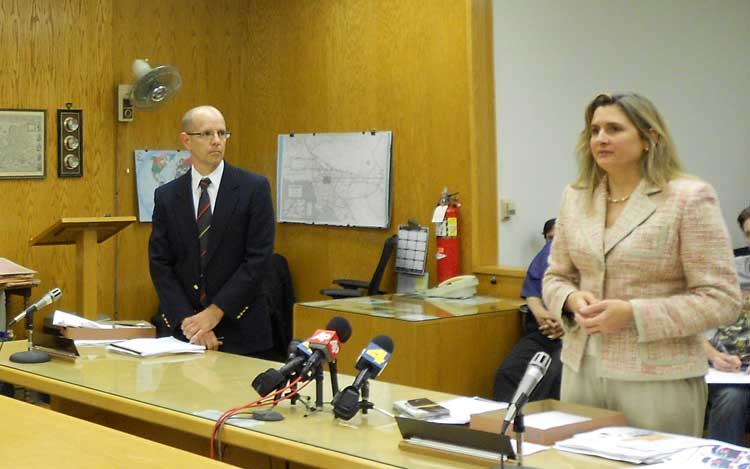
Heather Peters with Neil Schmidt from Honda in Small Claims Court, Torrance, California.

Unfortunately, as most of us know, being included in some sort of class action – credit card fees, defective part, overpaid interest, etc. – doesn’t usually net you much. Sometimes you have to go back for years in your records to submit a claim.

For example, many people don’t have the time and inclination to spend hours going over credit card statements from 6 years ago to see how much they paid in foreign transaction fees. You have to read lengthy letters and small print and fill out confusing forms. You can remain in the class and (1) accept $10 for all the fees you may have overpaid during a 4 year period, (2) opt out of the settlement and sue the big corporation yourself (good luck), or (3) spend lots of time and effort going back over years of statements and submit a claim, with the appropriate paperwork, on a timely basis, in hopes of getting maybe $50 or $100.

Most people just give up and accept a small check that comes months or years after a claim is submitted and the matter is settled.

If you think that the only people who win in these cases are big corporations and an army of attorneys (on both sides), you’re not alone.  Ms. Peters was mad as hell and she wasn’t going to accept a paltry $200 from Honda while the attorneys made over $8 million.  And she won!

I’ll try and summarize the 26 page ruling by Superior Court Commissioner Douglas G. Carnahan:

  • Ms. Peters has the right to bring this case in small claims court.
  • She properly opted-out of the proposed class action settlement.
  • Both sides had stacks of “testimony” from happy HCH owners and dissatisfied HCH owners. The court really didn’t look at either of these submissions as dispositive of either Honda’s defense or Ms. Peter’s claims of monetary injury.
  • Ms. Peters paid $30,485.96 for her 2006 Honda Civic Hybrid on April 23, 2006 from Honda of Santa Monica.
  • She had always been dissatisfied with the fuel economy of her HCH. The EPA ratings of 50 mpg were never achieved and the performance of her HCH was closer to 40 mpg. Starting in March 2008, she began a series of technical consultations and repairs with the Honda dealer having to do with the hybrid operations of the vehicle. These lasted from 2008-2011.
  • In August of 2010, she received a “Product Update” from Honda to “fix” factory-installed software that made the hybrid battery deteriorate and fail before its normal useful life, particularly in warm weather.  It also rewrote the code for the start/stop engine function.
  • After the software update, the car’s performance deteriorated, not improved.  It went from around 40 mpg to 30 mpg.
  • Ms. Peters was eligible to participate in the class action lawsuit against Honda, Lockaby v. American Honda, pending in San Diego Superior Court. Under the settlement, she would have received $200 plus a $1,000 voucher towards the purchase of a new Honda or Acura vehicle.
  • Ms. Peters sued Honda for $122,113.46: (1) MSRP LX v. Hybrid premium, $5,440; (2) premium paid over MSRP for “Hybrid Premium,” $3,290; reduced resale value due to stigma, $5,208; actual increased gas cost to date, $1,110.48; future increased gas costs, $8,200; IMA battery replacement costs, $2,304.98; punitive damages for fraud, $91,585.09.  You go girl!

Findings of the court:

  • The court found that Honda had misrepresented the mileage of the 2006 HCH and that Honda’s advertising and printed literature was “misleading.”
  • Honda’s defense of “your mileage may vary” didn’t stick. The judge noted that drivers in large urban areas like Los Angeles are naturally going to experience stop-and-go driving and normally use their AC. Something Honda didn’t note anywhere in its advertising or literature.
  • Honda misrepresented at least one of the points of the Product Update (software) as the engine didn’t start sooner than represented. The engine in Ms. Peters’s car had trouble shutting off at stops, let alone restarting.
  • The court found Honda guilty of “negligent misrepresentation,” but not fraud. Fraud is very hard to prove.

Damages:

  • No punitive damages were imposed as the court did not find clear and convincing evidence that Honda concealed or misrepresented problems with the HCH generally, or with the software patch, out of oppression, malice or intentional fraud.
  • Damages, battery replacement: Ms. Peters is entitled to the replacement cost for the IMA battery, $2,304.98.
  • Damages, Federal Tax Credit: Ms Peters did not take the credit of $2,100 (bad tax preparer, IMHO) and Honda’s not responsible for her not taking it. Award, nothing.
  • Damages, fuel costs: For the period of purchase to the Product Update, the court awarded Ms. Peters $803.24 for the difference between 50 mpg and 40 mpg based on actual mileage.
  • Damages, fuel costs: From the date of the Product Update to the day the lawsuit was filed (December 2, 2011), when fuel economy dipped to 30 mpg from 40 mpg, the court awarded Ms. Peters $237.38.
  • Damages, loss of use:  Since Ms. Peters is keeping the car and there was no specific evidence before the court, Ms. Peters was awarded nothing.
  • Damages, diminution in value: The court found that Ms. Peters successfully argued that she was stuck with a car that had diminished resale value, and using Kelly Blue Book figures, the court awarded her $5,208 in compensation.
  • Damages, loss of future fuel costs: Ms. Peters claimed future loss of $8,200, assuming she keeps the car for 200,000 miles. The court applied a different loss methodology assuming she only kept the car for 150,000 miles, using the difference between 50 mpg and 40 mpg (assuming the replaced battery upped the fuel economy again).  Total award, $2,767.50.
  • Costs, prejudgement interest: The court awarded Ms. Peters $313.22 based on the battery replacement award of $2,304.98 over 496 days at 10% interest rate. [Where can I get 10% interest??]
  • Cost, filing and copying: The court found that Ms. Peters’ $247.87 for copying was reasonable and awarded her a reimbursement of her $85.00 filing fee.
  • Total award: $9,867.19.

Honda has already indicated that it intends to appeal the Small Claims decision to Superior Court in Los Angeles County. In Superior Court, Honda can bring in the heavy legal guns, including outside council Latham & Watkins.  It will be expensive for Ms. Peters to fight Honda in Superior Court, but in her February 1, 2012 press release, she says:

Honda has said it will appeal, but Heather anticipates being able to put on an even stronger case next time supported by additional evidence received through her website, including a Honda whistleblower.

No matter how this turns out, this is a public relations nightmare for Honda. This case has garnered national attention and it will continue to be closely watched.  And who doesn’t love whistleblower information? When you have the David v. Goliath thing going on, people tend to root for the underdog and Honda just comes off as the big bad corporation, not the gentle, humble, economical, earth-friendly, mass-market company Honda portrays itself in advertising.

Honda’s Japanese and American managers have done a terrible job here. This case should have been settled long before this legal action.

#dontsettlewithhonda


In any constellation, some stars appear brighter than others. In the constellation of Fuji Heavy Industries, Ltd. – one of Japan’s largest industrial companies – its subsidiary, Subaru, is that shining star.

Literally and figuratively, Subaru, which is the Japanese word for the Pleaides – has been a rock star in the depressed auto sales environment spawned by the collapse of the economy in 2008. Over the past few years, Subaru has seen double-digit sales increases and 2011 was its best year ever.

Perhaps it’s Subaru’s legendary reliability or perhaps its just that the company stayed laser-focused on its core “outdoor lifestyle vehicles” for its rabidly-loyal customers. Whatever the reason, there is no argument that Subaru has hit a successful formula that continues to resonate with hard-core enthusiasts as well as more recent members of the Subaru family.

If you know nothing about Subaru, you should know that it has two defining traits. First, it’s the only mass-market auto manufacturer that uses flat boxer engines in all its vehicles. (Porsche uses boxer engines in its sports cars, but not its other products.) And that boxer engine always drives all four wheels to form what Subaru calls symmetrical all-wheel drive.

Here’s an animation of how the Subaru boxer engine and symmetrical all-wheel drive work:

While Subaru is a popular niche brand in the Southland, you really need to drive up to Big Bear, Mammoth or anywhere in the Pacific Northwest to appreciate how many people choose a Subaru over other AWD cars. The first time I went to Jackson Hole, I was amazed by the number of people (full-time residents) who had a big 4-wheel drive pickup or SUV and a Subaru wagon in their driveways.

The Impreza has been Subaru’s humble entry-level car for many years. For 2012, while Honda and Toyota played it safe with subtle evolutions of their core products, Subaru took a quantum leap with the Impreza. The body, while remaining almost identical in size to the outgoing model, received new creased and crisp sheet metal and the interior lost much of the cheap-looking plastics in favor of more tailored, textured and soft-touch materials.

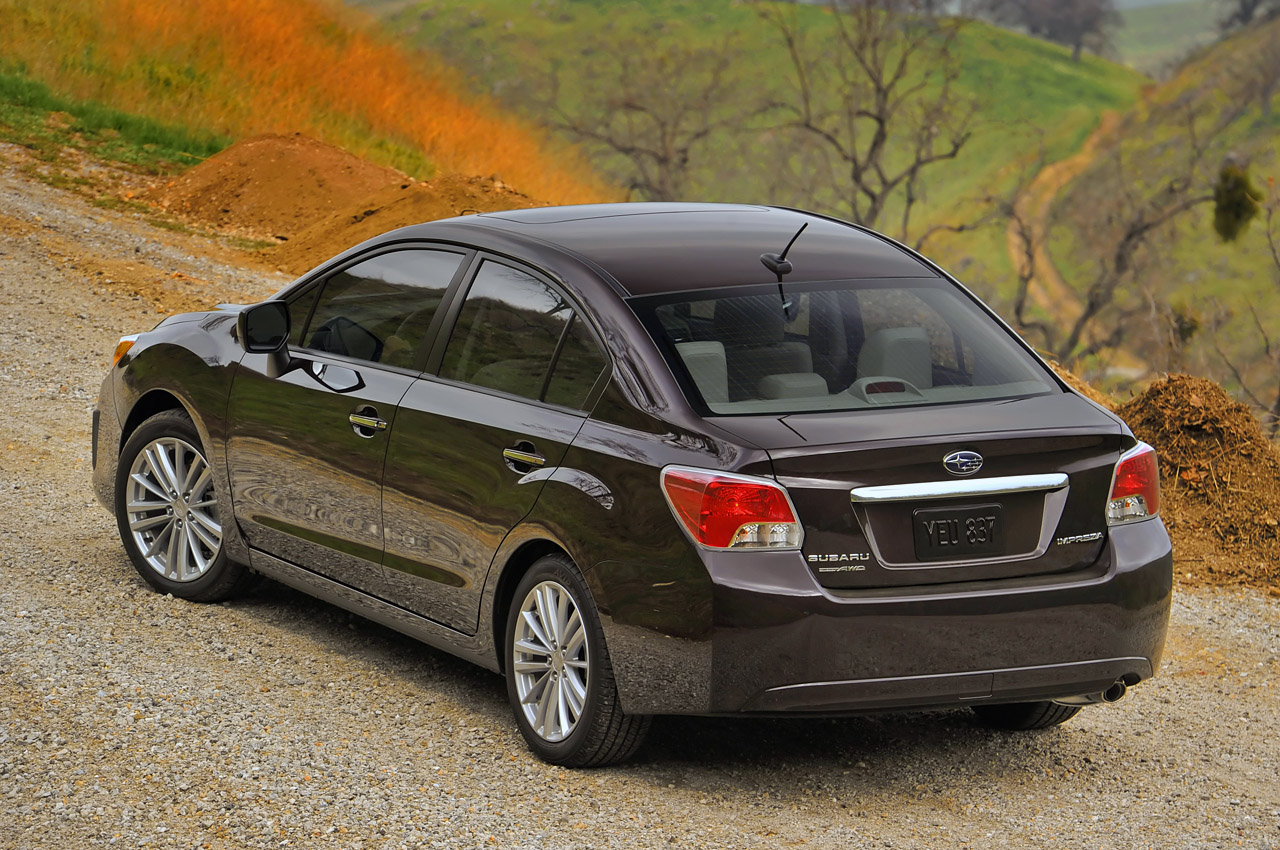
2012 Subaru Impreza Sedan

Beneath the handsome new metal (with nicely detailed wheel wells) is Subaru’s new 2.0L boxer engine making a relatively modest 148 hp 145 lb-ft of torque. The new engine sheds half a liter and 22 horsepower, but you’d never know it because its power and torque is managed much more efficiently by the new Lineartronic CVT (continuously variable transmission) that replaces the old-school four-speed automatic. Both a 5-speed manual and the CVT are available, but the CVT is the only transmission offered on the top-line Limited model.

Subaru's new 2.0L Boxer engine

Subaru claims a zero to 60 mpg time of 9.8 seconds, 0.3 seconds faster than the last Impreza that had a more powerful engine. While it’s not glacial, it’s 1/10th of a second slower than a standard Prius. It did seem quick off the line, but it takes a bit more time and effort for the engine to achieve highway speed.

The big news, however, is that fuel economy jumped from a decidedly uncompetitive 20 mpg city, 26 mpg highway to 27 mpg city, 36 mpg highway. That stunning 30% increase instantly makes Subaru competitive with other subcompact cars, even while sporting the heavier AWD hardware not available on any competitor like the Honda Civic or Ford Focus.

The new Impreza has a smaller gas tank (14.5 gallons), but with the boosted fuel economy, it still has a potential cruising range of more than 500 miles.

The base 2012 Impreza 2.0i sedan is $17,495. Additional trim levels are Premium and Limited. Add $500 for the 5-door version and $1,000 for the 5-door Sport. I wanted to test the much more rakish and desirable 5-door Sport Limited model; but those are so popular, dealers can’t keep them in stock.

My gracious host at Subaru Pacific had a loaded Limited sedan (MSRP $24,895) ready for me to test. The standard Lineartronic CVT produces the best fuel economy. The sedan is identical to the 5-door/Sport model from the B-pillar forward, so both should have the same driving characteristics.

2012 Impreza Sedan

First, I’d like to state for the record that I’m not a big fan of CVTs. CVTs are a bit buzzy and the mechanical shifts I like to feel when driving are missing. That said, Subaru’s CVT is pretty advanced and civilized. Humming and complaining was reserved for heavy acceleration. However, in normal stop-and-go city traffic and highway speed cruising, the transmission works well and is unobtrusive.

Subaru's Lineartronic CVT in the 2012 Impreza

The Lineartronic’s “M” mode gives the driver the feel and control of a 6-speed automatic. Handsome silver paddle shifters behind the steering wheel engage the fun. The LCD information screen between the analog gauges displays the number corresponding to the “gear” you feel you’re in. Slick stuff, but it’s more of a gimmick than useful. You’ll find yourself just leaving it in Drive and saving the manual mode for a steep decline.

2012 Impreza steering wheel with paddle shifters and audio/telephone and cruise controls. You can see the top edge on the paddle shifter barely visible above the right spoke.

The four-wheel independent suspension with double wishbones in the rear and MacPherson struts up front absorb rough surfaces better than in the past and the overall architecture is 110 pounds lighter (mostly from engine weight) and more rigid. Subaru added some sound-deadening materials that makes the cabin a place where you can hold a normal conversation at highway speeds, even if there is some road noise.

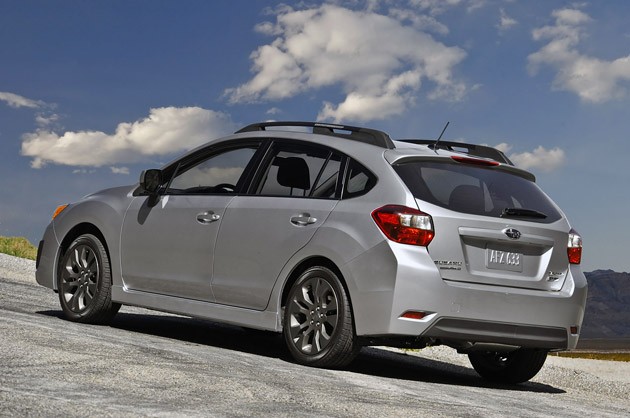
2012 Subaru Impreza Sport. It's almost a wagon, and I know people are calling it a wagon. Subaru calls it a 5-Door.

Standard 4-wheel antilock disc brakes (ABS) with Electronic Brake-force Distribution (EBD) grab the wheels with assurance. Some cars in this class are still cutting costs with rear drum brakes. Of course, there are loads of airbags and the standard electronic nannies of traction control (TCS) and vehicle dynamics control (VDC) and the IIHS awarded the 2012 Impreza its Top Safety Pick rating.

Driving the new Impreza is an uncomplicated experience. As I discussed above, it’s not fast, but it is quick off the line which is good for city driving. There is no torque steer, thanks to the AWD and the 50/50 split torque management system. The electric power steering is light and easy, if a bit vague. It tracked dead straight with my hands off the wheel. It also had a great turning radius (34.8 feet) that allowed me to do doughnuts in the Porsche Pacific parking lot.

The little Subie’s low CG and stiffer structure help keep it flat and controlled in corners — this is no Costa Concordia. Visibility was excellent due to a low belt-line and the new higher seating position.

Creature features are present too. There is the usual power windows, mirrors and remote locking. Leather trimmed seats are standard on the Limited model, as is the effective single-zone automatic climate control, automatic headlights and two-level heated front seats for those chilly mornings.

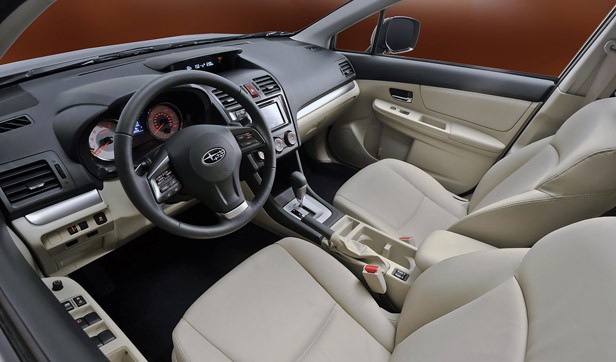
The interior of the 2012 Subaru Impreza Limited is much improved.

The back-lit analog instruments are easy to read and a vertical LCD screen between the two gauge displays the gear and fuel level was well as information from the multi-function trip computer including ambient temperature, average fuel economy and time. A 4.3″ horizontal LCD screen centered on top of the dash also displays information from the mufti-function trip computer.

The simple analog gauges are easy to read as in the center car information screen.

The Limited trim level includes a 6-speaker single-CD audio system with USB/iPod/AUX and power port (under the armrest) and Bluetooth hands-free connectivity.

The $2,000 Moonroof + Navigation Package on my tester added a power moonroof, GPS touch-screen navigation, an upgraded audio system with HD radio, iTunes tagging, XM Satellite Radio, XM Real-Time Traffic, Bluetooth 2.0 audio streaming, an SD card reader (music only) and SMS text messaging capabilities.

The center dash console is decidedly uncluttered and mercifully free of fake plastic wood. I liked the dark graphite plastic surround and the aluminum-look horizontal blades on either side.

The rotary automatic climate control knobs are easy to use and have a quality feel with notches. There is no digital readout for the climate setting. The optional GPS navigation system is uncluttered with only three buttons and one volume knob.

Only three buttons adorn the left side of the navigation screen Audio, Voice Control and Map. Simple, yes, but I was looking for a dedicated telephone button. All radio functions are performed through the touch-screen, but I think physical shortcut buttons for AM/FM/Sat/Aux would be helpful. Redundant audio and telephone controls are on the steering.

My car was equipped with the optional $250 auto-dimming rearview mirror with digital compass and HomeLink garage opener. I love the compass and ditching the garage door opener clipped to the visor tidies things up. It can be factory-ordered or dealer-installed.

Of course, I have a few gripes. I would have liked more legroom and additional driver’s seat adjustments. The good news is that I was able to sit behind myself, and I had the front seat as far back as could go for my 6 foot 1 inch frame. In fact, the 2012 Impreza added one inch to the wheelbase which helped engineers add two inches of rear leg room. This is much appreciated space in a small car.

There is a much welcome increase in rear seat legroom.

The door plastics were still hard, although textured. The dash cowl was covered with softer plastic, more in line with the competition. I give Subaru props for the effort, but compared to the competition, there is room for improvement.

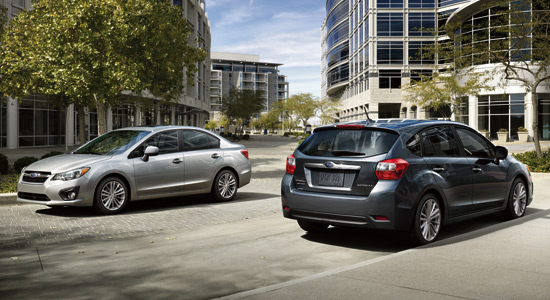
2012 Subaru Impreza Sedan and 5-door Sport

The 6.1 inch navigation screen looks small compared to the 7 inch screen in the Hyundai Elantra and the 8 inch one in the Focus. However, the full color graphics were sharp and the touch screen was responsive. I’d also like a backup camera.

So here’s the deal: A fully-loaded Impreza is just slightly more than a similar Civic or Elantra. But only Subaru delivers as standard equipment, its reliable, proven symmetrical all-wheel drive with a new, efficient boxer engine and a CVT.

The Verdict: The 2012 Impreza is a fun, economical and versatile little car that can take you places no other subcompact dare go. And based on 2012 Impreza sales – a 58% increase in December 2011 alone – I’d say the secret is out.

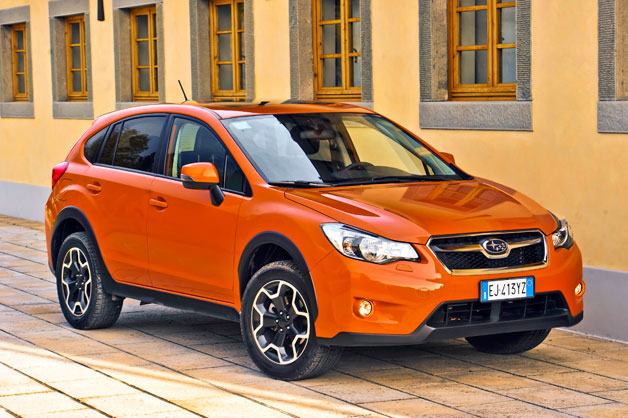
2013 Subaru XV Crosstrek

Note: If you want something with more ground clearance, something in the crossover category, the 2013 Subaru XV Crosstrek, based on the 2012 Impreza platform and drivetrain, is coming in a few months.