First, let’s review Moore’s Law: It is the observation that over the history of computing hardware, the number of transistors on integrated circuits doubles approximately every two years. It also describes a driving force of technological and social change in the late 20th and early 21st centuries.
In this context, “democratization” can be defined as the spread or diffusion of technology throughout the things we use in our everyday lives from a refrigerator to an automobile.
So how does Moore’ Law and the democratization of technology apply to the modern automobile?
Technology has been in trickling down from expensive to entry level automobiles since they were first invented. Headlights, electronic starters, windshield wipers and automatic transmissions were all once considered high tech that became democratized.
Early Examples
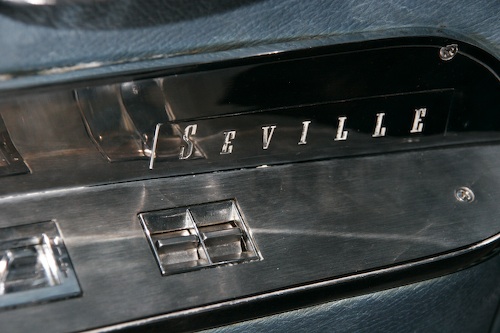
Remember when power windows, like these on a vintage Cadillac Seville, were really special and cool? Now, it’s so common, you don’t even think about it.
Just a few decades ago, commonplace conveniences like power windows, power door locks or a day-night rear view mirror were luxuries. As a kid in the 1960s and 1970s, I used to marvel at power windows. They were just so damn awesome and fun! Given a chance, I could play with the window switches until the battery died. Okay, it happened and the adults were none too thrilled about it; however, today, it’s taken for granted that all but the very cheapest cars have these features as standard equipment.
Air conditioning used to be a big deal too. We used to fight to be in the front seat near the AC vents as the rest of the station wagon didn’t cool very well. Now almost every vehicle has it as standard equipment and it doesn’t overheat the car.
Digital Media and Communications Technology Merging with Automobiles
iTunes, Apple’s digital music store, opened in April 2003 and seemingly overnight, the entire music business model was upended and it is still trying to cope with the fallout. Almost all record store chains have vanished and sales of physical CDs have been in freefall ever since. No one carries a CD or cassette player. If you see anyone – of any age – listening to music outside their home or car, it’s almost always with a digital music player and earphones. Boomboxes? Those are so 1990s.

Various generations of Apple’s iPod

Various generations of Apple’s iPod Nano
It was only five short years ago that Apple’s iPhone revolutionized the smartphone market. From nearly zero market share in 2007, smartphones now account for than 50% of all mobile phones in the U.S market.

Apple’s co-founder Steve Jobs holding the original iPhone in 2007
And today, almost every single in-car infotainment system, even a very basic one, has a way to integrate a smartphone or digital music player (like an iPod), even if it’s only an auxiliary line-in jack. Manufacturers are tripping over each other finding ways to integrate smartphones, apps and touch-screen technology into in-dash infotainment systems. The way smartphone technology is integrated into your car’s interface has become a major selling point for any car sold today.

Cadillac’s new CUE (Cadillac User Experience) infotainment system looks very much like an iPhone or iPad with its beautiful color touch-screen interface and various functions that look like apps.
Recent Examples of the Speed of Democratization
In 2006, for the 2007 model year, Lexus introduced a new generation of its flagship LS sedan. One of it’s “dazzle me” features was its Automated Parallel Parking system that used sensors to to steer the car into a preselected parking space. It was the first time this feature was offered on any vehicle in the U.S.

A 2007 Lexus LS460, introduced in 2006.
Lexus’s original automated system, part of a $4,315 option package, needed a large berth to perform its magical moves in what seemed like slow motion. On the mean streets of LA, if you actually found a streetside parking space big enough for the land yacht, you risked a road rage incident because of how long you’d be blocking an entire lane of traffic.
Today that same feature, Active Park Assist, is available on a 2013 Ford Focus for $395 (it was first made available in 2011 on the 2012 Focus). And for that price, you get a rear view camera, front parking sensors, and ultrasonic sensors. Ford claims the car will park itself, with very little driver input, in as little as 24 seconds.
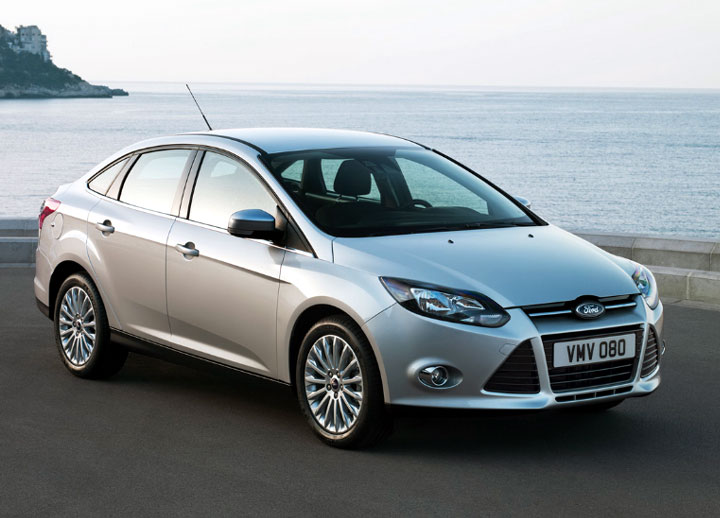
2013 Ford Focus Sedan Titanium
That same year, the 2007 Lexus LS was fitted with the first production 8-speed automatic transmission. Today, every BMW (except for the M-cars) has an 8-speed automatic transmission either as standard or optional kit. The same ZF 8-speed automatic (BMW doesn’t make its own transmissions) is available in most Audis as well as Chrysler Group products with rear- or all-wheel drive.
Do you remember, decades ago, when Cadillac offered a “Twilight Sentinel” that essentially automated the headlights? That feature used to be a big deal only available on top-line luxury cars. Today, you can get that feature on Kia Forte.
Not so long ago, Dual-Zone Digital Automatic Climate control was a feature only offered on some big, expensive luxo-cruisers. In less just a few years, every Honda Accord, Toyota Camry and Nissan Altima offered the same digital dual-zone automatic climate control systems. The technology to do this has become very inexpensive.
Let’s compare some pricing. The 2013 Hyundai Elantra Limited is very well equipped, including freight, at $21,720. The only option package is the Technology package that costs $2,350 — and you get a lot for your money: A GPS Navigation system with a 7” full color screen, a rear view camera, a 360 watt premium audio system, dual zone automatic climate control, automatic headlights and keyless entry and with a push button start.
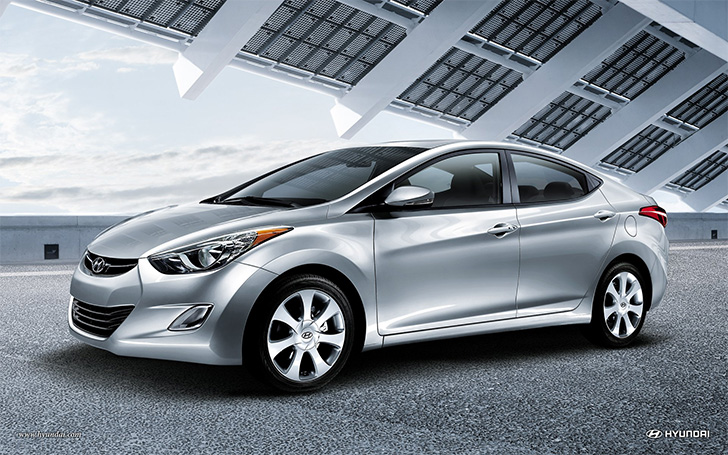
2013 Hyundai Elantra Limited Sedan
Now let’s compare this to the all-new 2012 BMW 328i, with a base price, including freight, of $37,395. Automatic headlights are standard on all BMWs as is dual-zone automatic climate control. First, let’s add the Premium Package for $3,100: Leather seating surfaces, lumbar adjustment, a moonroof, satellite radio with a 1-year subscription and keyless entry and ignition. Leather seating surfaces, a moonroof and satellite radio are standard on the compact Elantra Limited.
To match the lowly Elantra’s kit, the 328i needs to add navigation – $2,150; heated seats – $500; rear view camera – $400; and an upgraded Harmon Kardon Surround System, $875.

2012 BMW 328i Sedan
In total, you’d have to add $7,025 in options to the base BMW (a whopping $44,420) just to match the technology on the $24,070 Hyundai.
This is what has happened and is continuing to happen with all sorts of features that used to be reserved for expensive luxury cars that are now affordable and available on humble mass-market cars – from subcompact hatchbacks to full-size sedans and SUVs.
I’ll be the first to tell you that the tech in the BMW is probably better and more advanced than that in that in the Hyundai or that BMW’s leather seats are far superior to the much cheaper ones inside the Elantra. But the point is that the technology and materials like leather, soft-touch plastics and LED lighting has democratized its way to entry-level cars and consumers can feel like they aren’t missing too much by not paying so much more for a more prestigious brand.
Consumers are the winners in the democratization of technology on cars. With the technology trump cards being taken away from the likes of Mercedes, BMW, Audi and Infiniti, the luxury car makers must find new, more novel high-tech ways to distinguish their cars from the more mundane, entry level, mass-market offerings of companies like Hyundai/Kia, Toyota, Chrysler, Chevrolet or Ford.
Of course stellar drivetrains, high performance models, LED lighting, sophisticated chassis and suspension systems, high quality materials, design and build quality are still distinguishing factors in such legendary brands as Porsche, Mercedes and BMW. But even those advantages are constantly under assault as technological advances in manufacturing allow all carmakers to make higher-quality, safer vehicles with better fit and finish, upgraded plastics and beautiful paint jobs.
The New Poster Child for Tech Democratization: The 2013 Ford Fusion
Ford is upping the ante again this fall as the 2013 Fusion comes to market. Ford marketing says the new Fusion is “America’s Smartest Midsize Sedan” and that it can “see what the driver can’t.” It can be equipped with front and rear cameras, front and side radar, and front, rear and side ultrasonic sensors to accomplish the task.
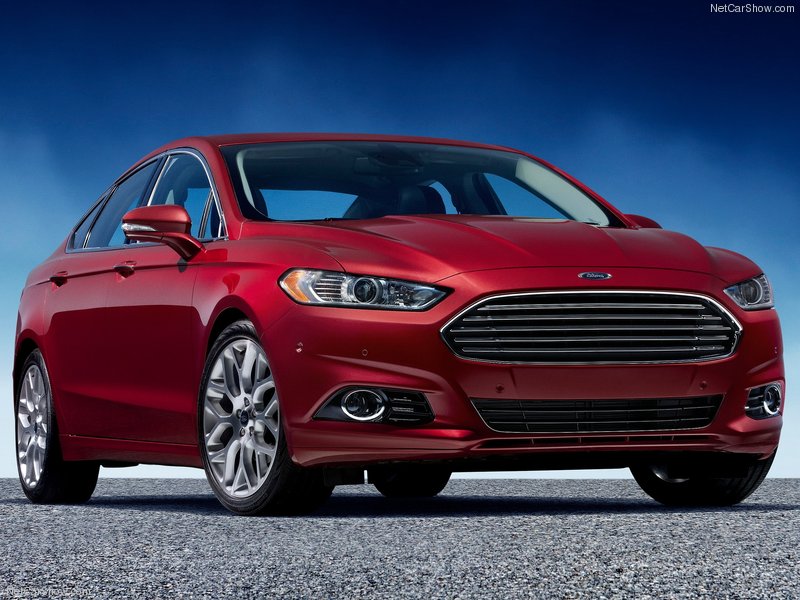
2013 Ford Fusion

The 2013 Ford Fusion is available with a dizzying array of cameras, radar and ultrasound sensors.
The web of cameras and sensors are all networked together with high-speed processing chips and millions of lines of software code. Ford’s Driver-Assist Technology for the 2013 Fusion includes a rearview camera to assist the driver when backing up, a Blind-Spot Indicator System that warns the driver of cars in lanes on either side and a Cross-Traffic Alert assist in locating traffic to the rear and sides when backing out of a parking space or driveway.

Driver-Assist Technologies available on the 2013 Ford Fusion
Pull-Drift Compensation and a Lane-Keeping System nudge you back into the lane with a bit of torque applied to the electric power steering if the car senses it is going outside the lane without driver input. Active Park Assist parallel parks the car for the driver – like the system introduced in 2011 on the 2012 Focus. Driver Alert System provides a visual (flashing lights) and audio (beeping) alert if it senses you falling asleep.
The radar-based Adaptive Cruise Control adjusts the speed to follow the car in front of you if that car is going slower than your set speed. The system will also brake the car to a complete stop if traffic grinds to a stand still. Using the same radar, Forward Collision Warning loudly alerts you to a pending frontal crash.
So what does all this set you back? The 2013 Fusion Titanium (top trim level) starts at $30,995. The total cost of all the Driver Assist gizmos I described above is $2,790 for a fully-loaded MSRP of $33,785. That’s $3,610 less than the stripped-down entry level BMW 328i sedan. Active Cruise Control alone is a $2,400 option on the Beemer.

The interior of the 2013 Ford Fusion looks like a very nice place to spend time. I think it will be a very popular midsize sedan and proves that American can compete with the Japanese and Koreans. The era when import brands have an advantage over the domestic manufacturers is officially over.
In short, the 2013 Ford Fusion takes the democratization of automotive technology to a whole new level and makes the Fusion stand out from the crowded pack that includes: the all-new 2013 Honda Accord, the all-new 2013 Nissan Altima, the one year old Toyota Camry and the two-year old Hyundai Sonata and Kia Optima. Even the all-new 2013 Chevy Malibu is at least in the running here. The Fusion, however, sets the bar higher.
To the driving enthusiast like me, assuming price wasn’t an obstacle, I’d go for the rear-drive Ultimate Driving Machine any day over the front-drive cushy family hauler from Ford.
But the vast majority of buyers look at the value of a “common” brand like Ford and see that they can drive a sharp-looking, high-tech near-luxury car with a different badge for just a fraction of the price of a similarly-equipped luxury brand car. In other words, Ford gives you much more value for your money.
Conclusion
In keeping with Moore’s Law, we can only expect to see more advanced technology features to appear on less-expensive cars as costs continue to fall, processing speeds increase and technology advances. Everyone will benefit from this democratization of technology.







 Todd Bianco's ACarIsNotARefrigerator.com Blog