Archive for the ‘Safety’ Category


It was just a couple weeks ago that I was cursing my rental Chevrolet Malibu because it’s hind quarters was too high for me to see the car I was backing into trying to parallel park. Since you rarely parallel park on a test drive, this is one of those nasty unexpected annoyances that pop up during your ownership of any given car. I was also profoundly annoyed by the blind spot created by the large B pillar every time I tried to check my left blind spot.

The Malibu's rear looks "normal" but it's too high when you look backwards.

It’s really hard to review an appliance like the 2010 Malibu LS. The styling is anonymous – neither exciting nor displeasing. It starts right up (as any car should) and stops with some level of assurance. The steering wheel is connected to the rack with a strand of al dente spaghetti, although in slow-speed parking tangos, the steering feel is more like freshly-poured cement. Only when pressed does the Malibu exhibit torque steer.

The anonymous styling of the 2010 Chevrolet Malibu. Better than the past, but that bar is so low almost anything would have been an improvement.

The Malibu has plenty of room for four passengers. It will be very tight with five adults. The picture makes it look even more like a rental car. Thanks, Chevrolet!
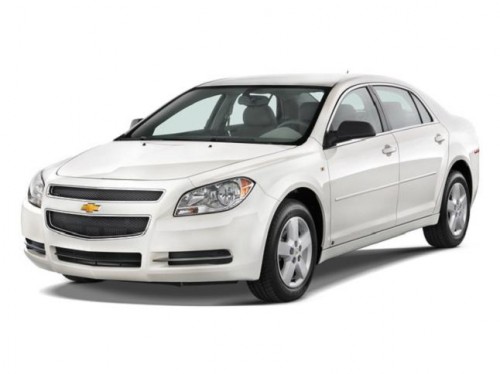
Most people would be hard-pressed to identify this as a Chevrolet Malibu, particularly if you get rid of the Chevy Bow Tie in the front.

The ‘Bu (an internal GM nickname, so the story goes) was an adequate rental appliance for our four days touring Richmond, Virginia and Washington DC. The trunk swallowed all the luggage with plenty of room to spare. The driver’s seat was relatively comfortable for the slog from Richmond to DC.
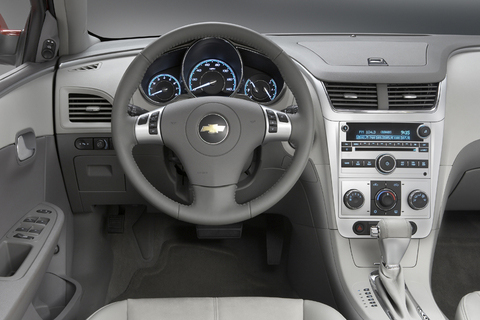
The base Malibu interior is well-designed and fairly straight forward. It didn't take long to find and master all the controls.

(Richmond is a lovely city, but I’m not sure they’ve been informed that the Civil War, uh I mean War for Southern Independence or War of Northern Aggression, ended 145 years ago.)

For most of the trip, the 6-speed automatic shifted unobtrusively, with a tendency to upshift to save fuel. When prodded, the silicon chips think for a moment, the transmission kicks down and the standard 2.4 liter, 169 hp Ecotec I-4 engine wails in misery. When I had to do some fast shifting from reverse to drive shoehorning the Malibu into rare and illusive DC parking spaces, the transmission actually clunked a couple times between gears.

The upgraded interior with leather in the top-of-the-line Malibu LTZ shows off the double dash design and is much more pleasing to the eyes.

As a daily transportation appliance, the Malibu rates a C+ or B-. It’s a solid effort from the “old GM” and in 2008, it was the best Chevrolet passenger car (damning with faint praise, I’m afraid). The switchgear, steering column stalks and center console displays are familiar parts bin stuff. The turn signal click clack is so annoying that anything longer than a couple seconds causes migraines.

On the plus side, we got an around 26 mpg during the trip, which is above average for this segment.

(more…)


It was a lovely sunny day and I was driving northbound on Griffith Park Boulevard in my new 1987 Mercedes-Benz 190E 2.6. As was my habit, I was looking at For Sale signs on some of those cute homes on the east side of the street. Those were days when you could buy one of those homes for less than $200,000.

What I didn’t notice was the gigantic moving truck parked directly in front of me in the traffic lane. My distraction turned to panic when I looked back to the street. There was opposing traffic and I had nowhere to go. I instinctively slammed the brakes, both feet, as hard as I could. While my life was flashing through my head, I heard a strange staccato stuttering sound, the brakes pulsed and the car stopped just a couple feet short of the menacing T-bar.

In almost any other car, I wouldn’t have stopped in time and I would have been seriously injured or worse.

In those days, anti-lock brakes were the domain of German luxury cars. Lexus and Infiniti didn’t exist yet and the Detroit Three were floundering in mediocrity.

I was aware that my car had the feature, but in the fraction of a second I had to react, it didn’t cross my mind. I’m thankful the Mercedes had anti-lock brakes. The new era of electronic driving assistants became very real and tangible to me in that instant.

Two other factors favored me that day. In addition to the ABS system, the car had nearly new tires with lots of tread (translate: grip) and the road was clean and dry. Most people ignore their tires and this can be a fatal mistake. Worn tires and ones that are either under- or over-inflated tires, rob your vehicle of its best stopping power and accident avoidance agility.

Fast forward more than 20 years and virtually every car sold has ABS. Electronic stability control is also now mandated on most new vehicles. But what’s really changed is that your car has become a sophisticated mash up of high-strength steel, greasy bits, plastic and high-speed computers that control almost every aspect of driving.

Computer programs can instantly change the way the steering and throttle respond to driver input. Computers control the valve timing and fuel injection systems. They can deactivate cylinders and new stop-start technology automatically kills and revives the internal combustion when it’s not needed. Sensors monitor and adjust anything from the climate to the ambient lighting.

The most significant advances have been made in expensive electronic and mechanical vehicle safety. Electronic nannies do amazing things to keep you safe. Air bags at every corner of a vehicle protect you in a crash and are even being placed in seat belts. High strength, lightweight alloys guard the passengers.

This year, Toyota made the headlines with wild tales of runaway vehicles with sticky throttles and bunched up floor mats. Toyota is now a defendant in hundreds of cases of lawsuits related to unintended acceleration; yet so far, neither government investigators, nor Toyota, nor independent scientists have been able to find a software defect in Toyota’s electronic throttles. Much of the “black box” data shows that many of the crashes were a result of driver error. People do confuse the pedals when they are panicked.

To mitigate the damage to its reputation and falling market share, Toyota has replaced millions of throttles and reprogrammed the software to automatically cut off the fuel supply when it detects both accelerator and brake pedals pressed simultaneously.

Last month, I was invited to a Lexus safety demonstration event at the Toyota Motor Speedway in glamorous Irwindale. I arrived an hour early, and to my delight, they were all set up and ready to go so I was offered unhurried drives on the various courses demonstrating a host of electronic nannies on 2011 Lexus (and Toyota) vehicles.

Lexus Safety Event Registration

Lexus calls its unintended acceleration mitigation system “Smart Stop Technology” and it’s standard on all 2011 Lexus vehicles. Lexus needs to reassure its customers that the electronic drive-by-wire throttle systems are safe and that they won’t die in a fiery crash like the one that happened in a 2009 Lexus ES350 in northern San Diego County on August 28, 2009. (more…)