World meet the United States. United States meet the World. For the first time in a generation, an American car company is selling a first-rate, European-engineered world car in the US. Hallelujah! Cue the balloons.
The Fiesta nameplate hasn’t been used by Ford North America for almost three decades. Ford brought the first-generation Fiesta to the US in an ill-timed attempt to find its place in the brave new world post-Arab oil embargo and under new EPA rules.
While the first-generation supermini Fiesta was a hit in the rest of the world, American consumers weren’t ready for the tiny, fuel-efficient, but crude sardine can. Five generations of the Fiesta have graced all continents save North America for the past thirty years. The all-new sixth generation Fiesta went on sale in Europe in 2008 and has finally made its way to the US this summer as a 2011 model.
Ford can save buckets of cash if a car can be sold in all markets worldwide. It costs hundreds of millions of dollars to develop or re-engineer a car for each market. Opening the US market to world cars amortizes development costs over a larger number of units sold and brings the cost structure down to a point where selling a small, inexpensive car, built in Mexico, is profitable for Ford.
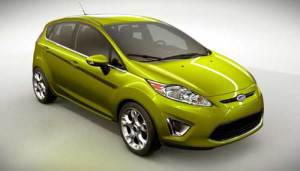
The 2011 Ford Fiesta Hatch
I confess that I love hatchback cars. They are so versatile and cute; however, market research informs car companies that Americans won’t buy hatchbacks. This is why Honda no longer sells a Civic hatchback. Same for the Toyota Corolla. The Honda Fit gets great reviews but doesn’t sell in high volumes. In Europe, hatchbacks easily outsell sedan variants. Go figure.
Maybe tastes are changing. I hope so because the Fiesta Hatch is by far more desirable than the sedan. Given the diminutive size of the Fiesta (160.1 inches), the hatch just makes sense. Flip the back seats down and you have much more cargo for groceries or a dorm room junk.

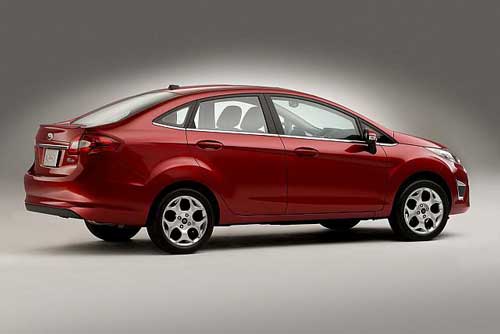
2011 Ford Fiesta Sedan
I test drove the base Fiesta SE Hatch ($16,190) with the PowerShift automatic ($1,125). Most of you will choose the automatic in a city like LA. That’s why dealers only order automatics. My Fiesta had Rapid Spec Package 203A ($775) which included SYNC voice-activated hands-free phone and music system, 80-watt premium sound, Sports Appearance package, cruise control and 15 inch painted aluminum wheels. Sirius Satellite Radio added $370 for a total sticker of $17,990.
The new PowerShift transmission is an automated manual six-speed dual clutch gearbox that Ford jointly developed with Getrag of Germany. It’s much lighter than a standard automatic transmission and increases fuel economy by as much as 10%, according to Ford. In most driving conditions, the target owner will think it’s a regular automatic.

Ford's new DirectShift dual-clutch automated manual transmission
The only thing that surprised me was that the car didn’t creep at a dead stop. I took my foot off the brake, expecting some forward movement, but nothing happened until I tapped the gas pedal. Odd at first, but you get used to this the first day of driving.
I’m six feet one inch tall, but I managed to find a comfortable position with the four-way front seat manual adjustments and manual tilt/telescope steering wheel. Unfortunately, unless you are a double-leg amputee, you aren’t sitting behind me. It’s a great two person small car. If you want to seat four people, I’d suggest four young anorexic females under five-four.

2011 Ford Fiesta - Hatch open for cargo
The little 1.6 liter Duratec Ti-VCT I-4 seemed to have plenty of pep for the usual LA stop-and-go traffic and dodging through freeway messes. I found the steering direct and responsive as someone tried to back into my tester from a blind driveway. The base 15” wheels were plenty for most drivers, although I’d prefer the 16” wheels with better gum.

Ford's new "Kinetic" styling looks great on the Fiesta's small sides
The ride was a bit choppy, but that comes with the supermini with the territory. When you’re dealing with such a short wheel bases (98” – Fiesta, 97.1” MINI, 98.4” Honda Fit), it’s hard to smooth out LA’s horrible streets. The independent front MacPherson struts and twist beam rear suspension perform their job diligently. An independent rear suspension would be preferable; but it would have been a packaging problem that sucked up more interior volume than could be justified by the extra cost.
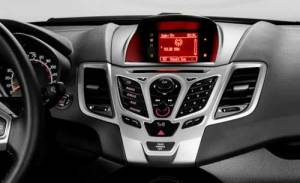
Fiesta's Center Stack
The interior is fresh and easy to decipher. The little infotainment screen presents its data in bright red LED readout. There is no navigation system available – most kids driving this car will have a hand-held device or use their smart phone with its own navigation software. The USB port in the center is well located and can be used to charge your iPhone. Cup holders are on the small size; but a larger hole (in the center area where an armrest should be) can be used for Big Gulps as long as you don’t rock the boat too much.
Overall quality of plastics and fabrics was as good as Honda or Mazda. I found a couple panels that had unacceptable gaps; however, that may be fixed as the factory hits its stride.

Upgraded leather interior looks great
I checked out an upgraded SES Hatch with the leather seating surfaces and VIP entry package with keyless ignition. The contrasting piping on the seats looked terrific. These touches add maturity to an otherwise very youthful design.
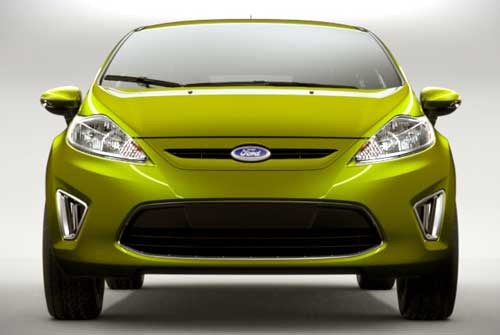
Ford’s new “kinetic” design language works well on the Fiesta, including the “exotic dragon’s-eye” headlamps. The sides have a high character crease sweeping through the door handles to the rear C pillar and the front style line slinks around the headlamps, below the Blue Oval in the front grille and up through the A-pillars/roof. There is almost no overhang on the rear wheels which give the car the illusion of extra length.
These details distinguish the Fiesta from its boring Japanese and Korean competition and moves it closer to the MINI in character. The lack of cheap bling lends a more expensive look to the Fiesta as do the body-colored mirrors with signal repeaters.

Sweeping styling lines look best on the hatchback
The Fiesta is the best entry-level supermini since the 2001 introduction of the MINI Cooper. It’s also the best domestic entry-level car in decades. The Fiesta starts at $13,320 with EPA estimates of 29/40 mpg. Think of it as a budget non-hybrid that’s a good first car for the kids. The Mazda2 shares the same basic chassis yet the Fiesta outshines the Mazda2 in all metrics. I see great things in Ford’s future.

Front Face hasa nice lines

Keyless Ignition is a nice upscale touch






 Todd Bianco's ACarIsNotARefrigerator.com Blog