Archive for the ‘Automobile Manufacturers’ Category


If you’re like me, you’ve read all the glowing reviews of the all-new 2013 Cadillac ATS, the entry level Caddy that was created to slay the mighty Germans, with the BMW 3-series directly in the engineers’ cross-hairs.

The first 2013 Cadillac ATS rolls off the assembly line. It was a great moment for GM's luxury division.

The first 2013 Cadillac ATS rolls off the assembly line. It was a great moment for GM’s luxury division.

I certainly was skeptical. After all, the Bavarian Motor Works has been honing its 3-Series for decades and it’s the de-facto benchmark by which all compact sports sedans must be compared. Cadillac’s engineers tore apart the 3er to see what makes it tick and then built the company’s all-new rear-drive Alpha platform to meet, match or exceed the standards of BMW.

The short answer is that Cadillac has succeeded in making a competitive, first-rate compact sports sedan. Is it a BMW? No, it’s not, but it’s a great freshman entry. It’s not quite carved from one block of granite and doesn’t convey the decades of engineering experience and crammed trophy cases that paved the way for the current (internal code) F30 BMW is built.

A BMW 328i sedan - the benchmark for all compact sports sedans and the target of the 2013 Cadillac ATS.

A BMW 328i sedan – the benchmark for all compact sports sedans and the target of the 2013 Cadillac ATS.

Perhaps I’m biased because I’ve owned at least one or more cars from all the German manufactures. Perhaps I’m predisposed to expect mediocre product from the Wreath and Crest division of General Motors. However, in the ultra-competitive luxury car market, brand image is vital and perception translates into sales reality.

GM’s luxury division is going to have to work magic to get BMW, Mercedes or Lexus owners to cross shop – particularly in a region like Southern California where a Caddy is joke punch line, not something you drive. Cadillac’s customers skew much older and attracting youth to the brand – youth that will appreciate the driving dynamics of the ATS and who will know how to use all the electronic gizmos – will be key to the future of the brand.

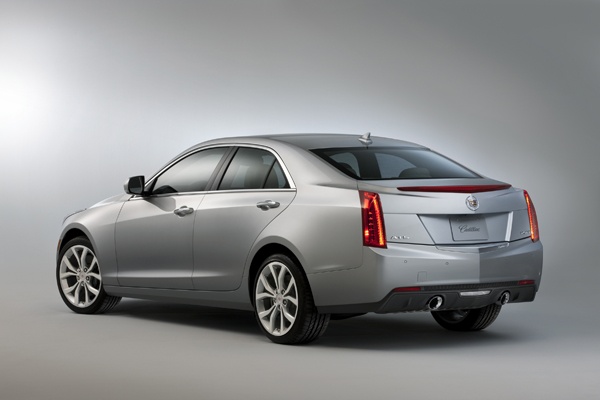
I’d like to get past the styling before we get to the actual driving experience. The ATS wears a conservative, toned-down version of Cadillac’s decade-old Art & Science theme. I like the way the vertical headlight array sweeps up the front fenders and the mini fins in back are a Cadillac hallmark. The rear center brake light is nicely integrated into the trunk lid. The whole package works well, but color choice is very important to the overall look.
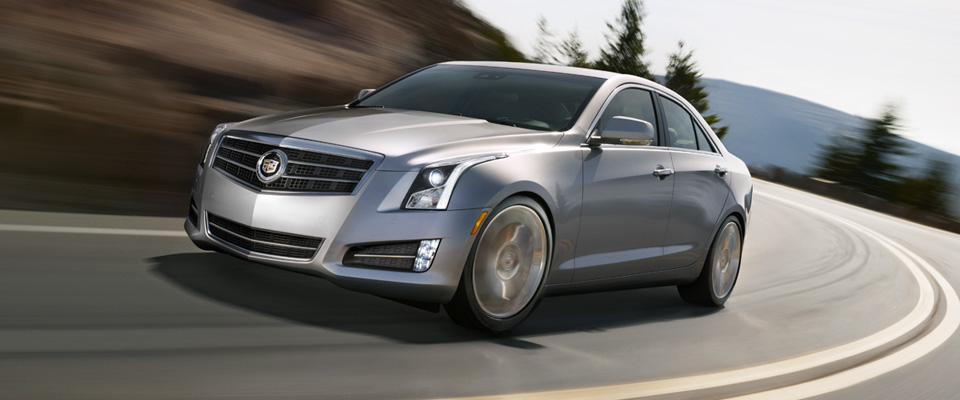
2013 Cadillac ATS Luxury Sports Sedan

2013 Cadillac ATS Luxury Sports Sedan

Detail of the 2013 Cadillac ATS'  headlight module. Note how the vertical LED running lights sweep up and over the front wheel fender. A nice touch.
Detail of the 2013 Cadillac ATS’ headlight module. Note how the vertical LED running lights sweep up and over the front wheel fender. A nice touch.

The rear of the 2013 Cadillac ATS. You can still see vestiges of fins in the vertical taillights and the center brake light is nicely integrated into the trunk spoiler.

The rear of the 2013 Cadillac ATS. You can still see vestiges of fins in the vertical taillights and the center brake light is nicely integrated into the trunk spoiler.

The ATS’ Alpha chassis is text book sports sedan: Front engine, rear-wheel drive, four-wheel independent, multilink suspension, four-wheel anti-lock disc brakes and optional all-wheel drive. Like all modern cars, to save weight and engine drag, the ATS uses the latest-generation electric power steering unit from Germany’s ZF.

Cadillac offers three engine options: The base unit is a Chevy 2.5 L four-cylinder unit with direct injection making 202 hp. Next up is a 2.0L turbo four, also with direct injection, making 272 hp and the most potent engine (before the inevitable ATS-V makes its debut) is the familiar 3.6L direct injected V6 good for 321 hp.

The standard transmission on all trim levels is GM’s aging 6-speed automatic with paddle shifters. You can get a 6-speed manual transmission only on the 2.0 turbo models. GM always seems late to the party on transmission. Its competitors have been using 7- and 8-speed automatics for a while now. However there is hope. The just-introduced 2014 Cadillac CTS, which also rides on the Alpha platform, will use an Aisin (aToyota affiliate) 8-speed automatic on some models with V6 engines. The 8-speed should migrate to the ATS in the next model year. Problem solved.

I drove the ATS 3.6 Luxury with a base MSRP $42,090 – much more than the standard ATS 2.5 that starts at $34,000. Aside from the V6, 6-speed automatic and an assortment of other goodies, it come standard with the CUE (Cadillac User Experience) infotainment system (sans navigation). My tester had the optional $845 Driver Awareness Package and nothing else.
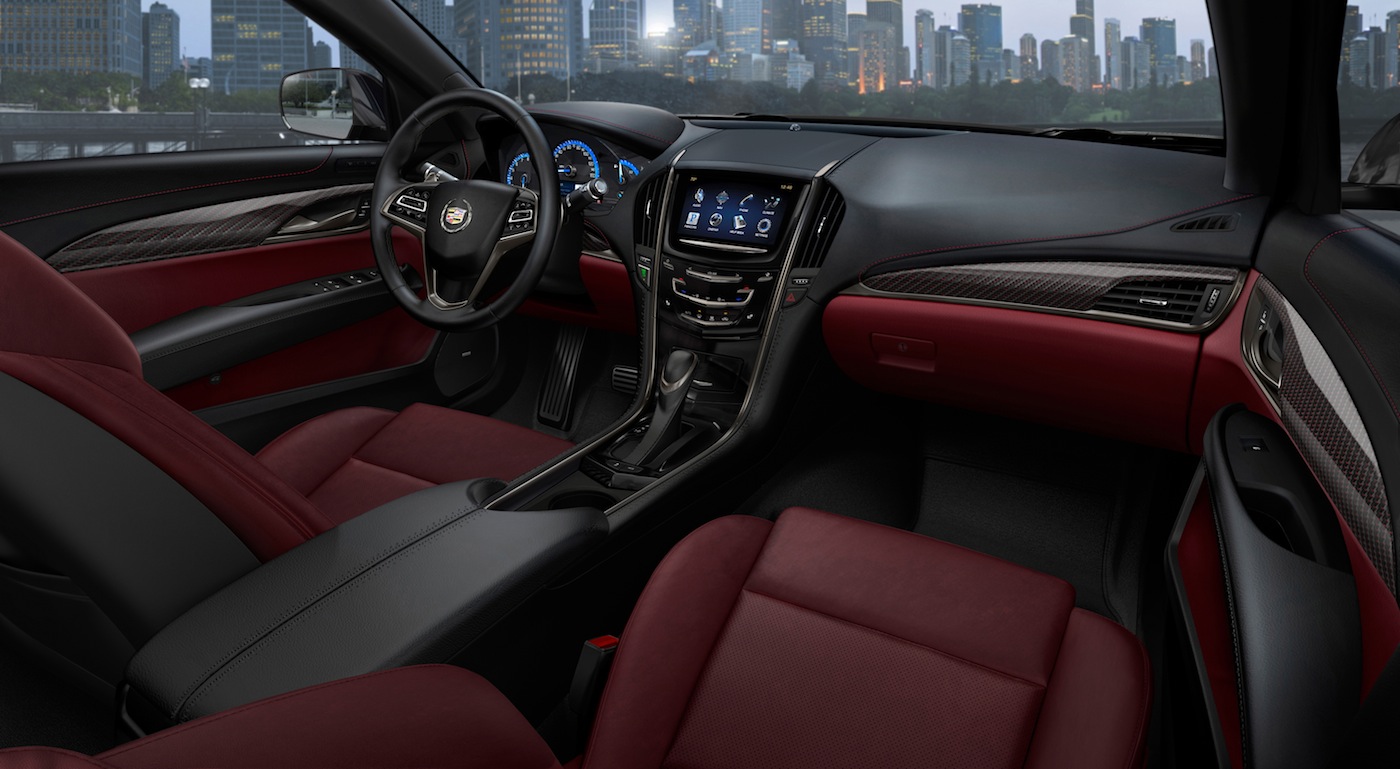
Morello Red leather with Jet Black accents is an optional interior on the ATS

Morello Red leather with Jet Black accents is an optional interior on the ATS

The ATS was a delight to drive. If this was around in the Roman times, Mercury wouldn’t have needed wings on his shoes. The 3.6 has plenty of power and a very broad torque range. It effortlessly flew up hills and down wide boulevards. This was a happy time for my right foot; just don’t watch the instant fuel economy readout.

The ATS felt light and nimble, even in “Luxury” trim wearing only standard 17 inch wheels and all-season tires. And I do mean light. The V6 ATS weighs around 3,400 – about 100 pounds less than the comparable BMW 335i. It’s also balanced nearly 50-50 front/rear, long a BMW bragging point. It easily tosses into turns and straightens out without feeling like the mass is still moving in the opposite direction.
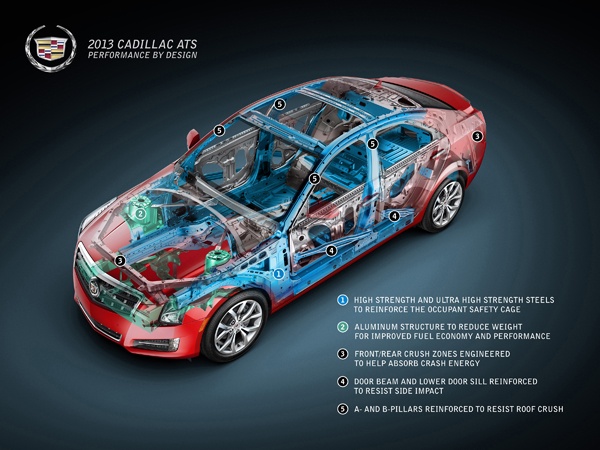
A cutaway of the 2013 Cadillac ATS shows how weight was saved by using aluminum and high-tensile steel.

A cutaway of the 2013 Cadillac ATS shows how weight was saved by using aluminum and high-tensile steel.

Fortunately, the Cadillac doesn’t use run-flat tires like almost every BMW. Even on highway braille bumps and uneven surfaces, the chassis was calm, quiet and composed, facilitating a sporty but comfortable ride. It was a joy.

Steering is light, well balanced with commendable road feel. Much can be attributed to the ZF EPS unit, but Cadillac’s engineers really spent bundles of time and untold computing hours tuning the steering – and it shows. There was no drift, and it tracked laser straight and small movements yielded exacting results. I wished for slightly better on-center feel. That said, I wished for the same things when I drove 2012 BMW 328i and it’s the benchmark.

Cabin quality was on par with the competition, but not to the level of Audi. Materials felt rich, plastics were mostly soft to the touch (with a few glaring exceptions) and I liked the French stitching on the dash. Some switchgear felt cheap.

The cock pit of the 2013 Cadillac ATS sports sedan. This one has CUE, Cadillac User Experience, the brand's high-tech infotainment system.

The cock pit of the 2013 Cadillac ATS sports sedan. This one has CUE, Cadillac User Experience, the brand’s high-tech infotainment system.

For me, the cabin was a bit claustrophobic – I’m 6’1” tall, 180 pounds. While I fit in the seat, and I liked the electric adjustments, side bolsters and the manual thigh support extension, I just felt like the passenger and I were too close. There was an unconscious jousting of elbows for the slim center arm rest.

And with me in the driver’s seat, the back seat is good only for small adults or children. There was barely room for our two dachshunds. The BMW 3 seemed to have more space. Trunk space was on par with the others in this category. If your idea of weekend fun is Swedish meatballs and flat-packed furniture, buy an SUV.

Cadillac’s CUE infotainment system is frustrating and might be enough to kill the deal. I’ve driven many cars with more responsive touch screens. I believe Chevy’s MyLink infotainment system that mixes a more responsive touch-screen with old-school knobs and buttons is far superior. While CUE’s haptic feedback is nice, I always felt a hesitation when I punched a function on the slick 8 inch full color screen. It was slow enough to make me almost want to touch the control again. Like many others, I’m used to the instant response of an iPad screen and CUE feels like the design predates the iPad which is already on its third generation.
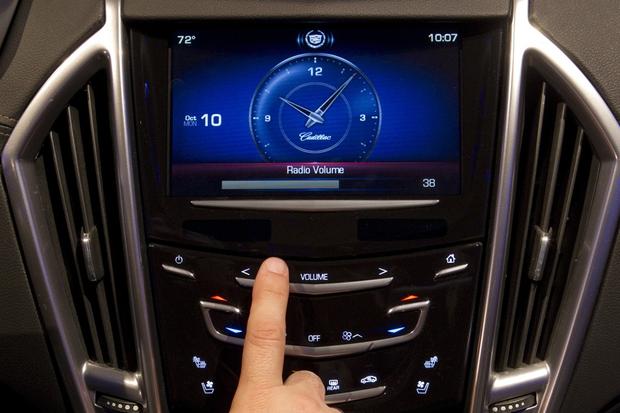
The capacitive sensing touch screen of CUE.

The capacitive sensing touch screen of CUE.

I also don’t like the lack of physical knobs for things like volume or climate control. While I’m sure you’d get used to sliding your finger over the slick center panel to raise or lower volume, I’m willing to bet users will elect to control that kind of stuff with the redundant hard buttons on the steering wheel.
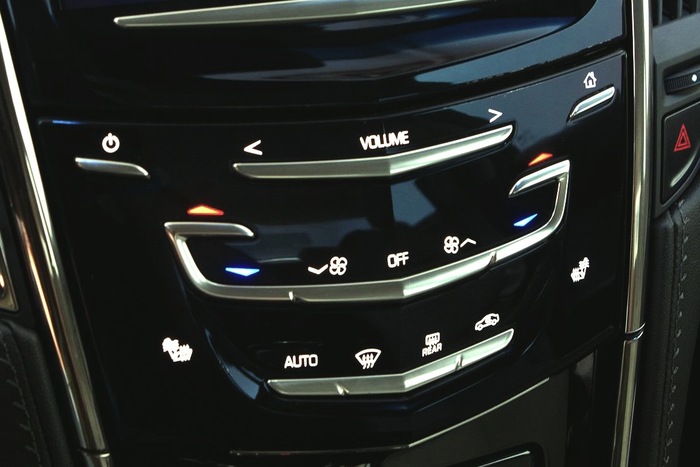
The center dash touch panel of the 2013 Cadillac ATS has no knobs or physical buttons. Everything is touch sensitive. It's easier to turn the knob to turn the sound up or push it to turn the system off.

The center dash touch panel of the 2013 Cadillac ATS has no knobs or physical buttons. Everything is touch sensitive. It’s easier to turn the knob to turn the sound up or push it to turn the system off.

The very fact that the 2013 Cadillac ATS exists is a minor miracle and I wouldn’t hesitate to recommend it to someone looking for something different from the standard issue (in LA) BMW 328i, Audi A4 or Mercedes C250. But for me, it’s really the Almost There Sedan from Cadillac. It would only be attractive on a heavily-vented short-term lease. I have high hopes for the ATS, particularly when it matriculates to its 2nd generation. Maybe then, some of its freshman flaws will be exorcised and we can call it the All There Sedan.

[Editor’s note: March 2013 sales were announced two days ago. Cadillac’s March 2013 sales were up 55%. The ATS had its best month since launch, with 3,587 units sold – outselling the Audi A4/Allroad, but still a distance from the BMW 3-series with nearly 9,000 unit sales. Ward’s Automotive reports that 70% of ATS sales were “conquest sales” from BMW, Mercedes-Benz and Lexus.  Fifty percent of ATS sales were with the 2.0T engine, with the remaining half split evenly between the base 2.5L I4 and the 3.6L V6 engines. ]


Of the three Detroit manufacturers, only Ford has been a major player in the hybrid car game for several years now. The Ford Fusion Hybrid and Escape Hybrid were the two main-stay offerings from Ford until the company completely revamped its lineup in 2012 for the 2013 model year with all-new  hybrid offerings.

Ford dropped the Escape Hybrid when it introduced a completely redesigned model for the 2013 model year. More fuel efficient gas engines in the new Escape are able to achieve nearly the same level of economy as the outgoing hybrid model.

To replace the Escape Hybrid, Ford introduced the 2013 C-Max which is available only as a hybrid or plug-in hybrid known as the C-Max Energi. The C-Max, based on the outstanding Focus platform, has been sold in Europe in various forms for years – just not as a hybrid.

2013 Ford C-Max Hybrid SEL

2013 Ford C-Max Hybrid SEL

Ford reconfigured the C-Max for US sales by getting rid of its rear sliding doors in favor of conventional 4-doors. Ford marketing believed that sliding doors would automatically brand the C-Max with the Scarlet M (for minivan) and, in the States, the M-word is the kiss of death.

The compact interior of the 2013 C-Max will seat five - but that's two adults and three small children.

The compact interior of the 2013 C-Max will seat five – but that’s two adults and three small children.

The C-Max is as close as we are going to get to a Focus wagon and it’s the only direct competitor to the Toyota Prius V. It’s tall, like the Mazda5 compact minivan and you sit a bit higher and more upright than a normal car. The rear liftgate is large and the floor height is marginally higher than a comparable passenger car for easy loading. Lots of glass surrounds you so visibility is excellent and the large side mirrors are tipped with concave mirrors that provide an analog solution to blind spots.

2013 Ford C-Max Hybrid - Rear

2013 Ford C-Max Hybrid – Rear

My 6′ 1” frame fit into the driver’s seat, but there wasn’t much extra room. The standard manual tilt/telescoping helped make things comfortable. Rear seats are best for children or small adults as the cushions are short, with no thigh support and there’s a paucity of larger adult legroom. It should be fairly easy to strap in child seats as the tall doors and the C-Max’s diminutive size put belts and buckles in easy reach for weary parents.

The rear seats of the C-Max split 60/40 and fold flat. Not much leg room for adults, but it's pretty easy to reach in to grab the kids.

The rear seats of the C-Max split 60/40 and fold flat. Not much leg room for adults, but it’s pretty easy to reach in to grab the kids.

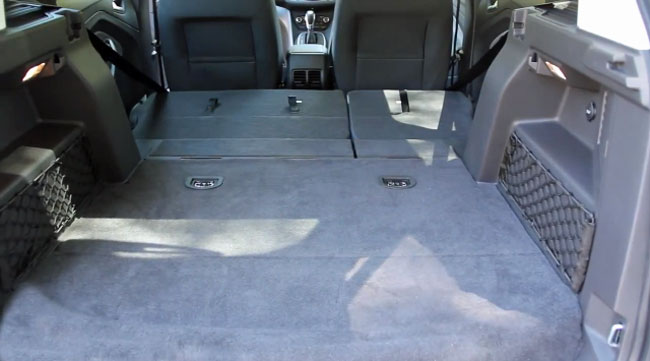
The flat-folding rear seats split 60/40 to open up 52.6 square feet of cargo space. Perfect for a Costco run or a couple large dogs. It would be nice if the rear windows rolled all the way down, but I’m not sure the rear occupants would care.

Plenty of cargo space in the back of the Ford C-Max with the rear seats folded down.

Plenty of cargo space in the back of the Ford C-Max with the rear seats folded down.

MyFord Touch is Ford’s much maligned infotainment system that is the number one cause of customers’ dissatisfaction with Ford vehicles in recent in JD Power & Associates surveys. Consumer Reports slammed Ford both before and after a major software update to the system. I’m a fairly tech-savvy guy, so I have mixed feelings about it.

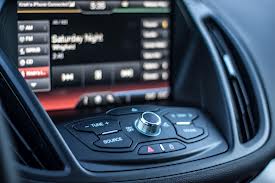
The 8 inch color display on the C-Max is set high – too high, in my opinion – in the center stack. It’s deeply inset (as opposed to flush) in the dash and there is a table ledge of hard button controls in front of the screen.

The 8 inch touch screen of MyFord Touch is deeply inset into the dash. Note the hard shortcut buttons and volume control in front of the screen.

The 8 inch touch screen of MyFord Touch is deeply inset into the dash. Note the hard shortcut buttons and volume control in front of the screen.

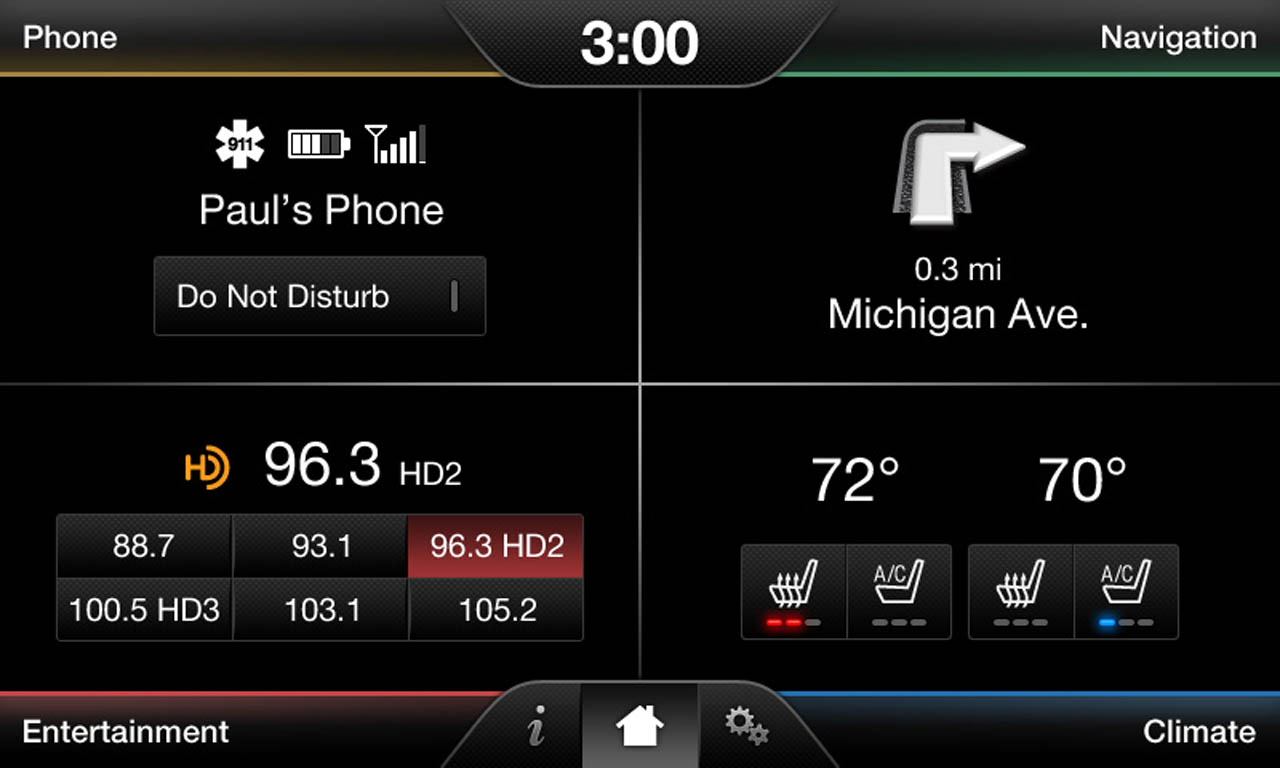
I think that you’d get used to it with some time; but the on-screen fonts are too small and delicate and each of the four major function – telephone, information (including navigation), radio and climate are brought up only by touching a slim bar that is either in the top or bottom of each assigned quadrant.

Because of the placement of the screen, when your hand reaches for one of those functions, your hand partially blocks your view of the screen, so you’re mostly poking around blind. It’s also hard to see the hard-button controls that are on the ledge in front of the screen. There are some redundant “hard” controls for things like volume or climate control; but selecting a preset radio station can be difficult with bumpy streets and the slim on-screen touch controls. At least the touch response is fast.

The four quadrants of MyFord Touch. To bring any area up to full screen, you tap on the slim area at the top or bottom corners.

The four quadrants of MyFord Touch. To bring any area up to full screen, you tap on the slim area at the top or bottom corners.

Power for the C-Max comes from a 2.0L Atkinson-cycle I-4 hybrid engine channeled through an electronically controlled Continuously Variable Transmission (CVT). The gas engine is good for 141 hp and 129 lb-ft of torque. Together with the permanent magnet AC synchronous electric motor, the system is good for 188 hp with a top speed (not that you’ll ever get there in this car) of 115 mpg. Ford says the C-Max can go up to 62 mph in electric-only mode, but it’s nearly impossible to do without being on a closed track with nearly zero gravity on your left foot. The statistic is useless in normal driving.

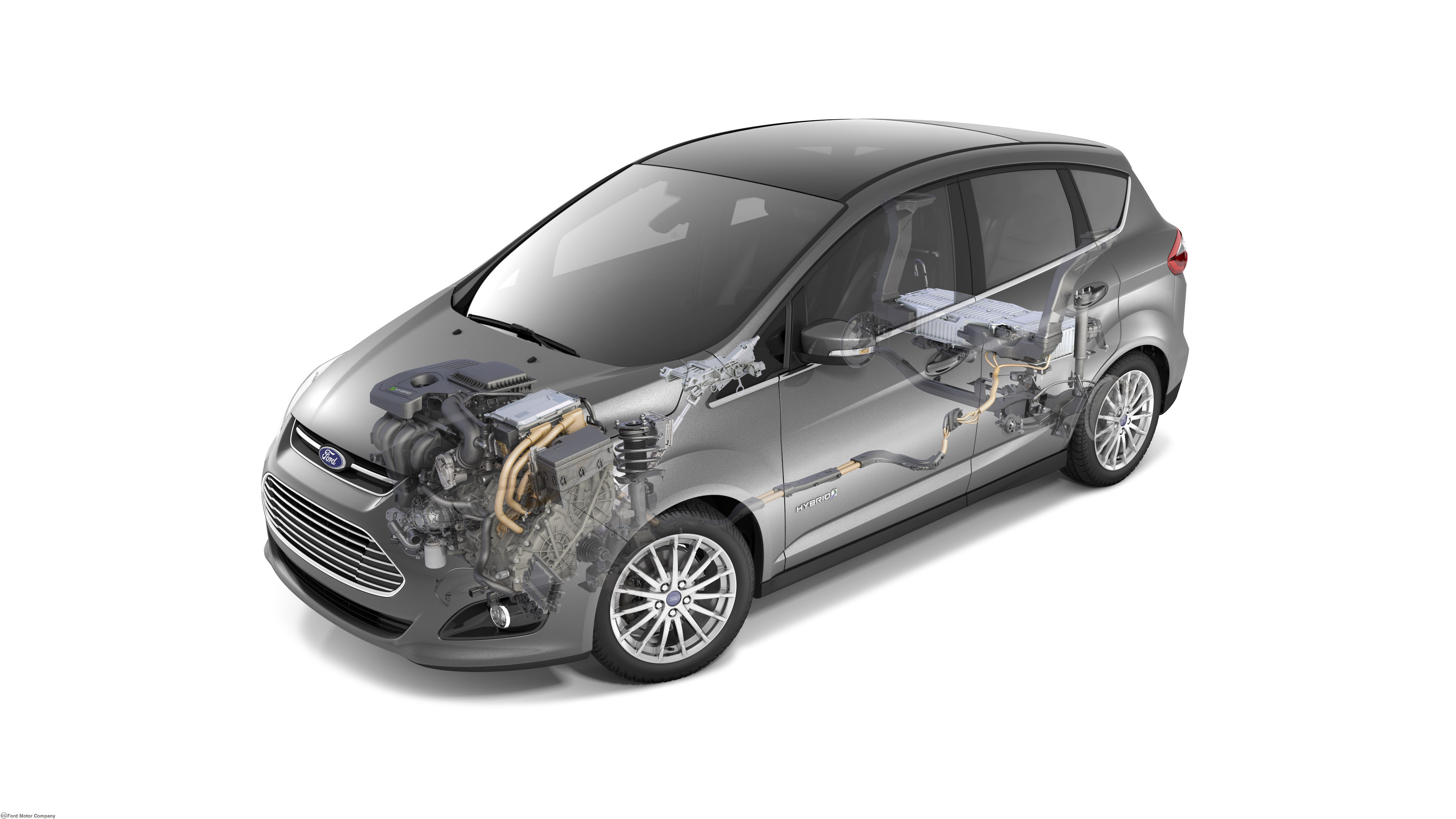
The C-Max’s electric motor is powered by a compact 1.4 kWh lithium-ion battery and, like the Prius, regenerative brakes feed the battery when you brake and the gas engine runs a generator to keep the battery charged. The battery doesn’t suck up any cargo space. Nifty graphics in the instrument panel show you how “green” you’re driving and which direction the electrons are flowing.

A cutaway of the 2013 Ford C-Max Hybrid.

A cutaway of the 2013 Ford C-Max Hybrid.

Speaking of the Prius, I think Ford engineers have jumped over Toyota’s flagship hybrid when it comes to smoothness of operation. Most of the time, it’s hard to notice when the gas engine goes on and off. You don’t feel the shakes and vibrations associated with the Prius. Even Ford’s CVT lacks a distinctive whine unless it’s pushed hard. The regenerative brakes don’t have that touchy-grabby hybrid feel either. In short, the driving experience is utterly normal except for the odd silence when the car is started and when it’s drifting in EV mode.

The cockpit of the 2013 Ford C-Max Hybrid. It bears more than a passing resemblance to the Ford Focus, which serves as the basis for the C-Max.

The cockpit of the 2013 Ford C-Max Hybrid. It bears more than a passing resemblance to the Ford Focus, which serves as the basis for the C-Max.

I like the compact size, ease of operation and visibility of the C-Max for daily city driving. The electric power steering had decent feedback – shocking, really, when compared to the electric rubber band attached to the Prius. While the C-Max will never be a NASCAR pace car, it scoots up to city speeds easily and without fuss, never feeling underpowered. I think it would need a bit more time to come to highway speed. Its turning radius was good and parking was easy. The C-Max was also relatively quiet for a small car.

Ergonomics are very good and the plastics and switchgear is on par with the excellent Focus. I’m not sure how much I’d like it on highway trips where road noise and the short wheelbase might make for a noisy and choppy ride.

While the C-Max may not be the sexiest car in the parking lot, it is fresh and modern.

While the C-Max may not be the sexiest car in the parking lot, it is fresh and modern.

The C-Max’s stated EPA fuel economy is impressive – 47 mpg city, highway and combined , besting the Prius V’s 42 mpg combined. However, several media sources, including Consumer Reports, has called out Ford, challenging those figures for the 2013 C-Max.

The C-Max I drove showed an average 28 mpg – but you expect lower figures in a tester. CR states that the C-Max achieved overall fuel economy of 37 mpg during its tests. By comparison, the Prius V achieved 41 mpg in CR’s test cycle – just 1 mpg shy of its EPA rating. So while the C-Max bests the Prius V in the EPA number game, in the real world, the Prius V bests the C-Max by 4 mpg. If you buy a C-Max, I recommend lowered expectations when it comes to fuel economy.

The 2013 C-Max Hybrid SE starts at $25,995 and a fully-loaded SEL can easily grow to $33,500 with niceties like leather-trimmed seats, navigation, an upgraded infotainment system and MyFord Touch, hands-free park assist, hands-free liftgate, rearview camera, parking sensors and a panoramic fixed glass roof. The Prius V can get pricey too, starting at $27,445 and rising all the way to $37,535.

While the C-Max Hybrid wouldn’t fit my driving needs, I believe it is a sweet little tall wagon that drives well (like its cousin, the Ford Focus) and offers lots of grown up features for a reasonable price. I wouldn’t call it stylish, but it is a fresh face in the hybrid market – particularly in Prius-happy L.A. The C-Max will appeal both to Eco-conscious buyers as well as people just looking for good fuel economy in a tidy, versatile package.Ford C-Max badge