My hands are always cold and it’s often quite uncomfortable. One frigid LA winter morning, several years ago, I drove a friend’s Range Rover with a heated steering wheel and it was a revelation. Ever since I’ve wanted a car with that option. So I confess that the only reason I checked the option box for Adaptive Cruise Control (ACC) on my 2012 Dodge Charger is because it was the only way I could get the heated steering wheel.
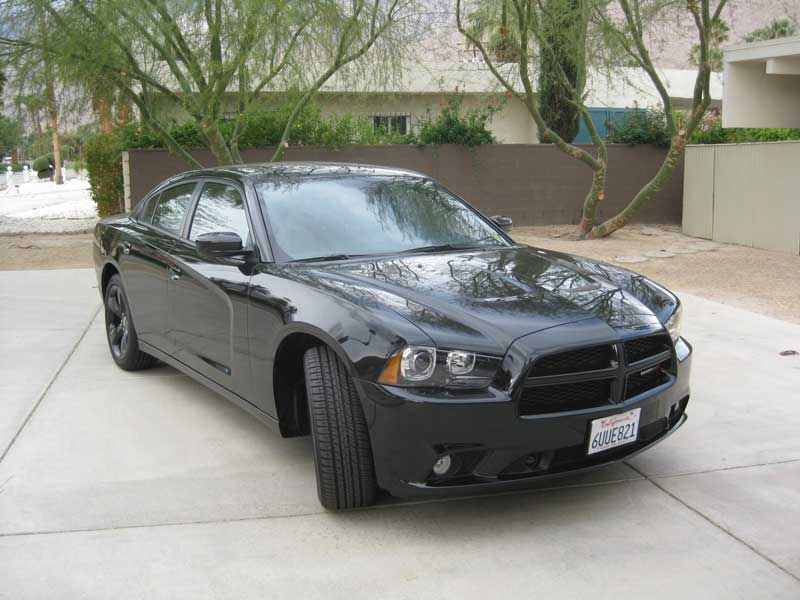
The 2012 Dodge Charger SXT Plus. Note the small "eagle eye" in the front lower fascia to the right of the (right) fog light.
What I wasn’t prepared for is how ACC has changed the way I drive and has changed my life – for the better.
Thom and I love to spend weekends at our condo in Palm Springs, but to get there you have to drive the dull, 120 miles from our home in West Hollywood, through the vast suburbia of Inland Empire through the San Gorgonio Pass into Palm Springs. Even the dog is bored by the trip.
The hotel tower of the Morongo Casino Spa Resort in Cabazon, CA.
The worst and most stressful portion of the drive is getting from the Land of No Freeways (thank you, Beverly Hills) to the point on the Hollywood Freeway where it morphs into Interstate 10. Once all the splits are done, I-10 opens up to a long, uninvolving slog through such tantalizing destinations as West Covina and Fontana. You know you’re 22 minutes from Central Palm Springs when you pass the Morongo Casino & Resort Spa Hotel that looks like the desert was fracked with ipecac.
I use cruise control to relieve my heavy foot, get better fuel economy and hopefully avoid the California Highway Patrol’s radar gun. However, it’s no secret that people don’t pay attention to driving and certainly don’t drive a constant speed. We’ve all had the experience at cruising along when a minivan suddenly slows everyone down. It’s usually driven by a wearied and stressed-out mom trying to mediate Israeli-Palestinian peace in the rear. Drop out of cruise and try to go around then back to speed.
I’ve now entered the surreal and serene world of Adaptive Cruise Control. I set it to 75 mph, select a comfortable following distance and rest my right foot for the next 100 miles. I select 75 mph because it seems to best approximate the flow of traffic in open stretches of freeway and it’s not too fast to garner the attention of the ever-lurking CHP. There are plenty of other “sacrifices” that fly by me at 80 – 100 mph who will get caught. At least that’s the plan and it’s work well for several years now.
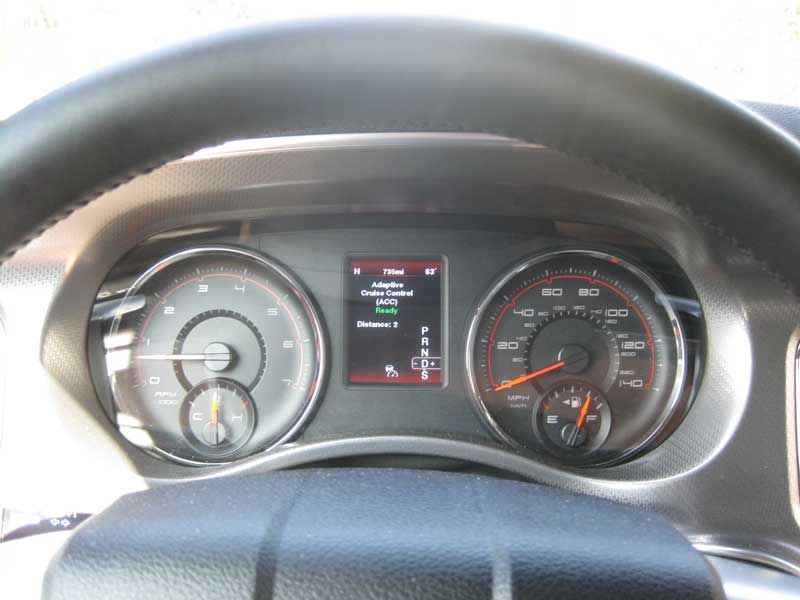
The driver's information screen tells you that adaptive cruise control is on and ready to use.
The car’s on-board radar constantly monitors the speed of the vehicle in front of you and makes the infinite adjustments to maintain a safe distance and constant speed. At first, your reaction is to hit the brake when you come up on a slower car or someone cuts in front of you; but it’s not necessary as the system does it for you. The technology foreshadows a futuristic vision of all cars having sensor systems that talk to not only other cars, but to Big Brother’s SkyNet in hopes of avoiding accidents, saving lives and moving traffic more efficiently.
The first time the car brakes itself, you realize the pedal by your foot isn’t moving. In addition to the car’s standard power-assisted hydraulic anti-lock brakes, the car is equipped with a redundant brake-by-wire system to service the ACC. The Electronic Brake Controller (EBC) also facilitates additional stopping power in a panic brake situation.
Twice now, I’ve set the ACC to 75 mph on our way back from PS to LA. I do it as soon as I pass the last stoplight on northwest-bound Highway 111 at Mountain Gate. I haven’t touched either the brake or accelerator until I’m at the La Brea Ave exit on the westbound Santa Monica freeway. Not once. That’s astounding. That’s a game-changing technology.
Another feature of ACC that differs from standard cruise control is the speed setting. I can set the upper speed limit regardless of my current speed. I simply hit the +/RES (resume) button on the steering wheel until I reach the desired number. My top speed is displayed in the ACC screen of the car’s electronic vehicle information center. You can’t do that on a standard cruise control.
If traffic grinds to a halt, the system disengages below 20 mph and the center display screen beeps and flashes BRAKE! The system uses up to 25% of the car’s braking capacity through the EBC; but it can’t fully stop the car. (Some systems can fully stop the car if it senses an emergency.)
The ACC also allows you to set the following distance comfortable to you. The three settings on my car are: 3 (long), 2 (medium) and 1 (short). I’m most comfortable with the medium setting which is around 3-4 car lengths.
The same ACC radar system and electronic brakes also form the car’s Forward Collision Warning (FCW) system. The FWC default is “on” and you may never notice it until a car in front of you slams on its brakes or cuts you off.
This just happened to me when a car rudely cut in front of me with little distance between our cars. We’ve all been there, right? The FCW system chimed rapidly like Dr. Sheldon Cooper knocking on Penny’s door. The word “BRAKE!” flashed urgently in the center display. I was on the situation instantly even without FCW, but it’s nice to know how fast and accurately the system reacted.
I hate to admit that the adaptive cruise control makes me a safer driver. I’m not tailgating. I’m less stressed-out over distracted drivers and vacillating traffic speeds as the car adapts to the leading car. I change lanes less frequently and if I’m momentarily distracted, the car automatically slows down, so there is less risk of sudden braking. I’m even more comfortable as I can rest my legs in a more forward position. And as a bonus, I find I’m getting better fuel economy because the cruise control module and drive-by-wire throttle can adjust and adapt much faster than my own lead foot.
If you regularly drive long distances on the open highway, don’t hesitate to check the adaptive cruise control option box for your next new car. This is one electronic nanny you can have a long-term affair with and not get kicked out of the house. It will change your life.
2012 Dodge Charger SXT Plus with the Blacktop performance package. The blacked-out car looks a bit sinister and some drivers mistake it for a cop car and get out of my way. That's not a bad thing!
The 2012 North American International Auto Show in Detroit kicked off Monday with a slew of new, exciting products.
GM, Ford and Chrysler came on strong with some exciting new designs that are sure to be a hit in the market. Nissan and Porsche returned to the show after being absent during some of the dark years of the recession. The all-new Mercedes-Benz SL made its world debut, VW showed off some cool green concepts and the all-new, all-important BMW 3-Series made its North American debut.
I sifted through the deluge of information from Day 1 and below are the ones I found most interesting and/or important.
Acura:
Honda’s mild-luxury division is back in the chair for another round of hair and makeup. The current TSX, a slightly restyled Euro Accord, is gone in favor of an all-new ILX sedan based on the new generation Honda Civic. Acura thinks that the ILX will nail Gen Y who demand something better (and better-looking) than a Civic. Priced under $30,000, the ILX will be available with three powertrains, just like the Civic: A 2.0L 4-cylinder mated to an automatic (hopefully 6-speed); the hybrid system out of the Civic Hybrid – a 1.5L gas engine with Integrated Motor Assist, and the 2.4L 4-cylinder Civic Si engine with a 6-speed manual transmission. If you think it looks like the outgoing TSX, join the club.
2013 Acura ILX. I wish Acura would ditch the beak.
The 2013 Acura ILX looks a bit better from the rear, but not by much.
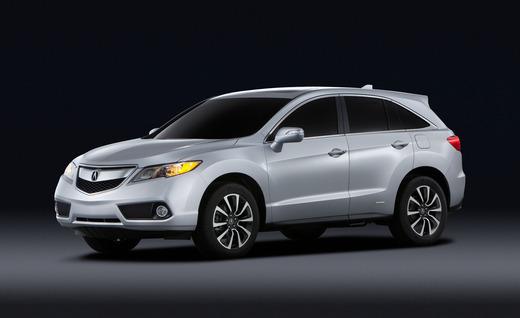
Not satisfied with one new product, Acura showed the all-new RDX, based on the new Honda CR-V. This time around, thankfully, Honda ditched the laggy turbo four, 5-speed automatic and expensive SH-AWD in favor of Honda’s 3.5L 273 hp V6, a six-speed automatic and the simpler and lighter AWD system found in the CR-V. The Acura beak is still there, but to my eye, this “concept” (which is production ready) looks a bit dull and sad. I don’t see anything that will make it stand out in the crowd of smaller CUVs.
2013 Acura RDX - Concept - although we understand it's pretty close to the production version.
The interior of the 2013 Acura is handsome; however, it's not too much different from the outgoing TSX - which has a similar interior.
The real news is the long-awaited return of the Acura NSX super car. This time around, Acura is aiming high. As high as the upcoming Porsche 918 Hybrid and the Audi R8. The NSX is to be designed in the US and built in Honda’s Ohio plant. The details released are the stuff of boy-racer dreams. It will have Honda’s first Sport Hybrid Super Handling All-Wheel Drive system. A next-generation 3.5L V6 engine will add direct injection and be good for at least 308 hp and 266 lb-ft of torque. It will be mated to a dual-clutch automatic with a built-in electric motor driving the rear wheels. In addition, a pair of electric motors at the front axle will drive the front wheels and also be capable of propelling the NSX in electric-only mode. Also new is another wordy system: Bilateral Torque Adjustable Control – a.k.a. torque vectoring. The entire system is melded together with silicon chips and highly-sophisticated software to produce all-wheel drive. It should be amazing. Honda says is should go into production in 3-4 years.
Acura NSX Concept. I hope the eagle beak gets toned down in any production version.
Acura NSX Concept
Cadillac:
GM’s luxury division is finally dead serious about taking on the Audi A4, BMW 3-series and Mercedes C-class. No more rebadged Chevrolets (Cimmaron) and no Opel reskins (Catera). The Cadillac ATS rides on an all-new, bespoke rear-drive platform and offers the choice of three engines as well as all-wheel drive:
Base engine is a 2.5L inline four with 200 hp and 188 lb-ft torque. The only transmission is a 6-speed automatic and it’s only available in RWD.
Optional 2.0L turbo four making 270 hp and 260 lb-ft torque. Choices of a 6-speed manual or 6-speed automatic. AWD is optional, but only with the automatic transmission.
Optional 3.6L V6 with 318 hp (take that BMW 335i) and 276 lb-ft of torque. The only transmission is the 6-speed automatic and AWD is available.
Cadillac is using a sophisticated 5-link independent rear suspension with struts up front – this matches what the Germans have had for years. Cadillac claims a 50/50 front/rear weight distribution to match BMW’s long-held mantra. It’s also relatively svelte at around 3,400 lbs, which should help performance and fuel economy. Electric power steering is sourced from ZF in Germany. It will offer a vast array of electronic gadgets and nannies, including adaptive cruise control, lane-departure warning, blind-spot warning, heads-up display, and adaptive headlights. Cadillac’s new CUE (Cadillac User Experience) is optional with an 8-inch display. Prices haven’t yet been announced; however, you can bet it will closely match the new BMW 3-series, so maybe $32,000-$34,000 base. It should go on sale this summer.
2013 Cadillac ATS
2013 Cadillac ATS
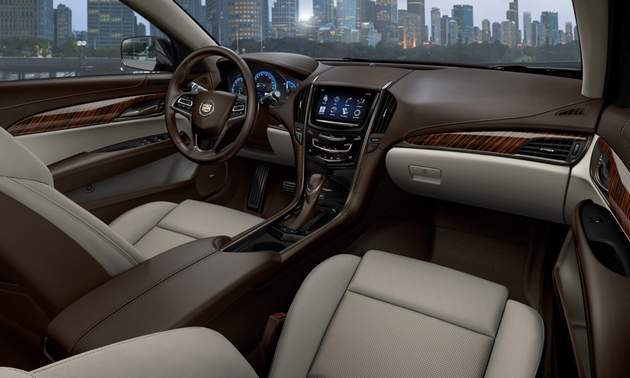
The Cadillac ATS has a handsome, balanced interior. The leather looks nice and Cadillac swears the wood is real.
Chevrolet:
The Heartbeat of America had some interesting concept cars and one hot hatch.
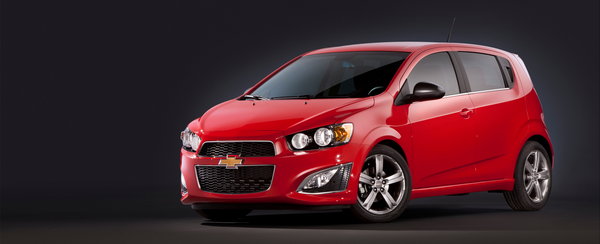
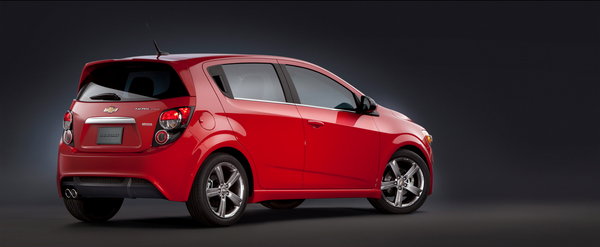
The 2013 Chevy Sonic RS is more of a styling exercise than tuner car. The RS starts with the 5-door Sonic with the optional 1.4L turbo four making 138 hp and 148 lb-ft of torque – so there is no engine upgrade or tweak. It comes with a 6-speed manual or optional 6-speed automatic transmission. The exterior gets some new fascia, unique grille, rocker panels, a revised bumper and a spoiler. Inside, Chevy’s MyLink infotainment system will be standard with a 7 inch touch screen and Bluetooth. The Sonic RS does get a stiffer suspension and rear disc brakes, so it should handle and stop a bit better than the standard Sonic. Pricing hasn’t been announced yet.
2013 Chevrolet Sonic RS
2013 Chevrolet Sonic RS
Chevrolet also debuted two concept cars in an attempt to attract more Gen Y buyers (a burgeoning demographic).
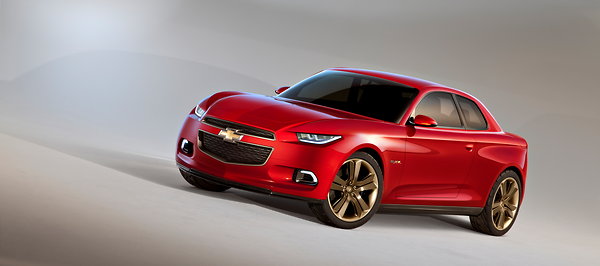
First up is the Code 130R. It’s a rear-drive (yah!) four-seat coupe that has some of the looks and about the size of the BMW 1-series coupe. Car & Driver magazine reports that it sits on the same platform as the ATS, but this isn’t confirmed by GM. Power comes from Chevy’s 1.4L turbo four, bumped to 150 hp and 148 lb-ft of torque. It is also fitted with GM’s mild-hybrid system called eAssist, currently in the Buick LaCrosse. It comes with either a 6-speed manual or 6-speed automatic transmission. Frankly, I think it looks cartoonish – like it comes from the latest Cars animated film. Chevy calls it a “heritage” look. The rear looks like a squeezed Camaro.
Chevrolet Code 130R Coupe Concept
Chevrolet Code 130R Coupe
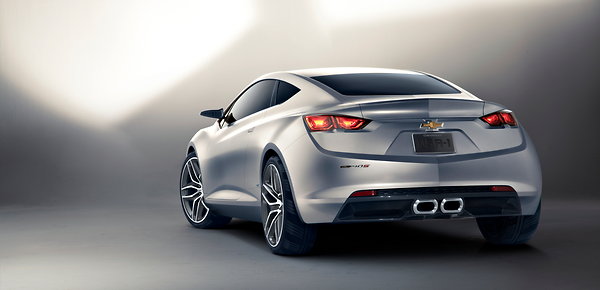
Next is Chevy’s Tru 140S Concept hatchback. It’s about the size of a Chevy Cruze and rides on the same platform. Like the Code 130R, it has a 1.4L turbo four making 150 hp and 148 lb-ft of torque. However, instead of the eAssist, it gets a start/stop system to save gas. Transmission choices are also the same as the Code 130R – six speeds, automatic or manual. Chevy says it seats four people (albeit very tight). While I’m not in Detroit and didn’t see it in person, the matte white paint is supposed to be sick.
Chevrolet Tru 140S Concept Hatchback. I love the headlights.
Chevrolet Tru 140S Concept Hatchback
Dodge:
I can’t resist the obvious metaphor: The 2013 Dodge Dart is right on target. Starting at $15,995, this stellar new 4-door sedan (and only a sedan) based on the Alfa Romeo Giulietta, is a star among a sea of subcompact anonymity. While it’s instantly recognizable as a Dodge by the cross-hair grille and mini-Charger-like taillights, you can see the Italian influences in the interior.
2013 Dodge Dart
2013 Dodge Dart - it definitely has the Charger's rear end.
Some dizzy designers at Dodge decided that the Dart should be easily customizable. There are no less than twelve exterior colors and fourteen interior and trim colors. The model levels will sound familiar to Dodge buyers: SE, SXT, Rallye, Limited and coming a bit later, R/T.
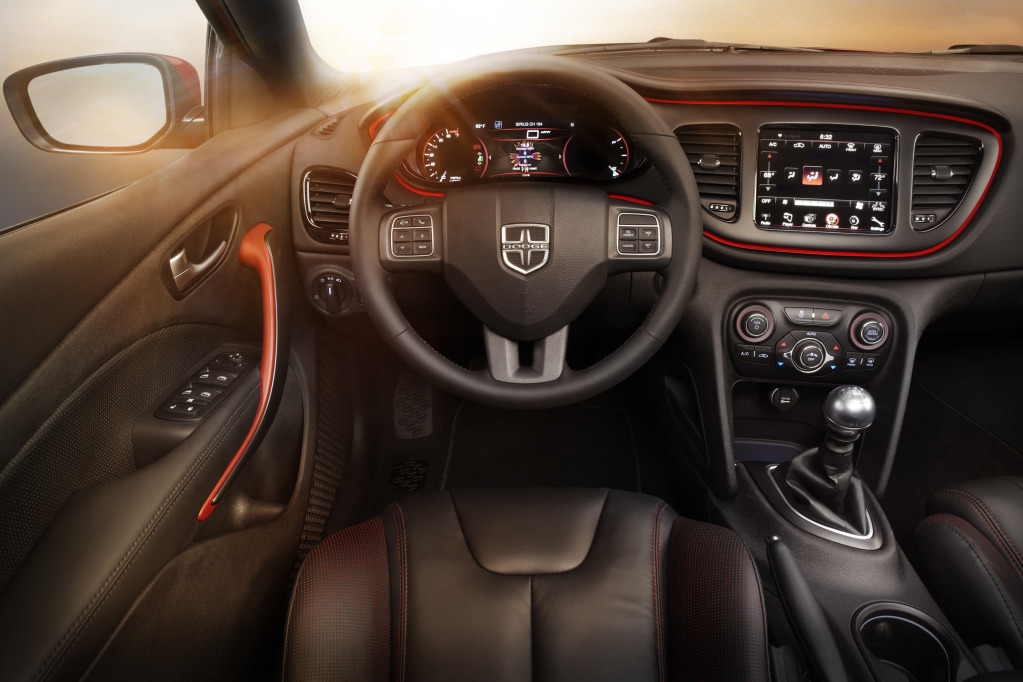
The Dart's cockpit looks inviting. The large 8 inch touch-screen is also used in other Dodge products.
The Dart's seats look much nicer than a standard subcompact car. That's the Italian speaking.
There are three different engines and three transmissions:
The base engine is a “Tigershark” 2.0L inline 4-cylinder engine making a respectable 160 hp and 145 lb-ft of torque. It can be had with either a six-speed manual or automatic.
Optional on the SE, SXT, Rallye and Limited is a 1.4L 4-cylinder turbocharged and intercooled engine similar to the unit found in the Fiat 500 Abarth. It makes 160 hp and a whopping 184 lb-ft of torque, which makes all the difference given the engine has the same ponies as the Tigershark 2.0. It can be mated to Fiat’s all-new 6-speed dual clutch automatic as well as the regular 6-speed manual and automatic.
A few months after launch, an all-aluminum 2.4L Tigershark 4-cylinder engine with a tantalizing 184 hp and 171 lb-ft of torque will be introduced. It’s available only on the R/T trim level. You get your choice of the 6-speed manual or automatic – no dual clutch option.
Dodge hasn’t released full pricing levels or fuel economy ratings. However, it’s likely that at least one of the powertrains will hit the seemingly-magical 40 mpg highway mark.
Ford:
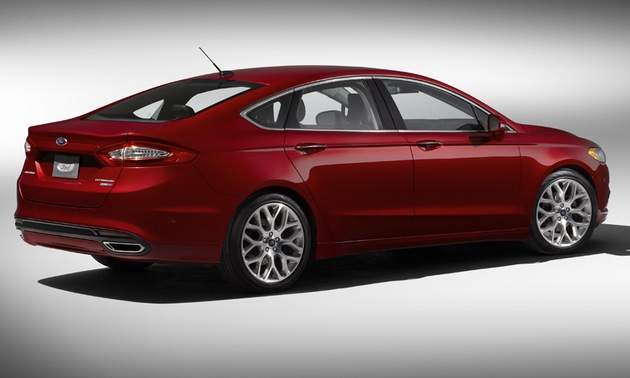
In keeping with Ford’s “One Ford” mantra, the 2013 Ford Fusion is the Mondeo in the rest of the world. Like the Focus from last year, the same great car available only outside the US is now the same worldwide. Only the names are different. The styling is forward and dynamic. It’s the new face of Ford and it bears more than a passing resemblance to the sensational Ford Evo concept shown in Frankfurt last year.
The Ford Evo concept car from the 2011 Frankfurt Auto Show
The Fusion is already a best-seller for Ford, with 248,067 units in 2011. By comparison, Honda sold 235,625 Accords, Toyota sold 308,510 Camrys and Hyundai sold 225,961 Sonatas. In short, this mid-size sedan is the heart of the passenger car market in the US.
2013 Ford Fusion
2013 Ford Fusion
The new Fusion will be sold in three familiar trim levels: S, SEL and Titanium. There are five (!) engine configurations, and none of them have more than four cylinders:
Base powertrain is a naturally-aspirated 2.5L inline 4 with 170 hp and 170 lb-ft of torque. The only transmission is a 6-speed automatic. Fuel economy figures were not released by Ford.
Option 1: An EcoBoost 1.6L direct-inject turbo-charged engine with 179 hp and 172 lb-ft of torque. It’s available with either a 6-speed manual or automatic. Fuel economy: 26 mpg city, 37 mpg highway.
Option 2: An EcoBoost 2.0L direct-inject turbo-charged engine with 237 hp and 250 lb-ft of torque. The only transmission is Ford’s dual clutch 6-speed automatic. Fuel economy: Ford says it will get 25% better fuel economy than the outgoing V6.
Hybrid powertrain: 2.0L Atkinson-cycle four-cylinder gas engine and a permanent-magnet AC synchronous motor. The pair is good for 185 hp and 130 lb-ft torque. The only transmission is an eCVT. Lithium-ion batteries replace the old nickle-metal hydride batteries. Fuel economy: 47 mpg city, 44 mpg highway. (Take that, Camry and Sonata hybrid!)
Plug-in Hybrid powertrain: 1.6L Atkinson-cycle four-cylinder replaces the 2.0 unit in the non-plug-in hybrid. The combined electric motor and gas engine is good for 185 hp and 130 lb-ft of torque and it has the same eCVT transmission. However, with benefit of the plug-in EV range, Ford says the Fusion Energi will get 100 mpg-e (equivalent).
Ford is offering a slew of electronic nannies to help distinguish the Fusion from the competition. It will offer adaptive cruise control, lane-keeping system (to help the drowsy driver), blind-spot warning, active parking assist (it will parallel park the car for you) and Ford’s controversial MyFord Touch infotainment system with voice recognition and customizable screens.
2013 Ford Fusion interior. You can see that it's similar to the Focus, but larger and better equipped.
It’s a slick package that is sure to attract the attention of the millions of car buyers looking for a mid-size family sedan. The two hybrids will also be a hit with greenies and hypermilers.
Mercedes-Benz
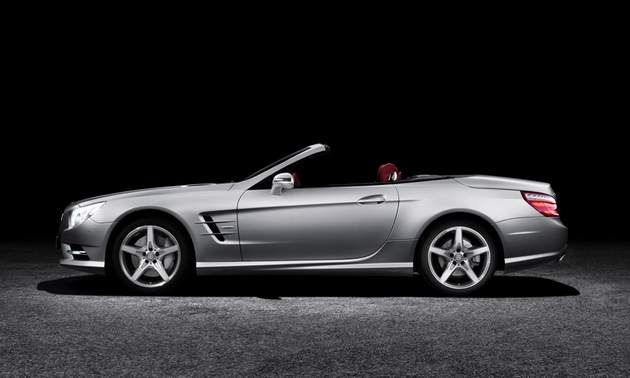
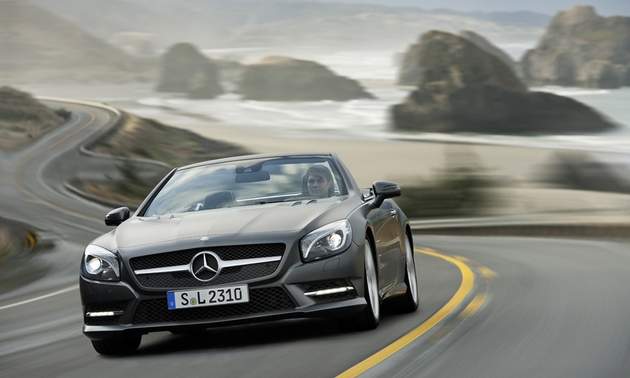
Mercedes chose Detroit for the world debut of its sensational new SL. The styling is controversial and I’ve read lots of complaints about it, but the more I look at the pictures, the better I like it. And I think color has much to do with opinions – you know, like it in black, hate it in silver.
2013 Mercedes-Benz SL550
2013 Mercedes-Benz SL550
For those not steeped in Mercedes’ Byzantine nomenclature, SL = sport leicht, or sport and lightweight. The SL lineage goes back to the ground-breaking 300SL Gullwing racer of the 1950s. For much of the past two decades, the concept of “lightweight” has been more of a formality than a reality as the SL easily weight two tons. For 2013, the all-new SL has an all-aluminum body and high-strength, lighter-weight steel in the frame. Mercedes claims a 275 pound weight loss – as much as one healthy Texan.
2013_Mercedes-Benz SL550
Power comes from Mercedes’ new 4.7L twin-turbo direct-inject V8 also found in the larger CL coupe. It’s good for 429 hp and 516 lb-ft of torque. The only transmission is a revised Mercedes 7-speed automatic with a start/stop function to improve fuel economy (like anyone buying an SL really cares). The 550SL should sprint to 60 mph in 4.5 seconds – about the same as the outgoing SL63 AMG.
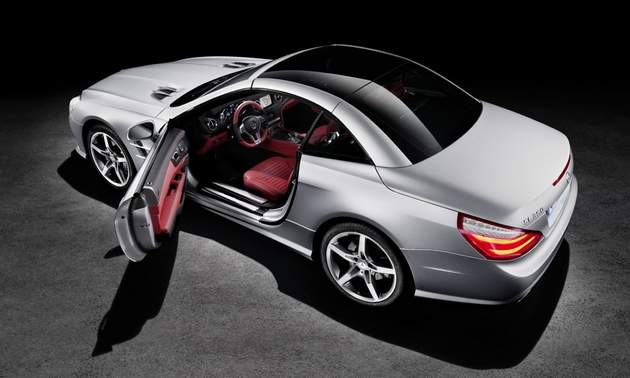
Mercedes thinks there is lots of Magic in the new SL. Like the refreshed SLK from 2011, you can opt for the Magic Sky Control folding glass roof. It’s like a gigantic skylight; however if you’re not in the mood for too much sun, you can press a button and the electrochromatic glass can be “dimmed” from opaque all the way to black. Neat trick and expensive.
The 2013 Mercedes-Benz SL550 with the Magic Sky Control electrochromatic glass roof.
The other Magic option is the Magic Vision Control. MVC is really a high-tech windshield wiper system. The heated wipers can de-ice your windshield and when you need the washers, the nozzles are incorporated into the wiper arms.
The interior of the 2013 Mercedes SL550 looks like a comforable place for a long trip. I love the red leather.
Of course it has all of Mercedes’ electronic nannies and safety systems. Also the latest version of the company’s COMAND infotainment system complete with downloadable apps. It goes on sale this spring (just in time for summer convertible weather) and although prices haven’t been announced, just figure it starts around $100,000.
Mercedes didn’t want to leave the green crowd out in the cold, so it introduced the E400 Hybrid. The hybrid system in the 2013 E400 is an evolution of that found in the S400 Hybrid. The E-class gets a 302 hp 3.5L direct-inject V6 coupled with a 27 hp electric motor sandwiched between the engine and the 7-speed automatic transmission. The electric motor musters 118 lb-ft of torque on its own so the E400 can go up to 22 mpg or a whole half a mile on electric power alone. Also, like the S400, the lithium-ion battery is placed in the engine bay so no trunk space is lost. I’m not impressed with the fuel economy numbers of 24 city, 31 highway. The 2012 E350 BlueTec diesel, on-sale now, gets 21 city, 32 highway — why pay the hybrid premium for the E400?
2013 Mercedes-Benz E400 Hybrid
Detail of the engine bay for the 2013 Mercedes-Benz E400 Hybrid
As if to rub salt in a wound, Mercedes also showed the 2013 E300 BlueTec Hybrid Concept. It will get substantially better fuel economy, but as usual, it’s not for the US market. WTF Mercedes?
Nissan
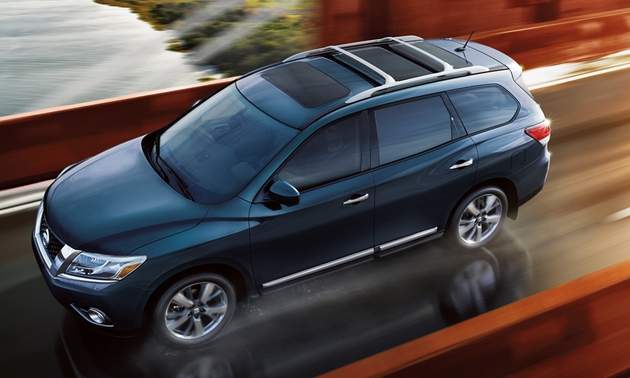
In the face of steadily-climbing fuel prices, Nissan served up a larger, non-truck-based 2013 Pathfinder SUV concept. It should be no surprise that Nissan would get its own version of the new Infiniti JX35, a 7 passenger unibody SUV introduced last year. The Pathfinder concept shares the same chassis and probably the same drivetrain, although Nissan was short on details. The Infiniti JX35 uses Nissan’s ubiquitous 3.5L V6 making 265 hp and 248 lb-ft of torque. The Pathfinder numbers would likely be a bit less. Also, like the JX, the engine will be coupled with Nissan’s despised CVT (continuously variable transmission). I know so many people who wish Nissan would ditch the use of the whiny CVT in almost all its cars; but Nissan is sticking with it.
2013 Nissan Pathfinder Concept
Nissan Pathfinder Concept Interior.
The old Pathfinder is an 0ld school body-on-frame, truck-based SUV. The Pathfinder Concept grows in practically all dimensions, but Nissan probably needs a big SUV that will hold a large family and not look like a tank (yeah, I’m talking about the Armada). The concept is handsome, if not exciting. I like it better than the Infiniti JX.
Porsche:
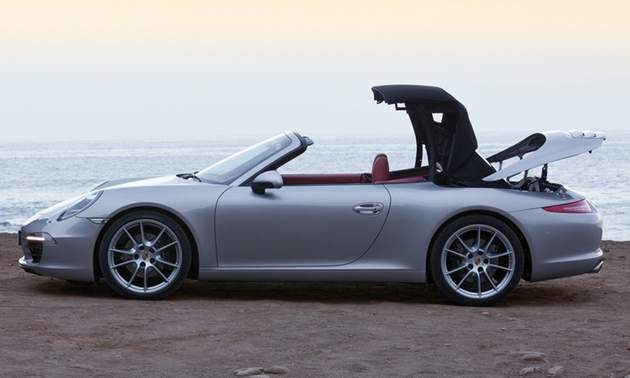
I know you might be tired of Porsche grabbing all the headlines and magazine covers for its all-new 911 that goes on sale this February. The accolades keep rolling in and I can’t wait to drive it. The big “news” in Detroit is the world debut of the cabriolet versions of the 911 Carrera and 911 Carrera S. Of course, the top is lighter and quieter and goes down in 13 seconds. Here are a couple pictures to drool over.
2012 Porsche 911 Carrera Cabriolet in Guards Red
The new Porsche 911 Carrera Cabriolet's top in action
The interior of the new 911 Cabriolet is about as good as it gets. It's sublime.
Volkswagen:
VW still wants to achieve world domination by 2018, knocking out both GM and Toyota for total worldwide sales. A big part of that strategy is doubling sales in the US. The new Jetta has been a hit, with sales up 44% for 2011 and it looks like VW will have the same success with the US/China-only Passat.
VW showed off two new “green” cars in Detroit. The production-ready 2013 Jetta Hybrid is VW’s 2nd hybrid in the US market following the expensive Touareg Hybrid. The gas-electric Jetta is powered by a new 1.4L turbocharged, direct-injected gas engine and it’s able to drive a whopping (not) 1.3 miles in EV mode. VW is short on details like fuel economy ratings and price, but it’s expected to go on sale this November.
2013 Volkswagen Jetta Hybrid
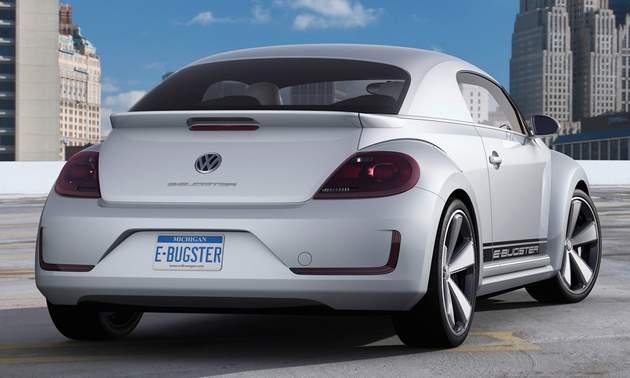
The second VW concept – and this time it’s really just testing the public’s temperature – is the e-Bugster, a highly-stylized Beetle with a chopped roof and lowered suspension. It’s powered by what VW calls Blue-e-Motion electric drive using a 85 kWh 114 hp electric motor and a single speed transmission. It uses a compact lithium-ion battery pack behind the front seats. The drivetrain is real and VW is planning to use it in an electric Golf to be sold in Europe and maybe later in the US. If we do get a “Bugster” (1) it won’t look nearly this cool and (2) VW has to change the name – it’s just a tad too easy to replace the “s” with another “g.”

 I’ve now entered the surreal and serene world of Adaptive Cruise Control. I set it to 75 mph, select a comfortable following distance and rest my right foot for the next 100 miles. I select 75 mph because it seems to best approximate the flow of traffic in open stretches of freeway and it’s not too fast to garner the attention of the ever-lurking CHP. There are plenty of other “sacrifices” that fly by me at 80 – 100 mph who will get caught. At least that’s the plan and it’s work well for several years now.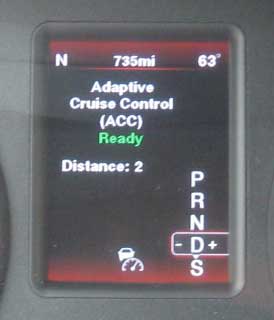


















 Todd Bianco's ACarIsNotARefrigerator.com Blog